

More than half of people taking medication for long-term conditions like high blood pressure, diabetes, or cholesterol don’t take it as prescribed. It’s not laziness. It’s not ignorance. It’s not even always forgetfulness. The real reasons are deeper, messier, and more human than most doctors realize.
It’s Not Just Forgetting
People think skipping pills is about memory. But if you ask someone why they missed their dose, the most common answer isn’t, “I forgot.” It’s, “I didn’t feel like I needed it.” Or, “It made me feel worse.” Or, “I couldn’t afford it this month.” The World Health Organization found that roughly 50% of patients with chronic illnesses don’t stick to their meds. That’s not a small number. That’s millions of people. And it’s not because they don’t care. It’s because the system doesn’t work for them.Cost Is the Silent Killer
You can have the perfect prescription. But if the co-pay is $80 and you’re choosing between meds and groceries, you’ll skip. The CDC says 20% to 30% of new prescriptions are never even filled because of cost. That’s not a mistake. That’s a survival choice. A 2023 survey by the American Medical Association found that half of all patients named cost as their top barrier. For seniors on fixed incomes, for single parents working two jobs, for people without good insurance - the price tag isn’t just a number. It’s a wall. And it’s not just the pill itself. It’s the lab tests, the doctor visits, the transportation to the pharmacy. One patient in Calgary told me she skips her blood pressure med every other month because the bus ride to the pharmacy costs more than her co-pay.Too Many Pills, Too Many Times
Imagine you’re 72. You have arthritis, high blood pressure, diabetes, and acid reflux. That’s four different pills. Some you take in the morning. Some at night. One with food. One on an empty stomach. One you crush. One you can’t crush. Now add in a blood thinner, a statin, and a vitamin D. That’s seven pills. Three times a day. That’s 21 doses every single day. Studies show that for every extra medication you add, your chance of missing a dose goes up by 16%. And when you’re supposed to take something four times a day, only about half of people manage it. Once-daily pills? Adherence jumps to 79%. It’s not that people are bad at math. It’s that the system assumes everyone has the mental bandwidth, the memory, and the routine to handle this complexity. Most don’t.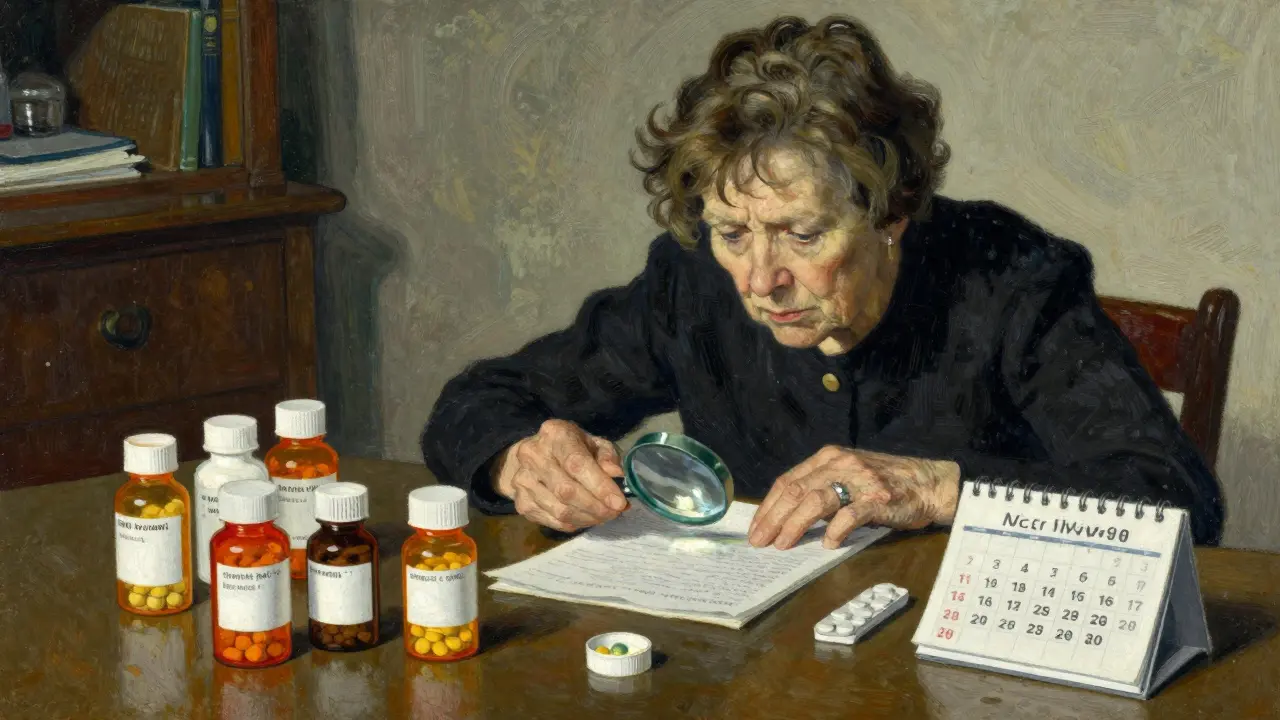
Confusing Instructions, Tiny Print
I’ve seen insulin pens with instructions so small they’re impossible to read without a magnifying glass. I’ve seen labels written in medical jargon: “Take 1 tablet PO q.d.” What does that even mean? “By mouth, once daily”? Maybe. But most patients don’t know. Forty percent of diabetic patients over 59 say they struggle because they can’t understand the directions. Health literacy isn’t about education level. It’s about clarity. If your doctor says, “Take this twice a day,” but the bottle says “Q12H,” you’re already lost. And it’s not just labels. Some pills come with complex devices - inhalers, injectables, patches - that require training. But most patients get a quick demo in a 15-minute office visit and are left to figure it out alone. No wonder people mess up.“I Don’t Feel Sick, So Why Take It?”
This is the invisible barrier. The one no one talks about. If you’re taking a blood pressure pill and you feel fine, why keep taking it? If your cholesterol is normal now, why bother? If you’re not in pain, why take the anti-inflammatory? This is called the “necessity-concerns” model. People weigh two things: Do I need this? And, Is it going to hurt me? If the answer to either is “no,” they stop. A study found 47% of nonadherence comes from doubts about whether the medicine is even necessary. That’s almost half. And it’s not irrational. It’s logical - if you don’t feel the effect, you assume it’s not working. Worse, some side effects are real. Nausea. Dizziness. Fatigue. People blame the pill, not the disease. And they quit. No one tells them these side effects often fade after a few weeks. No one tells them the risk of skipping is worse than the side effect.Forgetfulness Is Real - But It’s Not the Main Culprit
Yes, people forget. Especially older adults. One study found 44% of diabetic patients over 59 cited forgetfulness as their biggest issue. But here’s the thing: forgetfulness is often a symptom of something else. If you’re taking seven pills at three different times a day, you’re not just forgetting. You’re overwhelmed. If you’re depressed, your brain doesn’t prioritize routines. If you’re busy with work or kids, your mind is already full. And tech solutions? Apps, alarms, smart pillboxes? They help - but only if you’re comfortable with them. A 2023 AARP survey found 42% of people over 65 don’t trust or like digital tools. They’d rather use a paper calendar. Or just remember.
Kathryn Featherstone
December 20, 2025 AT 08:53I used to skip my blood pressure meds because I felt fine. Then I had a mini-stroke at 58. No warning. No pain. Just... silence in my brain for 12 minutes. I didn’t know meds were working until I stopped them. Now I take them like clockwork-even on days I feel great. Because feeling fine isn’t the goal. Staying alive is.
It’s not about willpower. It’s about respect-for your body, your family, your future self.
Nicole Rutherford
December 20, 2025 AT 18:03People are just lazy. If you can’t manage seven pills, maybe you shouldn’t be on seven pills. My grandma takes six meds and never misses one-she uses a pill organizer, writes it down, and calls her daughter if she’s unsure. No excuses. You want to live? Act like it.
Mark Able
December 21, 2025 AT 21:17Wait wait wait-so you’re saying the system is broken? Yeah, duh. But here’s the real issue: Big Pharma and insurance companies are literally designing this to fail. They profit off chronic illness. The more pills you take, the more money they make. Ever notice how every new drug costs $10,000 a year? Coincidence? Nah. It’s a racket.
And don’t get me started on how doctors get paid to push prescriptions, not to fix root causes. You think they care if you take your statin? They care if you show up for your next appointment. That’s the business model.
And yeah, I’ve seen the stats. I’ve read the studies. I’ve watched my uncle die because he couldn’t afford insulin. This isn’t healthcare. It’s a survival game-and we’re all losing.
Dorine Anthony
December 23, 2025 AT 00:41I work at a community clinic. We started offering free bus passes to the pharmacy last year. Adherence jumped 30% in six months. Simple. Cheap. Human.
Also, we started having pharmacists do 5-minute check-ins during refill pickups. Not sales pitches. Just: ‘How’s it going? Anything weird happening?’ Turns out people will tell you stuff if you ask nicely and don’t act like a judge.
It’s not rocket science. It’s just… kindness with structure.
Marsha Jentzsch
December 23, 2025 AT 17:41OMG YES!!! I’ve been saying this FOREVER!!! People don’t take meds because they’re scared!!! Not because they’re lazy or stupid!!! They’re scared of side effects!!! They’re scared the pills will make them sicker!!! They’re scared of the doctors who talk like robots!!! And they’re scared of being judged!!!
And don’t even get me started on the labels!!! ‘Q12H’??? That’s not English!!! That’s like a secret code from the government!!! They want us to fail!!! It’s all connected!!!
And the cost??!! I had to choose between my insulin and my daughter’s school supplies last month!!! She cried!!! I cried!!! And the pharmacist just shrugged!!!
It’s not just about pills-it’s about control!!! They want us dependent!!! They want us weak!!! They want us to keep buying!!!
STOP BLAMING PATIENTS!!! START BLAMING THE SYSTEM!!!
AND WHY ISN’T THIS ON THE NEWS???!!!
Janelle Moore
December 23, 2025 AT 19:35They’re lying. All of them. The whole system is fake. They don’t want you healthy. They want you hooked. That’s why they make you take so many pills. So you keep coming back. So they keep getting paid. The pills? They’re poison. The doctors? They’re paid to lie. The labs? They’re rigged. The insurance? They’re thieves.
I stopped taking everything last year. I feel better now. I eat garlic. I drink lemon water. I walk barefoot on grass. My blood pressure? Normal. My sugar? Fine. No meds. No lies.
They don’t want you to know this. But now you do.
Wake up.
They’re watching.
Henry Marcus
December 24, 2025 AT 18:15Let me tell you something no one else will: the pills aren’t the problem. The *timing* is. The government implants microchips in every prescription bottle to track when you take them. That’s why they make the labels so confusing-so you can’t figure out the real schedule. The real dose? It’s not what’s printed. It’s what the algorithm says you need. And they’re using it to manipulate your mood, your sleep, your thoughts.
I’ve seen the blueprints. I’ve talked to the insiders. They’re building a behavioral feedback loop. One pill at a time.
And if you don’t take it? They flag you. Then you get audited. Then your credit score drops. Then you lose your job. Then you’re back in the system. Smiling. Paying. Taking the next one.
They’re not trying to heal you. They’re trying to program you.
Check your pill bottle. Look at the barcode. It’s not a barcode. It’s a serial code. And it’s listening.
William Liu
December 26, 2025 AT 04:10It’s not hopeless. I’ve seen it. My dad had diabetes, hypertension, and heart failure. Took 12 pills a day. He was drowning. Then his pharmacist sat down with him, simplified everything into one daily combo pill, set up mail-order delivery, and called him every Friday just to say, ‘Hey, how’s it going?’
Three months later, he was hiking again. No hospital visits. No panic attacks. Just… life.
We didn’t fix his body. We fixed his burden.
That’s the difference.
jessica .
December 26, 2025 AT 13:03why do americans always blame the system? in my country we dont have this problem. we take our meds because its our duty. we dont make excuses. we dont whine about cost. we dont need apps or bus passes. we just do it. because we respect our health. because we are strong. because we are not weak like you.
you think your country is special? its just broken. you need discipline. not more programs. not more pills. just guts.
Ryan van Leent
December 27, 2025 AT 11:22So let me get this straight. We’re supposed to feel bad for people who don’t take their pills because they’re too busy or too broke? Meanwhile, I’m over here working two jobs, paying my own bills, taking my meds on time, and still getting yelled at by my doctor for not being ‘compliant’ with my ‘lifestyle changes.’
Yeah, the system’s broken. But guess what? I didn’t get handed a free pass. I didn’t get a free bus ride. I didn’t get a free pill.
So why should I care if someone else can’t be bothered?
Take responsibility. Or don’t. But don’t act like you’re the victim when you chose to skip your meds to buy a new phone.
Stop making excuses. Start taking pills.
That’s it.