

Every year, more than 1.5 million people in the U.S. end up in the emergency room because of mistakes with their medications. That’s not a typo. It’s not rare. It’s routine. And it’s entirely preventable.
Medication safety isn’t just about pharmacists double-checking labels. It’s about a broken system that lets errors slip through at every step-from the doctor’s office to the pharmacy counter to the patient’s medicine cabinet. When a pill is misprescribed, mislabeled, or misunderstood, the consequences aren’t just clinical. They’re personal. They’re financial. And they’re deadly.
Medication Errors Are a Silent Epidemic
The World Health Organization calls unsafe medication practices one of the top causes of harm in healthcare. In high-income countries, one in ten patients suffers harm from a medication error. In poorer nations, it’s one in twenty. That’s not a glitch. It’s a pattern.
Between 2020 and 2024, the U.S. saw over 200,000 incidents tied to faulty infusion pumps alone-204 of them fatal. Fentanyl-laced counterfeit pills seized by the DEA in 2023 numbered over 80 million. These aren’t outliers. They’re symptoms of a system that hasn’t kept pace with the complexity of modern drug use.
And it’s getting worse. The FDA approved over 3,200 new drugs between 2000 and 2023. Older medications got new uses. The population aged. By 2030, one in five Americans will be over 65-and older adults take an average of four prescriptions daily. More drugs. More people. More chances for something to go wrong.
The Real Cost Isn’t Just Lives-It’s Money
Medication errors don’t just hurt patients. They bankrupt the system.
The global cost? $42 billion a year. In the U.S. alone, non-adherence to prescriptions leads to $300 billion in avoidable costs and 125,000 preventable deaths annually. That’s more than traffic accidents or diabetes complications.
Think about it: a diabetic patient forgets to take their insulin. They end up in the ER. They’re hospitalized. They miss work. Their family pays out-of-pocket. The system bills insurance. The cycle repeats. This isn’t just bad care-it’s bad economics.
But here’s the good news: fixing it pays. Every dollar spent on medication safety programs returns $7.50 in savings. Pharmacist-led interventions? They return $13.20 for every dollar invested. That’s not a suggestion. That’s a business case.
Technology Can Help-But Only If It Works
Hospitals are spending millions on electronic health records, barcode scanners, and AI tools. And they work-when they’re used right.
Barcode-assisted medication administration cuts administration errors by 86%. Clinical decision support in EHRs reduces prescribing mistakes by 55%. AI models can now predict which patients are at highest risk of harm with 73% accuracy.
But here’s the catch: 63% of U.S. hospitals still don’t have fully compliant EHR systems. Only 42% of independent doctors use comprehensive safety tools. Too many systems talk to each other poorly-or not at all. A patient gets discharged from the hospital with five new meds. The primary care doctor doesn’t know. The pharmacist doesn’t know. The patient doesn’t know. And boom-another error.
The 21st Century Cures Act tried to fix this by mandating open APIs for health data. But by the end of 2024, only 63% of hospitals had fully implemented it. Interoperability isn’t optional anymore. It’s the baseline.

Human Factors Are Still the Biggest Risk
Most people think medication errors happen because someone’s careless. That’s wrong.
Dr. Roseanne Sayther’s 2024 study found that 89% of errors come from system failures-not human mistakes. Look-alike drug names. Confusing EHR interfaces. Rushed handoffs between shifts. Poorly designed packaging. These aren’t accidents. They’re design flaws.
On Reddit, nurses report near-miss errors every month because drugs like “Hydralazine” and “Hydroxyzine” look and sound the same. Pharmacists intercept errors caused by EHRs that default to the wrong dose. Patients leave the hospital confused about whether to take their blood pressure pill before or after breakfast.
One study showed 76% of hospitalized patients experienced communication issues about their meds. One in three didn’t understand their discharge instructions. That’s not negligence. That’s poor system design.
What Works-And What Doesn’t
Some places are getting it right.
The Mayo Clinic used AI to reconcile medications at discharge. Result? A 52% drop in post-hospital errors. Geisinger Health’s pharmacist-led program boosted adherence to 89% and cut readmissions by 27%.
The Netherlands cut medication errors by 44% by making electronic prescribing mandatory across all providers. The UK’s centralized reporting system led to a 30% drop in serious errors.
Meanwhile, the U.S. still has 12 states that don’t require pharmacy technicians to be certified. Only 38 states have formal training rules. There’s no national database for reporting errors. ECRI estimates only 14% of medication mistakes are ever formally reported.
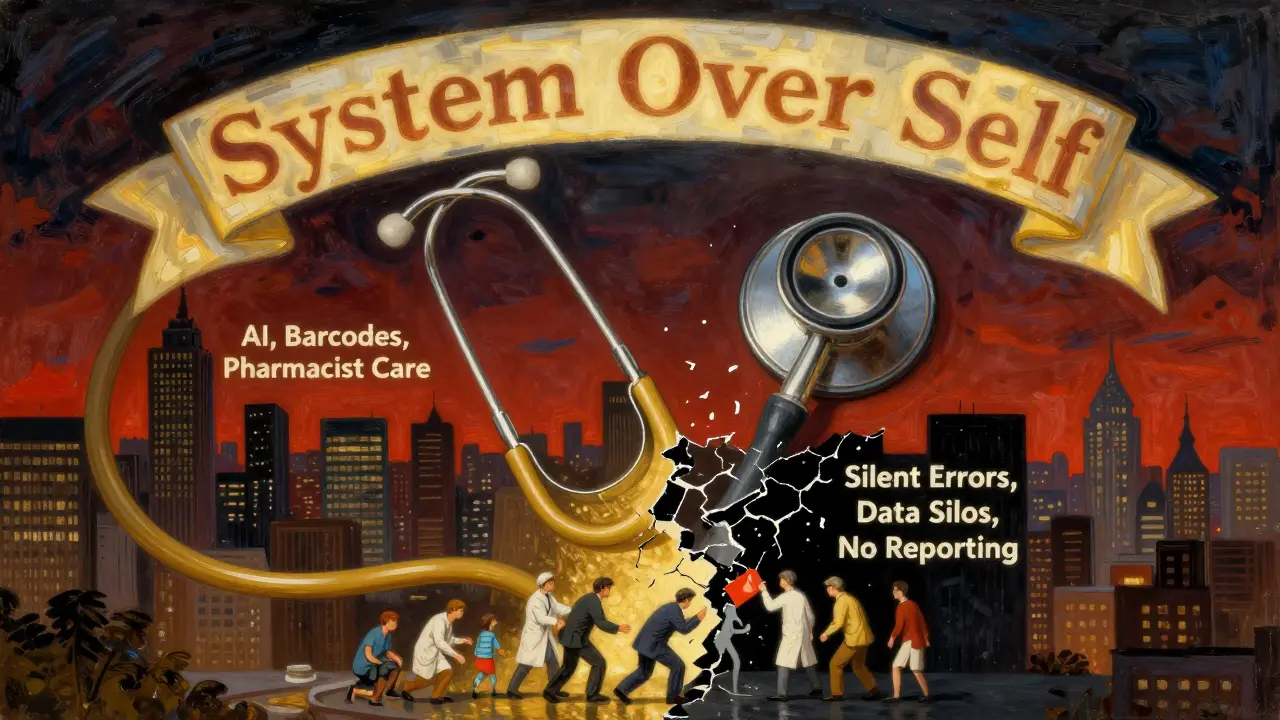
It’s not about more rules. It’s about consistent ones. Standardized training. Mandatory reporting. Shared data. Real accountability.
What Needs to Change Now
Medication safety isn’t a nice-to-have. It’s a public health emergency. Here’s what needs to happen:
- Make national medication error reporting mandatory. If you can’t measure it, you can’t fix it.
- Require standardized training for all pharmacy and nursing staff. No more patchwork state rules.
- Enforce full EHR interoperability. No more data silos. No more handoffs that lose critical info.
- Invest in pharmacist-led care. They’re the most underused safety resource in the system.
- Design for humans, not just technology. Simplify labels. Fix EHR interfaces. Use visual schedules. Patients aren’t doctors.
The FDA’s new Digital Health Center of Excellence, with its $45 million investment, is a step. CMS tying reimbursement to medication adherence metrics is another. But progress is slow. And every day it takes, someone gets hurt.
It’s Not About Blame. It’s About Systems.
Medication safety isn’t about punishing a nurse for giving the wrong pill. It’s about asking: Why did the system let that happen? Why was the interface confusing? Why wasn’t the patient’s full med list visible? Why wasn’t there a second check?
Dr. Tedros Adhanom Ghebreyesus of the WHO put it plainly: ‘This is a truly global challenge requiring coordinated action.’
The tools exist. The data proves it works. The cost of inaction is measured in lives lost and billions wasted. We know how to fix this. The question is: Do we have the will to do it?
Because if we don’t, the next person to end up in the ER because of a medication error might be someone you know.
What is medication safety and why does it matter?
Medication safety is the practice of preventing errors and harm during prescribing, dispensing, administering, and monitoring of drugs. It matters because medication errors cause over 1.5 million emergency visits in the U.S. each year, lead to 125,000 preventable deaths annually, and cost the healthcare system hundreds of billions of dollars. These aren’t rare mistakes-they’re systemic failures that can be prevented.
How common are medication errors in hospitals?
Studies show that 67% of patients experience at least one unintentional medication discrepancy during care transitions, like being discharged from the hospital. Nurses report near-miss errors at least once a month, often due to look-alike drug names or confusing EHR interfaces. Even with barcode systems in place, 37% of rural hospitals still lack basic safety protocols.
Can technology really reduce medication errors?
Yes-when used correctly. Barcode-assisted medication administration reduces administration errors by 86%. Clinical decision support in EHRs cuts prescribing mistakes by 55%. AI tools can predict high-risk patients with 73% accuracy. But technology alone isn’t enough. If systems don’t talk to each other, or if staff aren’t trained to use them, errors still happen.
Why do patients often misunderstand their medication instructions?
Because instructions are often given too quickly, in medical jargon, or without visual aids. A 2024 survey found that 76% of hospitalized patients had communication issues about their meds, and 32% were confused about discharge instructions. Simple fixes like visual medication schedules or pill organizers can reduce errors by 38%.
What’s being done to improve medication safety in the U.S.?
The FDA is enforcing the Drug Supply Chain Security Act to track drugs from manufacturer to patient. CMS now ties Medicare reimbursement to medication adherence rates. The CDC tracks adverse drug events. The WHO’s ‘Medication Without Harm’ initiative aims for a 50% global reduction in harm-but only high-income countries are close to meeting that goal. Progress is happening, but it’s uneven and too slow.
How can patients protect themselves from medication errors?
Keep a written list of all your meds-including dosages and why you take them. Ask your pharmacist to explain each one. Bring the list to every appointment. Don’t be afraid to ask: ‘Is this new medicine safe with what I’m already taking?’ Use pill organizers. Set phone reminders. If something doesn’t look right, speak up. You’re the last line of defense.
Joe Bartlett
December 17, 2025 AT 01:19UK does this right-mandatory e-prescribing, centralized reporting, zero tolerance for dumb errors. Why can’t the US just copy us? We’ve had this figured out for a decade.
Sachin Bhorde
December 17, 2025 AT 05:16Bro, I work in a Mumbai pharmacy and we still use handwritten scripts. No barcode scanners. No EHR. Just a guy with a magnifying glass and a prayer. But hey-at least we don’t have 3200 new drugs hitting the market every year. Simpler is safer sometimes.
That said, the WHO stat hits hard-1 in 20 patients harmed in low-income countries? That’s not a glitch, that’s a massacre. We need global standards, not just US-centric fixes.
And yeah, fentanyl-laced pills? 80 million seized? That’s not a med error-that’s a cartel operation. But the system lets it slip in because no one’s tracking pill distribution chain-wide. Fix the supply chain before you fix the EHR.
Also, ‘Hydralazine’ vs ‘Hydroxyzine’? I’ve seen nurses mix those. It’s not their fault. The fonts are identical. The EHR auto-fills the wrong one. Design fail.
Pharmacists are the unsung heroes. They catch 90% of these errors before they hit the patient. Pay them more. Let them do med reconciliations. Don’t make them just pill counters.
And stop blaming patients for not understanding ‘take with food’. My grandma thought ‘with food’ meant ‘during dinner’. She took her beta-blocker at 3am with a cookie. She’s fine now. But she almost didn’t make it.
Simple fix: pictograms. A plate. A clock. A pill. No words needed. I’ve seen it work in rural India. Why isn’t this mandatory in the US?
Marie Mee
December 17, 2025 AT 18:13They’re hiding the real cause-Big Pharma is pushing new drugs like candy to keep people hooked. The FDA approves 3200 drugs? That’s not progress, that’s a drug cartel with a license. They don’t care if you die as long as you keep buying.
And the ‘$7.50 return on investment’? That’s just PR fluff. The real ROI is in lawsuits. Hospitals pay out millions when someone dies from a med error. So they ‘invest’ in safety only when the lawyers come knocking.
They won’t fix this because it’s profitable to keep people sick. You think they want you to get better? No. They want you on 7 pills for life.
Naomi Lopez
December 19, 2025 AT 16:52It’s fascinating how the piece casually conflates systemic design failures with individual non-adherence. The $300B cost figure attributed to non-adherence is misleading-it conflates socioeconomic barriers (e.g., patients skipping doses due to cost) with clinical negligence. This is a classic neoliberal framing: blame the patient, not the market.
Moreover, the assertion that ‘technology works when used right’ is tautological. Of course it does. But the infrastructure for ‘right use’ is deliberately underfunded in Medicaid populations. This isn’t a tech problem. It’s a class problem.
And let’s not pretend AI predictions are neutral. The models are trained on biased datasets-elderly, Black, and low-income patients are disproportionately flagged as ‘high risk’ because their histories reflect systemic neglect, not inherent fragility.
What we need isn’t more apps. We need universal healthcare. Then-and only then-can we meaningfully address medication safety as a human right, not a cost-benefit spreadsheet.
Raven C
December 20, 2025 AT 14:21Let’s be perfectly clear: the entire system is a grotesque, Kafkaesque farce. We have 12 states that don’t require pharmacy tech certification-twelve!-and yet we’re talking about AI algorithms predicting risk? Please. This isn’t innovation. It’s digital glitter on a crumbling foundation.
And don’t get me started on the ‘$13.20 return’ myth. That’s calculated using cherry-picked pilot programs in elite academic hospitals. Try applying that to a rural clinic in West Virginia where the only pharmacist works 60 hours a week and has no time to talk to patients.
The real problem? We treat healthcare like a tech startup. We deploy shiny tools, ignore human context, and then wonder why people die. The solution isn’t more data. It’s more humanity. And we’ve forgotten how to do that.
Also, ‘medication safety’ sounds so sterile. It’s not safety. It’s survival. And right now, survival is a lottery.
Michael Whitaker
December 21, 2025 AT 22:58As someone who has spent 17 years in hospital administration, I must respectfully suggest that the article underestimates the complexity of interoperability. The 21st Century Cures Act mandates APIs, yes-but APIs are not magic. They require governance, data standards, and clinical alignment. Most institutions lack the leadership capacity to implement them properly.
Moreover, the assumption that ‘more rules = better outcomes’ is dangerously naive. We added 47 new compliance checklists last year. Error rates went up. Because staff are now drowning in checkboxes and not thinking.
The real solution? Empower frontline staff. Give them authority to pause a med order. Reward them for speaking up. And stop treating them like cogs in a machine.
Also, the WHO’s 50% reduction goal? Noble. But if you don’t fund it, it’s just a slogan. We’re not lacking solutions. We’re lacking political will.
Salome Perez
December 23, 2025 AT 12:44As a nurse from Puerto Rico who moved to the mainland, I’ve seen it all: Spanish-speaking elders confused by tiny print on pill bottles, diabetic patients choosing between insulin and rent, nurses rushing through discharge because they’re short-staffed.
But here’s what no one talks about: culture. In my community, we don’t ‘adhere’ to meds-we ‘honor our abuela’s advice.’ If she says take it after lunch, we take it after lunch. Even if the script says before.
So we started using color-coded pill boxes with pictures of meals: 🍳 = breakfast, 🍲 = lunch, 🌙 = bedtime. No words. Just visuals. Error rates dropped by 40% in three months.
It’s not about tech. It’s about dignity. We don’t need more rules. We need more listening.
And yes-I’ve seen fentanyl pills disguised as oxycodone. I’ve held a mother’s hand while her son coded from a fake pill bought on Instagram. That’s not a system failure. That’s a national trauma.
Let’s fix the system. But let’s also heal the people.
Evelyn Vélez Mejía
December 24, 2025 AT 04:34Medication safety is not a technical problem-it is an existential one. It forces us to confront the fragility of human cognition under institutional pressure. The doctor, rushed; the nurse, exhausted; the pharmacist, overwhelmed; the patient, terrified and linguistically disempowered.
Every pill is a microcosm of our societal values: efficiency over empathy, scale over safety, profit over personhood.
The 89% figure from Dr. Sayther’s study is not merely statistical-it is a moral indictment. We have built a world where error is inevitable, not because humans are flawed, but because we have designed systems that demand perfection from imperfect beings.
And yet, we still cling to the myth of individual responsibility: ‘Take your meds.’ ‘Follow the instructions.’ ‘Be your own advocate.’
But advocacy requires power. And the powerless are not expected to speak. They are expected to survive.
What we need is not a new algorithm, but a new ethics. One that places the human being-not the data point-at the center of every decision.
Jane Wei
December 25, 2025 AT 18:14My grandma took 11 pills a day. One day she mixed up her blood thinner with her thyroid med. Didn’t even realize until she started bleeding out of her gums. Took her 3 weeks to recover.
She’s 82. Doesn’t use a phone. Doesn’t read. Just trusts the doctor.
They gave her a 10-page handout. In 8-point font.
Fix the system. Not the patient.
Jody Patrick
December 25, 2025 AT 23:08USA is the best. We have the smartest doctors, the fanciest tech, the most funding. If people are dying from meds, it’s because they’re lazy or dumb. Stop blaming the system.
Chris Van Horn
December 27, 2025 AT 04:04THIS IS A COVER-UP. The FDA, CDC, and Big Pharma are in a secret pact. They know 90% of these ‘errors’ are caused by toxic additives in meds that are NEVER tested for long-term effects. The real death toll? 500,000/year. They’re hiding it. They’re silencing whistleblowers. The $42 billion cost? That’s just the tip of the iceberg.
Why do you think they’re pushing AI? To distract you. To make you think it’s a ‘glitch’-not a conspiracy.
My cousin died after taking ‘generic’ metformin. Autopsy showed traces of industrial solvents. The FDA said ‘it’s within tolerance.’ TOLERANCE?! For poison?!?
Wake up. This isn’t about safety. It’s about control.
Virginia Seitz
December 27, 2025 AT 12:16My mom uses a pill organizer with emojis 🕒💊🩺 and it changed everything. She doesn’t read, but she knows the picture of the sun means morning pill. 😊
Also, pharmacies should give out free pill organizers. It’s cheaper than ER visits. 💰❤️
Jigar shah
December 28, 2025 AT 02:34Interesting data. But I’m curious-how many of these errors occur during transitions of care? Like from hospital to home? That’s where the real gaps are. Especially in low-resource settings where follow-ups are non-existent.
Also, are there any studies on how language barriers affect med errors in multilingual communities? In India, we have patients who speak 3+ languages and get prescriptions in English. No wonder mistakes happen.
Michael Whitaker
December 29, 2025 AT 06:05Actually, Jigar-your point about transitions of care is spot on. We ran a pilot last year where we assigned a ‘med safety navigator’ for high-risk discharges. They called patients at 24h, 72h, and 7 days. Compliance jumped 61%. Error rates dropped 48%. It cost $120 per patient. Saved $11,000 in avoided readmissions.
But the hospital canceled it. Said ‘it’s not scalable.’
Scalable? Or just not profitable?