

Vitamin K Intake Calculator
Track Your Daily Vitamin K Intake
Maintain your intake between 90-120 micrograms (µg) daily for stable INR levels. Click below to add your meals and track your vitamin K intake.
Your Daily Intake
Daily Vitamin K Intake
Total: 0 µg
Why Consistency Matters
Patients who maintain consistent vitamin K intake (90-120 µg daily) spend 75-80% of their time in the ideal INR range. Fluctuating intake leads to unstable INR levels and increased risk of complications.
Consistency is more important than restriction. Try to consume the same amount of vitamin K-rich foods each day to stabilize your INR.
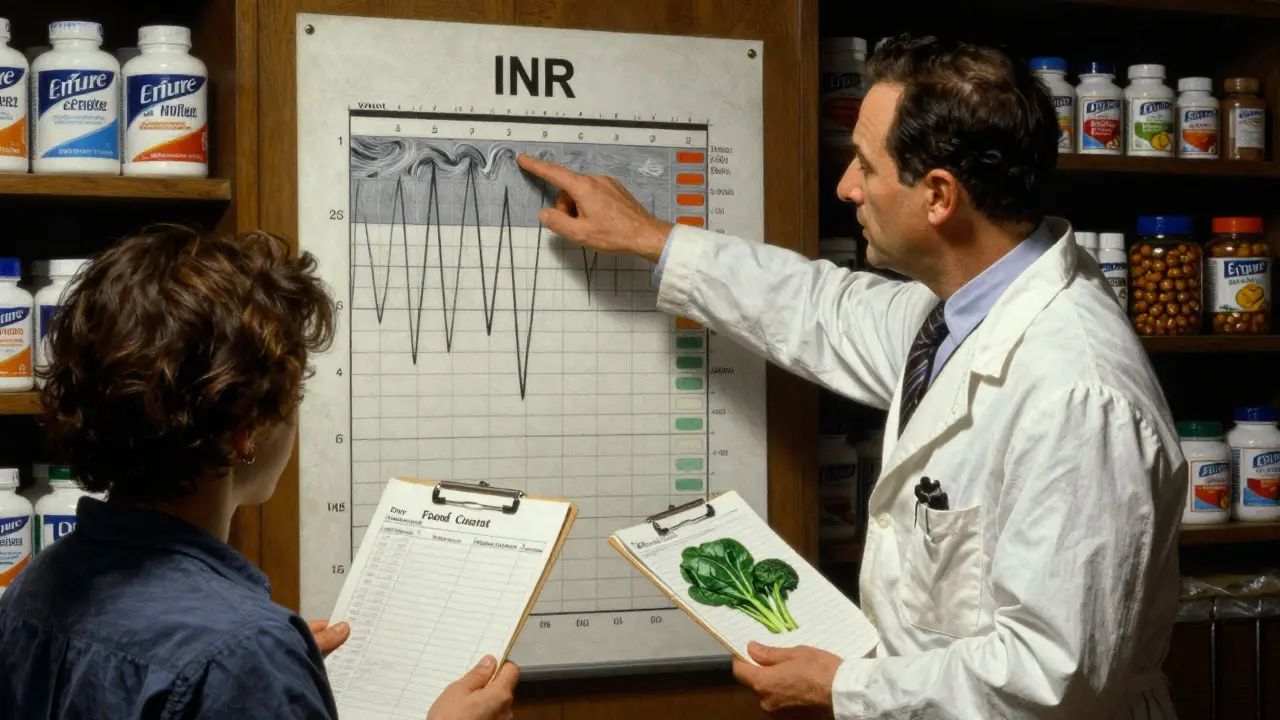
When you're on warfarin, your body is walking a tightrope. Too much vitamin K, and your blood clots too easily. Too little, and you risk dangerous bleeding. It’s not about cutting out spinach or kale-it’s about keeping your intake consistent. That’s the single most important thing you can do to keep your INR stable and avoid emergency visits.
Why Vitamin K Matters with Warfarin
Warfarin works by blocking vitamin K from helping your blood clot. It’s not a poison-it’s a precise tool. But vitamin K doesn’t just disappear when you eat it. It builds up in your liver and keeps working for days. So if you eat a big salad on Monday and nothing green all week, your INR will swing like a pendulum. One day it’s 2.8, safe. The next day it’s 1.7, and your risk of clotting goes up.The science is clear: patients who eat about 90 to 120 micrograms of vitamin K every day, give or take a little, spend 75-80% of their time in the ideal INR range. Those who flip-flop between high and low intake? Only 55-65%. That’s not just a number-it’s the difference between staying out of the hospital and ending up in one.
What Foods Have the Most Vitamin K?
Not all greens are created equal. Here’s what you need to know about the big players:- Cooked spinach: 889 µg per cup
- Cooked kale: 547 µg per cup
- Cooked collard greens: 772 µg per cup
- Cooked broccoli: 220 µg per cup
- Raw spinach: 145 µg per cup
- Asparagus: 70 µg per half-cup
- Green beans: 14 µg per half-cup
Notice something? Cooking spinach concentrates the vitamin K. A cup of raw spinach has less than a quarter of what cooked spinach does. That’s why people who switch from raw to cooked greens without realizing it end up with sudden INR drops.
Other sources: natto (fermented soybeans) is loaded with K2, a different form of vitamin K that also affects warfarin. Some cheeses, egg yolks, and chicken liver have small amounts. Most people don’t eat enough of these to cause big swings-but if you eat natto daily, your doctor needs to know.
Consistency Over Restriction
You’ve probably heard: “Avoid green vegetables.” That advice is outdated-and dangerous.When patients cut out vitamin K completely, they don’t stay away from it forever. One bite of kale at a family dinner, one smoothie with spinach, and suddenly their INR crashes. Their warfarin dose gets increased to compensate. Then they go back to eating nothing green, and their INR spikes again. It’s a cycle of instability that’s hard to break.
Instead, the American Heart Association, American College of Cardiology, and American Society of Hematology all say the same thing: eat a consistent amount every day. Pick one high-vitamin K food you like-maybe spinach-and have the same portion daily. One cup of cooked spinach? Fine. One cup every day. Your body learns to balance it. Your INR steadies. You sleep better.
Dr. John Fanikos at Brigham and Women’s Hospital put it simply: “Patients who eliminate vitamin K often end up with worse control than those who eat it regularly.”
What About Supplements and Meal Replacements?
This is where people get tripped up. You might think protein shakes or nutrition drinks are harmless. But many contain vitamin K.- Ensure®: 50 µg per serving
- Boost®: 55 µg per serving
- Many multivitamins: 50-100 µg
If you’re taking one of these daily and you don’t tell your doctor, it throws off your dose. Same goes for herbal supplements-green tea extract, alfalfa, and even some probiotics can affect vitamin K levels.
Bottom line: if it’s not in your regular diet, don’t add it. If you already take something with vitamin K, keep taking the same amount. Don’t start or stop without talking to your anticoagulation clinic.
Antibiotics, Illness, and Other Hidden Triggers
Your gut bacteria make a little bit of vitamin K2. When you take antibiotics-especially broad-spectrum ones like ciprofloxacin or amoxicillin-those bacteria die off. That means less vitamin K is being made. Your INR can rise unexpectedly, even if your diet hasn’t changed.Same thing happens when you’re sick. If you’re vomiting, not eating, or just feeling too tired to cook, you might eat less vitamin K than usual. That can push your INR up. The WARFARIN-ILLNESS trial showed INR levels jumped by 0.3 to 0.6 units in just 48 hours during illness.
That’s why it’s smart to have a plan: if you’re going to be sick, call your anticoagulation clinic before you feel awful. They might want to check your INR sooner. Don’t wait until you’re dizzy or bruising easily.
Tools That Actually Help
You don’t need to memorize micrograms. But you do need to track.- Use MyFitnessPal or Cronometer. They track vitamin K accurately if you log your food.
- Try CoumaDiet app-it’s built for warfarin users, pulls from USDA data, and shows daily K intake.
- Keep a food diary. Write down what you ate, even if it’s just “1 cup cooked spinach.”
- Plan your meals weekly. Cook a big batch of broccoli or kale on Sunday, portion it out. Eat the same thing Monday through Friday.
Patients who use these tools consistently see their time in therapeutic range jump by 10-15% within three months. That’s not magic. It’s structure.

What If Your INR Keeps Fluctuating?
Some people struggle even with consistency. That’s not your fault. It could be genetics, other medications, or how your body metabolizes warfarin.If you’ve tried consistency for 3-4 months and your INR still swings, talk to your doctor about:
- Switching to a DOAC (like apixaban or rivaroxaban)-no diet restrictions, fewer blood tests
- Getting genetic testing for CYP2C9 and VKORC1 genes-these affect how your body processes warfarin
- Trying low-dose vitamin K supplements (100-150 µg/day) under medical supervision
Yes, you read that right. Some studies show that giving patients a small, consistent dose of vitamin K supplements actually stabilizes their INR. It sounds backwards, but it works because it removes the variability.
What to Do Today
You don’t need to overhaul your life. Start small:- Check your last INR report. What was your vitamin K intake like in the week before?
- Pick one high-K food you already eat (spinach, broccoli, kale). Measure one cup cooked.
- Make a plan: eat that same portion every day for the next 14 days.
- Log it in an app or notebook.
- Call your anticoagulation clinic and say: “I’m trying to eat consistent vitamin K. Can we review my INR trend?”
After two weeks, you’ll know if it’s working. If your INR is steadier, you’ve just made the biggest improvement you can make without changing your medication.
Why This Still Matters in 2026
New blood thinners like Eliquis and Xarelto don’t care what you eat. But they cost 30 times more than warfarin. Many people can’t afford them. Insurance won’t cover them. So warfarin stays the only option.And here’s the truth: if you manage your vitamin K right, warfarin is just as safe as the expensive ones. The 2023 American Heart Association registry shows 35% of new atrial fibrillation patients are still on warfarin-and the ones who stick to consistent vitamin K intake have the same stroke risk as DOAC users.
This isn’t about being perfect. It’s about being predictable. Your body likes routine. Your doctor likes stability. Your INR likes consistency.
Jay Amparo
January 10, 2026 AT 09:25I used to think cutting out greens was the answer until my INR went nuts. Then I started eating the same cup of cooked spinach every single day-no more guessing. My doctor was shocked how stable it got. Turns out, consistency beats restriction every time.
Also, don’t sleep on the CoumaDiet app. It saved my life.
Lisa Cozad
January 10, 2026 AT 23:13This is the most practical guide I’ve ever read on warfarin. I’m a nurse and I’ve seen so many patients panic over kale. The idea of eating the same amount daily instead of avoiding it entirely? Genius. I’m printing this out for my clinic.
Saumya Roy Chaudhuri
January 12, 2026 AT 11:07You people are missing the real issue. Vitamin K isn’t the problem-it’s the damn food logs. Most patients don’t even know how much they’re eating. I tracked my intake for three months using Cronometer and realized I was eating raw spinach on weekends and cooked on weekdays. No wonder my INR was all over the place. You don’t need apps-you need discipline. And if you’re taking Ensure, you’re already doing it wrong.
Ian Cheung
January 14, 2026 AT 06:46Man I used to think warfarin was just a pill you swallowed and forgot about until my INR spiked to 5.2 and I ended up in the ER with a bruise the size of a grapefruit. Turns out I was eating kale smoothies on Mondays and nothing green the rest of the week. Now I eat one cup of broccoli every damn day like clockwork. No drama. No panic. Just steady. And yeah I still drink coffee but I don’t add that green tea extract crap anymore. Life’s better this way.
Also natto is a whole other beast. Don’t start that unless you wanna be friends with your lab tech.
Jaqueline santos bau
January 14, 2026 AT 07:48Why are people still on warfarin in 2026? It’s 2026. We have DOACs. If you can’t afford them then maybe you shouldn’t be on anticoagulants at all. This whole vitamin K thing is just a bandaid on a bullet wound. I’ve seen patients die because they ‘ate too much spinach’-it’s not a diet issue, it’s a systemic failure. Someone needs to fix this. Not you. Not me. Someone with power.
Ted Conerly
January 15, 2026 AT 12:40Biggest mistake I made? Thinking I could wing it. I didn’t track anything. Then I started logging my meals with MyFitnessPal and realized I was eating 300 µg of K on Tuesdays and 20 on Thursdays. No wonder I kept getting called in for draws. Now I cook a big batch of collard greens every Sunday and eat the same portion daily. My INR hasn’t budged in 6 months. You don’t need to be perfect. Just predictable. And yes, it’s boring. But so is a stroke.
Faith Edwards
January 16, 2026 AT 10:00It is both disheartening and profoundly concerning that the general populace continues to treat anticoagulation therapy as a matter of dietary whimsy rather than a clinically rigorous regimen. The notion that one may casually consume ‘a cup of spinach’ without regard to pharmacokinetic variability reflects a dangerous conflation of nutritional preference with medical necessity. One must recognize that vitamin K is not a variable to be negotiated-it is a biochemical constant that must be harmonized with warfarin’s pharmacodynamic profile through strict, physician-monitored adherence. The proliferation of mobile applications as ‘solutions’ is emblematic of a culture that seeks technological shortcuts for what requires disciplined, lifelong medical engagement. I implore you: consult your hematologist before you consume another leaf.
Kunal Majumder
January 18, 2026 AT 05:03Bro I was scared of veggies for a year after my first INR crash. Then my cousin told me: just eat the same thing every day. So now I have one cup of cooked kale with my eggs every morning. No more stress. No more panic calls to the clinic. I even started meal prepping on Sundays. It’s not sexy but it works. And if you’re on antibiotics? Call your doc before you get sick. Don’t wait till you’re purple.