

When you’re taking multiple medications, every pill matters. Missing one, doubling up, or mixing the wrong drugs can lead to serious harm-sometimes hospitalization or worse. That’s why using one pharmacy for all your prescriptions isn’t just convenient-it’s a critical safety step. It’s not about loyalty to a store. It’s about having a pharmacist who knows your full medication picture, spots hidden dangers, and helps you stay on track.
Why One Pharmacy Makes a Difference
Think of your medications like a puzzle. Each prescription fits a piece of your health. But if you get pieces from different stores, the picture gets messy. Pharmacists at a single pharmacy see every piece. They know what you’re taking, when, and why. That’s how they catch problems before they happen. In the U.S., nearly half of adults take at least one prescription drug. About 15% take five or more. That’s polypharmacy-and it’s risky. When you use multiple pharmacies, your pharmacist doesn’t have the full picture. They might not know you’re taking another blood thinner from a different store, or that your new painkiller interacts with your heart medication. The result? A 34% higher chance of dangerous drug interactions compared to using just one pharmacy. One of the most common and dangerous combinations is warfarin (a blood thinner) with NSAIDs like ibuprofen. Together, they can cause severe internal bleeding. A single pharmacist, seeing both prescriptions in your file, would flag this immediately. Two different pharmacies? The alert gets missed.How Drug Interaction Screening Works
Modern pharmacy software doesn’t just fill prescriptions. It scans every new drug against your entire list-prescriptions, over-the-counter meds, even supplements. These systems can detect over 10,000 possible interactions. But here’s the catch: if your meds are split across pharmacies, the system only sees part of your list. That’s why pharmacists override 80% of alerts when patients use multiple locations. They’re not ignoring warnings-they’re working with incomplete data. At a single pharmacy, the software has your full history. That means real-time alerts for things like:- Drug-drug interactions (e.g., statins and grapefruit juice)
- Drug-disease conflicts (e.g., decongestants raising blood pressure in hypertensive patients)
- Therapy duplication (e.g., taking two different pills with the same active ingredient)
Med Sync: The Secret Weapon for Adherence
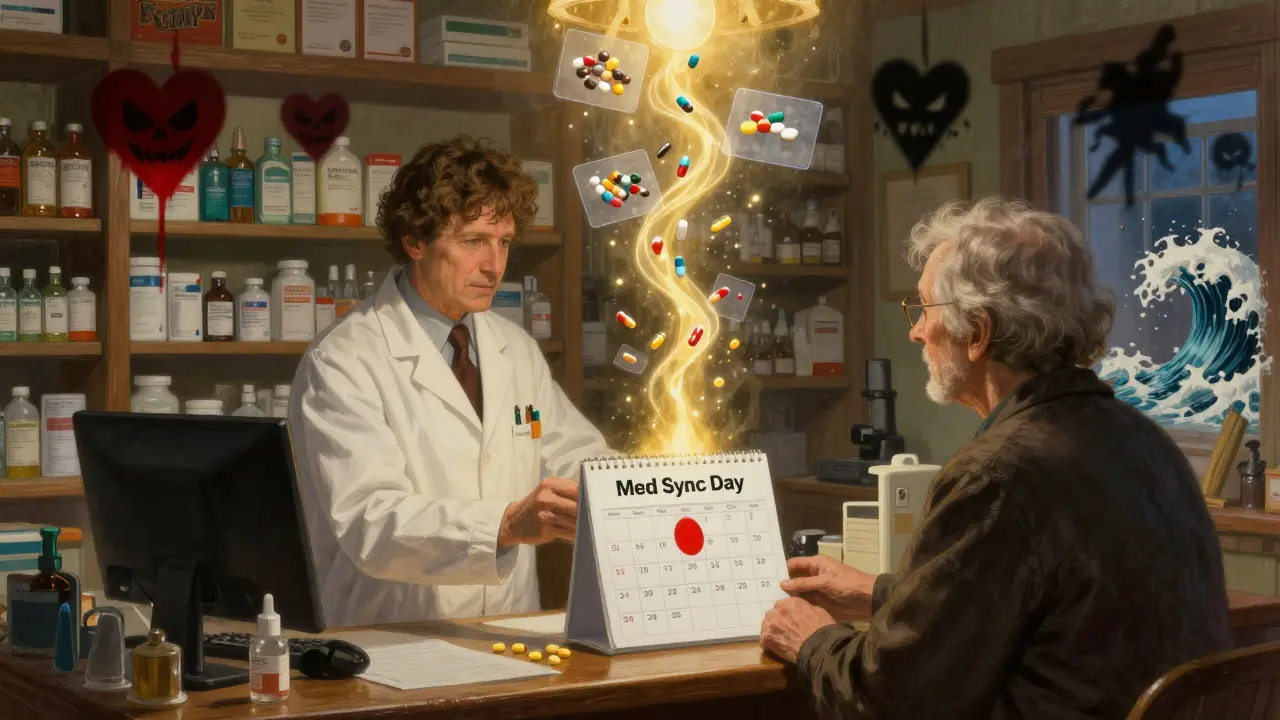
One of the biggest reasons people miss doses isn’t forgetfulness-it’s confusion. Juggling refill dates for five different meds across three pharmacies is a nightmare. That’s where medication synchronization (med sync) comes in. Med sync is a free program offered by most major chains like CVS, Walgreens, and independent pharmacies. Here’s how it works:- You sign up for the program.
- Your pharmacist reviews all your meds and identifies which ones can be aligned.
- They give you short-term refills to bring all your dates to the same day each month.
- You pick up everything on that one day-no more chasing refill reminders.
Real Risks of Using Multiple Pharmacies
It’s easy to think, “I just use the cheaper one.” But the cost savings aren’t worth the risk. A 2022 Consumer Reports study found that splitting prescriptions might save $150-$300 a year. But the Agency for Healthcare Research and Quality estimates that each preventable adverse drug event costs an average of $8,750 in hospital bills. Here’s what happens when you use multiple pharmacies:- You get conflicting instructions from different pharmacists.
- You forget which pharmacy filled which med, leading to accidental double-dosing.
- Emergency rooms can’t access your full medication list quickly.
What You Can Do Today
You don’t need to wait for a doctor’s appointment or a health scare to start using one pharmacy. Here’s how to make the switch:- Choose one pharmacy you trust-preferably one close to home or work.
- Call them and ask to transfer all your prescriptions. Most can do it in 2-5 business days.
- Bring a list of everything you take: prescriptions, OTC pain relievers, vitamins, herbal supplements. Even if you think it’s “not a drug,” it can interact.
- Ask to enroll in med sync. No extra cost. Just ask.
- Keep your list updated. Add new meds right away. Tell your pharmacist about any changes-even if they’re from a different doctor.
Why Pharmacists Are Your Secret Health Partner
Pharmacists aren’t just the people who hand you pills. They’re trained to spot risks you might miss. They know how your meds work together. They remember that you had a bad reaction to a certain antibiotic last year. They notice if you haven’t picked up your blood pressure med in three weeks. In a 2023 interview, Dr. Amit Kakar, Pharm.D., said: “All prescriptions are monitored. We prevent duplicate medication. We help patients take their prescriptions on time.” That’s not marketing. That’s daily practice at a single pharmacy. Patients who consolidate their prescriptions report 78% better understanding of their meds. They feel more in control. Less anxious. More confident.The Bigger Picture: Why This Matters Now
Health systems are catching on. Medicare Part D is now offering financial incentives to pharmacies that achieve 90%+ med sync rates. The 2023 Pharmacy Quality Alliance added “comprehensive medication review completion” as a key performance metric. That means pharmacies are being rewarded for doing this right. Meanwhile, new tools are emerging. In 2025, the University of Southern California plans to launch an AI-driven tool that analyzes medication combinations for both risks and benefits. But even the smartest AI can’t help if your data is scattered across five different systems. The truth is simple: fragmented care costs lives. And money. And time. Using one pharmacy doesn’t fix the broken healthcare system. But it gives you control over one of the most dangerous parts of it-your own meds.Can I still save money if I use just one pharmacy?
Yes, but you need to be strategic. Many pharmacies offer discount programs, loyalty cards, or generic alternatives. Ask your pharmacist to compare prices for your top meds. Some even match competitors’ prices. While splitting prescriptions might seem cheaper upfront, the risk of a hospital visit from a drug interaction far outweighs any short-term savings.
What if my doctor prescribes a new med from a different clinic?
Always tell your pharmacist. Even if the prescription goes to a different pharmacy, call your main pharmacy and ask them to add it to your file. You can also ask your doctor to send the prescription directly to your preferred pharmacy. Most clinics can do this electronically. Don’t assume the new pharmacy will update your main one-it won’t.
Do I need to switch pharmacies if I’m happy with my current one?
If you’re already using one pharmacy for all your prescriptions, you’re doing it right. No need to switch. But if you’re using two or more, even occasionally, it’s time to consolidate. The safety benefit isn’t about loyalty-it’s about completeness.
Can my pharmacist help with over-the-counter meds and supplements?
Absolutely. Many OTC products and supplements interact with prescription drugs. For example, St. John’s Wort can reduce the effectiveness of birth control, blood thinners, and antidepressants. Your pharmacist needs to know everything you take-even if you think it’s “natural” or “harmless.”
How often should I update my medication list?
Update it every time you start, stop, or change a medication-prescription or not. Even if you’re just trying a new pain reliever or vitamin. Keep a physical or digital list in your wallet or phone. Bring it to every appointment and every pharmacy visit. It’s your best safety tool.
evelyn wellding
January 16, 2026 AT 23:21Bianca Leonhardt
January 17, 2026 AT 16:57Travis Craw
January 19, 2026 AT 06:13vivek kumar
January 20, 2026 AT 14:57Riya Katyal
January 22, 2026 AT 08:08Henry Ip
January 23, 2026 AT 17:59swarnima singh
January 25, 2026 AT 01:14Isabella Reid
January 25, 2026 AT 23:58kanchan tiwari
January 26, 2026 AT 17:19Corey Chrisinger
January 26, 2026 AT 21:52Christina Bilotti
January 28, 2026 AT 21:32