

NSAID Risk Assessment Calculator
Risk Assessment Tool
This tool helps you understand your risk of NSAID-related gastrointestinal bleeding based on your specific health factors. Results are for informational purposes only and should not replace professional medical advice.
Your Risk Assessment
What does this mean?
Risk is calculated based on your responses. A score of 2 or more indicates high risk according to the American College of Gastroenterology guidelines.
Every year, millions of people reach for ibuprofen, naproxen, or aspirin to ease a headache, back pain, or arthritic flare-up. These drugs - non-steroidal anti-inflammatory drugs, or NSAIDs - work fast and feel like a miracle. But behind the relief is a quiet danger: NSAIDs can silently damage your stomach and intestines, leading to bleeding so severe it lands people in the hospital - or worse.
How NSAIDs Hurt Your Gut
NSAIDs block enzymes called COX-1 and COX-2. COX-2 causes pain and swelling, so blocking it helps. But COX-1 protects your stomach lining by making mucus and blood flow to keep it healthy. When NSAIDs shut down COX-1, your stomach loses its natural shield. That’s when acid starts eating away at the tissue. This isn’t just about heartburn. The damage can be invisible at first. You might not feel pain until there’s serious bleeding. Some people lose blood slowly - so slowly they don’t notice until they’re weak, pale, and anemic. Others bleed suddenly, vomiting blood or passing black, tarry stools. A 2020 JAMA Internal Medicine analysis found NSAID users are 3 to 4 times more likely to suffer upper gastrointestinal bleeding than non-users. And it’s not just the stomach. About 86% of people with NSAID-related lower GI bleeding never had a peptic ulcer. The damage can happen anywhere in the digestive tract.Who’s at the Highest Risk?
Not everyone who takes NSAIDs bleeds. But some people are walking into danger without knowing it. The biggest risk factors are simple to spot:- Age 70 or older - your stomach lining thins with age
- History of ulcers or prior GI bleeding - once it happens, it’s more likely to happen again
- Taking blood thinners like warfarin or aspirin - this doubles the bleeding risk
- Using corticosteroids like prednisone - these drugs weaken tissue repair
- Taking more than one NSAID at a time - even if one is over-the-counter
- Using high doses - over 1,200 mg of ibuprofen daily is a red flag
COX-2 Inhibitors: Safer for the Stomach - But Not Without Risk
Celecoxib (Celebrex) and other COX-2 inhibitors were designed to avoid COX-1, so they’re gentler on the gut. A 2000 Lancet study showed celecoxib caused half as many serious ulcers as ibuprofen. That sounds like a win - until you look at the heart. Rofecoxib (Vioxx) was pulled from the market in 2004 after it doubled heart attack risk. Celecoxib carries a smaller but still real risk. The FDA requires a black box warning on all NSAIDs for both GI and cardiovascular dangers. So choosing a COX-2 inhibitor isn’t a free pass. It’s a trade-off: less stomach damage, more heart risk. For someone with arthritis and no heart disease, it might be worth it. For someone with high blood pressure or a history of stroke? Not so much.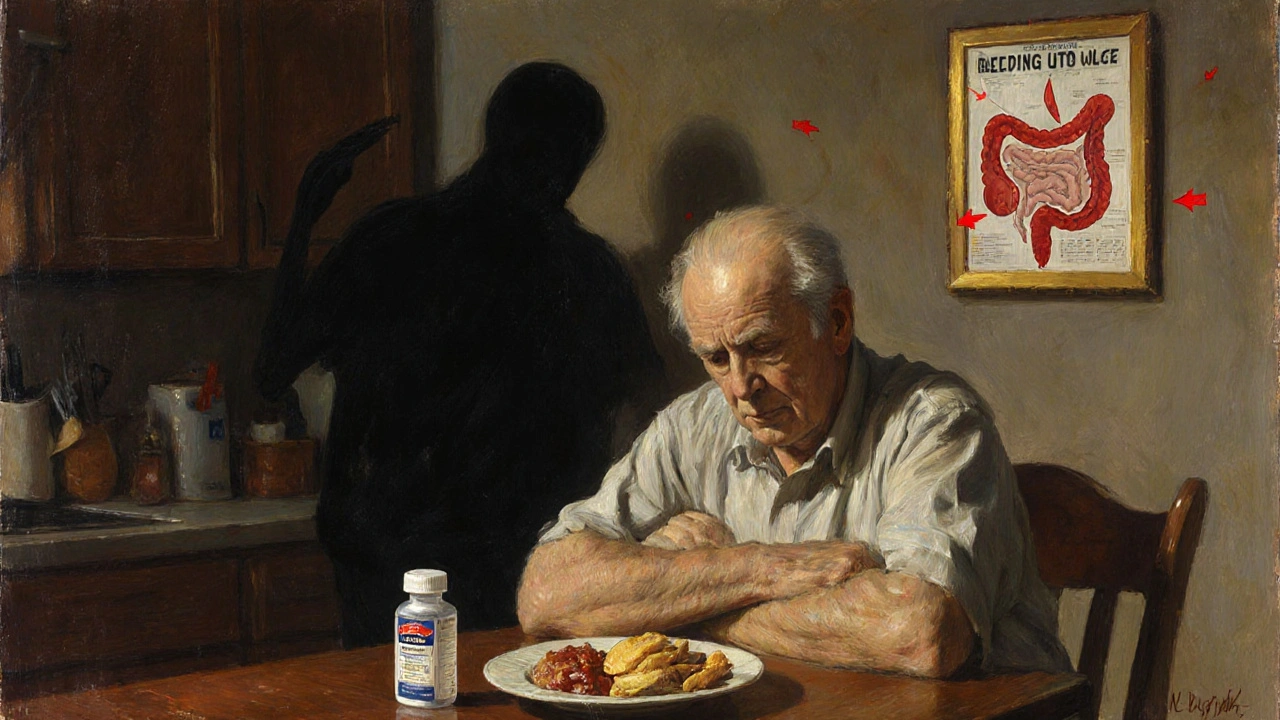
How to Protect Yourself - The Proven Strategies
If you need NSAIDs and you’re at risk, you don’t have to go without pain relief. You just need protection. Proton pump inhibitors (PPIs) like omeprazole, esomeprazole, or pantoprazole are the gold standard. A 2017 Cochrane review of over 13,000 patients found PPIs cut NSAID-related ulcers by 75%. That’s not a guess - it’s solid science. Start the PPI before you begin the NSAID. Don’t wait for symptoms. The American Gastroenterological Association says this reduces complications by 74%. Another option is misoprostol, a drug that rebuilds stomach lining. It works almost as well as PPIs - but it causes diarrhea in up to 20% of users and stomach cramps. It’s also not safe during pregnancy. So for most people, PPIs win. There’s also a newer combo drug: Vimovo. It’s naproxen and esomeprazole in one pill. The 2022 PRECISION-2 trial showed it cut ulcer complications from 25.6% down to 7.3%. That’s a huge drop. But it’s expensive. And it’s not for everyone.What About Over-the-Counter NSAIDs?
Just because you can buy them without a prescription doesn’t mean they’re safe. A 2021 Clinics in Medicine review found that 26% of people take OTC NSAIDs at doses higher than the label recommends. Many don’t realize they’re taking multiple NSAIDs at once - ibuprofen for pain, aspirin for heart protection, naproxen for arthritis. That’s a recipe for disaster. If you’re taking OTC NSAIDs more than 10 days a month, talk to your doctor. If you’re over 60, even occasional use can be risky. And if you’re taking any other meds - especially blood thinners - you’re playing with fire.
The Real Cost of NSAID Bleeding
This isn’t just a medical problem - it’s a financial and human one. In the U.S. alone, NSAID-related GI bleeding causes 107,000 hospitalizations and 16,500 deaths every year. The cost? $2.2 billion annually. That’s billions in emergency visits, blood transfusions, surgeries, and lost workdays. On Reddit, users share stories that numbers can’t capture. One person wrote about their 78-year-old mother who needed three units of blood after months of unnoticed bleeding from the small intestine. She had been taking ibuprofen daily for knee pain. No one connected the dots until she collapsed. But there’s hope. On Drugs.com, 78% of people who took celecoxib reported good pain control with little stomach trouble. The key? Using the right drug for the right person.What Should You Do?
Here’s what works in real life:- Ask yourself: Do I really need an NSAID? Could acetaminophen (Tylenol) work instead? It doesn’t hurt the stomach.
- If you must use NSAIDs, use the lowest dose for the shortest time possible.
- If you’re over 60, have a history of ulcers, or take blood thinners - ask your doctor about a PPI.
- Don’t assume OTC means safe. Read labels. Don’t mix NSAIDs.
- Watch for signs: black stools, fatigue, dizziness, unexplained anemia. These aren’t normal.
- Get screened. If you’ve had bleeding before, you need a plan - not just a pill.
What’s Coming Next?
Scientists are working on new drugs that fight pain without wrecking your gut. One type, called CINODs (COX-inhibiting nitric oxide donators), releases nitric oxide - a molecule that helps protect the stomach lining. Naproxcinod, tested in the 2021 NAPROX-2 trial, cut ulcer rates in half compared to naproxen. It’s not on the market yet, but it’s a sign that safer NSAIDs are possible. For now, the best tool we have is awareness. NSAIDs aren’t evil. They’re powerful. And like any powerful tool, they need respect. Use them wisely, protect your gut, and never ignore symptoms that feel "off."Can I take ibuprofen if I’ve had a peptic ulcer before?
If you’ve had a peptic ulcer or GI bleeding before, you should avoid standard NSAIDs like ibuprofen unless you’re also taking a proton pump inhibitor (PPI). Even then, your doctor may recommend a COX-2 inhibitor like celecoxib with a PPI instead. The risk of another bleed is very high - up to 2.5 times greater - without protection.
Are over-the-counter NSAIDs safer than prescription ones?
No. OTC NSAIDs like ibuprofen and naproxen carry the same risks as prescription versions. The difference is dosage and duration. Many people take OTC NSAIDs daily for months without realizing they’re harming their stomach. The FDA warns that even short-term use can cause bleeding, especially in older adults or those with other risk factors.
How do I know if I’m bleeding from NSAID use?
Signs can be subtle. Black, tarry stools or vomiting blood are obvious - but many people bleed slowly without symptoms. Watch for unexplained fatigue, dizziness, pale skin, or shortness of breath. These can mean iron deficiency anemia from hidden bleeding. A simple blood test can catch it early. Don’t wait for vomiting blood to get checked.
Is it safe to take aspirin with other NSAIDs?
No. Aspirin is an NSAID itself, and combining it with other NSAIDs like ibuprofen or naproxen dramatically increases your risk of bleeding. If you take low-dose aspirin for heart protection, avoid other NSAIDs. Use acetaminophen for pain instead. If you must use an NSAID, talk to your doctor about adding a PPI.
How long should I take a PPI with NSAIDs?
If you’re at high risk, take the PPI for as long as you’re taking the NSAID. For occasional use, you may only need it during the treatment period. But if you’re on NSAIDs long-term - say, for arthritis - you should stay on the PPI. Stopping it increases your ulcer risk quickly. Always follow your doctor’s advice - don’t stop or start a PPI on your own.
Are there natural alternatives to NSAIDs for joint pain?
Yes. For mild to moderate joint pain, options like physical therapy, weight loss, heat/cold therapy, and supplements like glucosamine or turmeric (curcumin) can help. Studies show turmeric has anti-inflammatory effects similar to ibuprofen in some cases - but without the GI risk. Talk to your doctor before starting any supplement, especially if you’re on other meds.
If you’ve been taking NSAIDs for years and never had a problem, that doesn’t mean you’re immune. Risk builds over time. The best move? Talk to your doctor. Get screened. Know your numbers. Your gut won’t warn you until it’s too late - but you can still act before then.
Aidan McCord-Amasis
November 16, 2025 AT 07:26Katie Baker
November 16, 2025 AT 18:55Jennifer Walton
November 18, 2025 AT 15:32Edward Ward
November 18, 2025 AT 20:04Kihya Beitz
November 19, 2025 AT 21:42John Foster
November 20, 2025 AT 05:14Adam Dille
November 22, 2025 AT 05:10Andrew Eppich
November 24, 2025 AT 04:58Jessica Chambers
November 25, 2025 AT 14:48BABA SABKA
November 27, 2025 AT 03:36Ogonna Igbo
November 28, 2025 AT 06:01Chris Bryan
November 29, 2025 AT 21:45Shyamal Spadoni
December 1, 2025 AT 06:08