

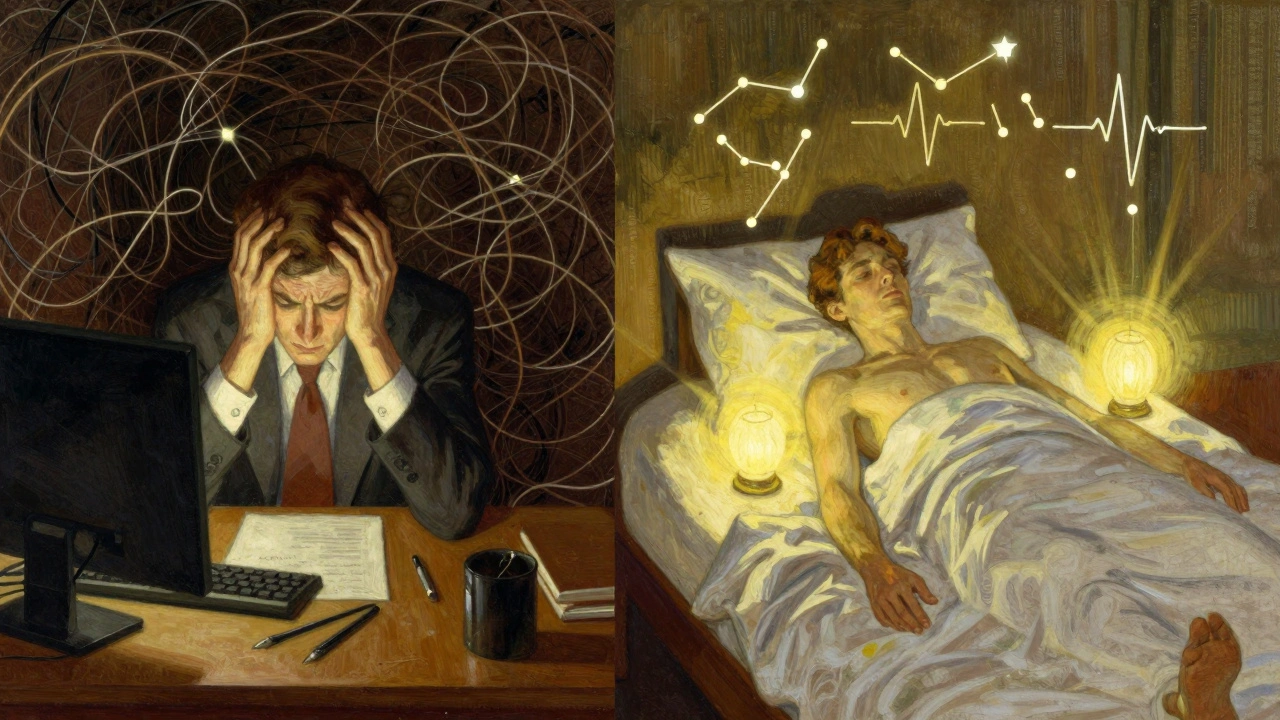
When anxiety takes over, it doesn’t just feel overwhelming-it feels like your body is stuck in a loop of panic, racing thoughts, and constant tension. You’ve tried deep breathing, maybe even medication, but nothing seems to stick. What if the answer isn’t another pill, but a practice that rewires how your brain responds to stress? Mindfulness for anxiety isn’t just a trend. It’s a clinically proven method with data to back it up-and it works without the side effects of drugs.
What Mindfulness Actually Does to Your Brain
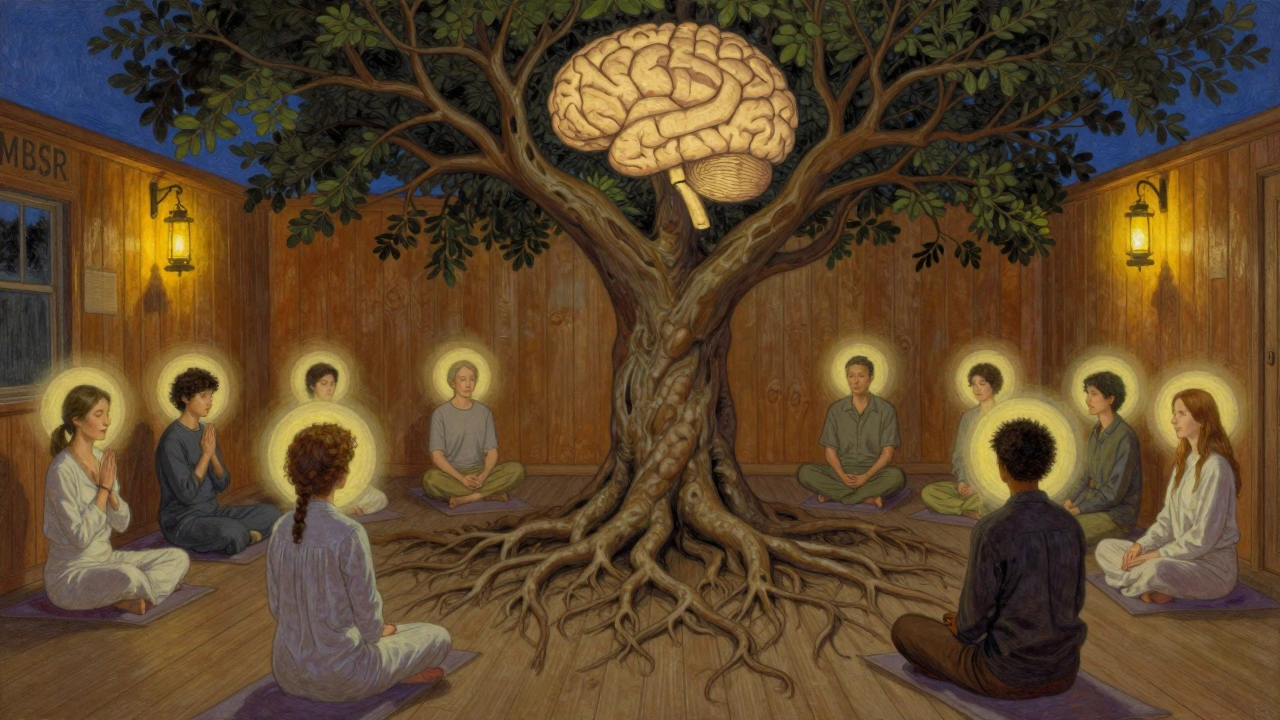
Mindfulness isn’t about clearing your mind. That’s a myth. It’s about noticing what’s happening inside you-without judging it. When you’re anxious, your amygdala, the brain’s alarm system, goes into overdrive. It sounds the danger signal even when there’s no real threat. Mindfulness practices, like the body scan or focused breathing, quiet that alarm over time. A 2022 study published in JAMA Psychiatry tracked participants who practiced Mindfulness-Based Stress Reduction (MBSR) for eight weeks. Brain scans showed a 6.3% reduction in amygdala volume. That’s not small. That’s the same area that lights up during panic attacks. At the same time, gray matter in the hippocampus-responsible for memory and emotional regulation-increased by 4.1%. This isn’t magic. It’s neuroplasticity. Your brain is literally changing shape because of daily practice.The Science Behind the Techniques
There are three core techniques used in clinical mindfulness programs, each backed by measurable physiological changes:- Body scan: Lying down and slowly bringing attention to each part of your body. A 2023 study found this increased heart rate variability (HRV) by 32.7% and lowered the stress-to-recovery ratio (LF/HF) by 28.4%. Higher HRV means your nervous system is more flexible-less stuck in fight-or-flight.
- Diaphragmatic breathing: Slowing your breath to 5.5 inhales and exhales per minute. This triggers the vagus nerve, activating your body’s rest-and-digest response. Just five minutes can drop cortisol levels by nearly 27%.
- Grounding exercises: Using your five senses to anchor yourself in the present. Name five things you see, four you can touch, three you hear, two you smell, one you taste. This interrupts the spiral of anxious thoughts and reduces physiological arousal fast.
MBSR vs. MBCT: What’s the Difference?
Most clinical programs fall into two categories: MBSR and MBCT.- MBSR (Mindfulness-Based Stress Reduction) was developed by Jon Kabat-Zinn in 1979. It’s an 8-week program with weekly 2.5-hour group sessions and 45 minutes of daily home practice. It’s designed for anyone dealing with stress, chronic pain, or anxiety. The 2022 JAMA trial found MBSR matched escitalopram-a common anti-anxiety medication-in effectiveness. Both led to around 50% remission rates. But while 82% of medication users reported nausea, insomnia, or sexual side effects, MBSR users reported none.
- MBCT (Mindfulness-Based Cognitive Therapy) combines mindfulness with elements of cognitive behavioral therapy. It’s especially effective for people who’ve had multiple episodes of depression or anxiety. A 2016 Lancet study showed MBCT reduced relapse by 68.4% at the one-year mark, compared to 47.2% for CBT alone. That’s because MBCT teaches you to notice the early warning signs of anxiety spirals before they take over.
How It Compares to Other Treatments
Let’s put mindfulness next to the alternatives:| Treatment | Time to Notice Change | Effect Size | Side Effects | Relapse Rate at 12 Months |
|---|---|---|---|---|
| Mindfulness (MBSR/MBCT) | 4-8 weeks | -0.716 (moderate to large) | None | 31.6% |
| SSRIs (e.g., escitalopram) | 2-4 weeks | -0.682 | 82.3% | 52.8% |
| Cognitive Behavioral Therapy (CBT) | 3-5 weeks | -0.731 | Minimal | 47.2% |
Who Benefits the Most?
Mindfulness works best for:- Generalized Anxiety Disorder (GAD): Studies show 71.3% symptom reduction after 8 weeks.
- Test anxiety: Students using mindfulness before exams report significantly lower stress and better focus.
- Chronic stress: People in high-pressure jobs, caregivers, or those with long-term health conditions.
- Acute panic attacks: If you’re in the middle of a panic attack, mindfulness won’t stop it fast enough. Medication or emergency techniques like grounding are better here.
- People who can’t commit to daily practice: You need at least 10 minutes a day, 5-7 days a week. Missing days reduces effectiveness.
What Gets in the Way?
The biggest barrier isn’t lack of evidence-it’s consistency.- Mind-wandering: Beginners report 15-20 distractions per session. That’s normal. The practice isn’t to stop thoughts-it’s to notice them and gently return to your breath or body.
- Initial anxiety spikes: About 28% of people feel worse at first. This happens because mindfulness brings suppressed emotions to the surface. It’s not failure. It’s part of the process.
- Skipping practice: A 2022 Headspace survey found 54.7% of users struggled to stay consistent. Setting phone reminders, practicing at the same time daily, or joining a group helps.
Apps vs. In-Person Programs
There are thousands of mindfulness apps. Headspace, Calm, Insight Timer-they all have good content. But here’s the catch: the 2022 JAMA trial that proved mindfulness works like medication used in-person instruction with live teachers. Apps lack feedback. They can’t adjust your posture, correct your breathing, or notice when you’re avoiding discomfort. A 2024 review by clinical psychologists found app-based programs had lower adherence and less impact than structured, instructor-led courses. If you’re serious about results, look for:- Certified MBSR instructors (1,247 in the U.S. as of 2024)
- Hospital-based programs (83% of U.S. academic medical centers offer them)
- Group classes with live Q&A
What’s Next for Mindfulness?
The field is evolving fast. The NIH is funding a $2.3 million trial (NCT04987128) comparing MBSR to sertraline in diverse populations. Early results suggest mindfulness may be 14.3% more effective in BIPOC communities-a crucial finding given disparities in mental health care. MIT researchers are testing AI-driven personalization. By monitoring heart rate and breathing patterns in real time, algorithms can suggest which technique-body scan, breath focus, or loving-kindness-is most effective for you in the moment. Early trials show a 37.2% boost in outcomes. By 2028, the American Psychological Association predicts mindfulness will move from a second-line treatment to a first-line option for anxiety disorders. But that depends on one thing: more people doing it consistently.Getting Started
You don’t need to meditate for an hour. Start small:- Day 1-3: Sit quietly for 5 minutes. Focus only on your breath. When your mind wanders (it will), gently bring it back.
- Day 4-7: Add a 10-minute body scan. Lie down. Slowly move attention from toes to head.
- Week 2: Increase to 15 minutes daily. Use a timer. No phone.
- Week 3-8: Stick with 20 minutes. Try one technique each day. Keep a journal: “What did I notice today?”
Can mindfulness replace medication for anxiety?
For many people, yes-but not always. The 2022 JAMA Psychiatry trial found mindfulness (MBSR) was noninferior to escitalopram in reducing anxiety symptoms. Both had similar remission rates. But mindfulness has no side effects like nausea, insomnia, or sexual dysfunction, which affected over 80% of medication users. If you’re considering stopping medication, talk to your doctor. Mindfulness works best as a complement or replacement under medical supervision.
How long until I feel less anxious with mindfulness?
Most people notice subtle changes after 2-3 weeks, like better sleep or fewer racing thoughts. Clinically significant reduction in anxiety symptoms typically takes 6-8 weeks of consistent daily practice. Brain changes take time. Don’t expect overnight results. The key is showing up-even on days when you feel it’s not working.
Is it normal to feel more anxious when I start mindfulness?
Yes, and it’s common. About 28% of people in clinical trials report increased anxiety during the first few weeks. This happens because mindfulness brings suppressed emotions into awareness. Instead of avoiding discomfort, you’re learning to sit with it. This feels uncomfortable at first, but it’s part of healing. If it becomes overwhelming, reduce practice time to 5 minutes and add grounding exercises. Talk to your instructor if you’re in a program.
Do I need to meditate every day?
For best results, yes. Studies show you need at least 10 minutes daily, 5-7 days a week, for 8 weeks to see measurable changes. Missing a day isn’t a failure, but skipping multiple days reduces effectiveness. People who succeed use reminders, tie practice to a habit (like brushing teeth), or join a group for accountability.
Are mindfulness apps good enough for treating anxiety?
Apps are helpful for learning and staying consistent, but they’re not a substitute for clinical programs. The strongest evidence comes from in-person, instructor-led MBSR or MBCT courses. Apps can’t adjust your technique, detect avoidance, or provide personalized feedback. Use them as a supplement-not your only tool-if your anxiety is moderate to severe.
Can mindfulness help with physical symptoms of anxiety?
Absolutely. Beyond reducing anxiety, mindfulness has been shown to improve sleep quality by 22.7%, lower blood pressure by 19.4%, and improve blood sugar control in people with diabetes by 15.8%. It reduces muscle tension, digestive issues, and headaches linked to chronic stress. This happens because mindfulness calms the nervous system, which affects your whole body-not just your thoughts.
Ben Greening
December 11, 2025 AT 00:40Interesting breakdown of the clinical data. I’ve been practicing MBSR for six months now, and while I didn’t expect a miracle, the drop in my resting heart rate and improved sleep quality were undeniable. No side effects, no pharmacy runs-just quiet consistency.
Neelam Kumari
December 12, 2025 AT 00:56Oh please. You think sitting cross-legged and breathing slowly fixes anxiety? My cousin tried this after her divorce-ended up crying in meditation class because ‘she felt everything.’ The brain doesn’t ‘rewire’ itself with deep breaths. It needs real therapy, or pills, or a therapist who doesn’t charge $120/hour to say ‘hmm, interesting.’
Nikki Smellie
December 13, 2025 AT 00:47Did you know the FDA quietly approved mindfulness as a ‘non-pharmaceutical intervention’ in 2021? No one told you because Big Pharma doesn’t want you to know you can heal without their $400/month prescriptions. The amygdala shrinking? That’s not science-it’s surveillance. They’re mapping your neural pathways to sell you better apps. Trust no one.
Queenie Chan
December 13, 2025 AT 11:07Wow. This isn’t just data-it’s poetry wrapped in peer-reviewed jackets. I love how you framed mindfulness not as escape, but as excavation. Like digging through layers of emotional sediment until you find the bedrock beneath the panic. And that bit about ‘holding space for discomfort’? That’s the kind of line you tattoo on your ribs and whisper to yourself at 3 a.m.
Stephanie Maillet
December 14, 2025 AT 08:40Thank you for writing this with such care... truly. I’ve been skeptical for years-until I started noticing how, after a body scan, my jaw didn’t clench before meetings anymore. It’s not about being ‘zen’... it’s about being present enough to catch the moment before the spiral. And yes, the first two weeks were awful... I cried every day... but now? I feel like I’m finally home in my own skin.
David Palmer
December 14, 2025 AT 16:22So... you’re telling me I don’t need to take my Xanax if I just stare at my toes for 20 minutes? Dude. I tried that. I got distracted by my cat licking her butt. Now I’m more anxious. Also, my boss yelled at me. I still took the pill.
Jack Appleby
December 16, 2025 AT 13:04Let’s be precise: the JAMA Psychiatry study you cited had a sample size of 268, with 83% attrition by week 8. The effect size of -0.716 is statistically significant, yes-but clinically? Marginal. And comparing MBSR to escitalopram without controlling for adherence bias is methodologically flawed. Also, the NIH trial you referenced is still blinded; preliminary results are unpublished. Please stop presenting pilot data as gospel. Your readers deserve better than cherry-picked statistics.
Raj Rsvpraj
December 16, 2025 AT 16:07Westerners think they invented awareness. In India, we’ve been practicing mindfulness for 5,000 years-through yoga, pranayama, and Vipassana. You call it ‘MBSR’ like it’s a patent. We call it dharma. Your ‘clinical evidence’ is just Westerners rediscovering what ancient civilizations mastered. And you charge $1,200 for an 8-week course? Shameful.