

Seniors are at a much higher risk of over-sedation and opioid overdose than younger adults. Their bodies process medications differently - metabolism slows, kidneys clear drugs more slowly, and the brain becomes more sensitive to sedatives. A 75-year-old taking the same dose of morphine as a 40-year-old isn’t just at risk - they’re in danger. Over-sedation doesn’t always look like someone passed out on the couch. Often, it’s subtle: slower breathing, confusion, unresponsiveness, or even just quieter than usual. And when it happens, it can turn deadly in minutes.
Why Seniors Are More Vulnerable
As we age, the body changes in ways that make sedatives and painkillers more powerful and longer-lasting. Liver function drops by 30% to 50% between ages 20 and 80. Kidneys filter out drugs at a rate that declines by about 0.8 mL/min/1.73m² every year after 40. That means a drug like midazolam or fentanyl stays in the system longer, building up over time. Even small doses can become toxic.Older adults also have a more permeable blood-brain barrier. This lets more medication reach the brain, increasing sedation. And if they’re on oxygen - which many are due to COPD or heart failure - their bodies can hide the signs of low oxygen. Pulse oximetry might show 94%, but they could be barely breathing. This is called silent hypoxia. It’s one of the most dangerous traps in senior care.
Key Signs of Over-Sedation and Overdose
You don’t need a medical degree to spot trouble. Watch for these clear, observable signs:- Slowed breathing - fewer than 8 breaths per minute, or long pauses between breaths (more than 10 seconds).
- Unresponsiveness - they don’t respond to voice, light touch, or shoulder shake. If they can’t open their eyes when called, it’s serious.
- Bluish lips or fingernails - a late sign, but critical. Don’t wait for this.
- Confusion or extreme drowsiness - if they’re normally alert but suddenly seem foggy, disoriented, or can’t follow simple commands, that’s a red flag.
- Low blood pressure - dizziness, cold skin, or fainting can signal overdose.
- Pinpoint pupils - especially with opioid use. This is a classic sign.
These signs don’t always appear together. One or two can be enough to trigger an emergency. Don’t wait for all of them.
Monitoring Tools That Save Lives
The gold standard for monitoring seniors during sedation is multimodal monitoring - using more than one device at once. No single tool catches everything.Pulse oximetry (SpO2) measures oxygen in the blood. It’s common, but it’s not enough. If someone is on oxygen, their SpO2 can look fine even when they’re not breathing enough. Set alarms at 90% - anything below that means action is needed.
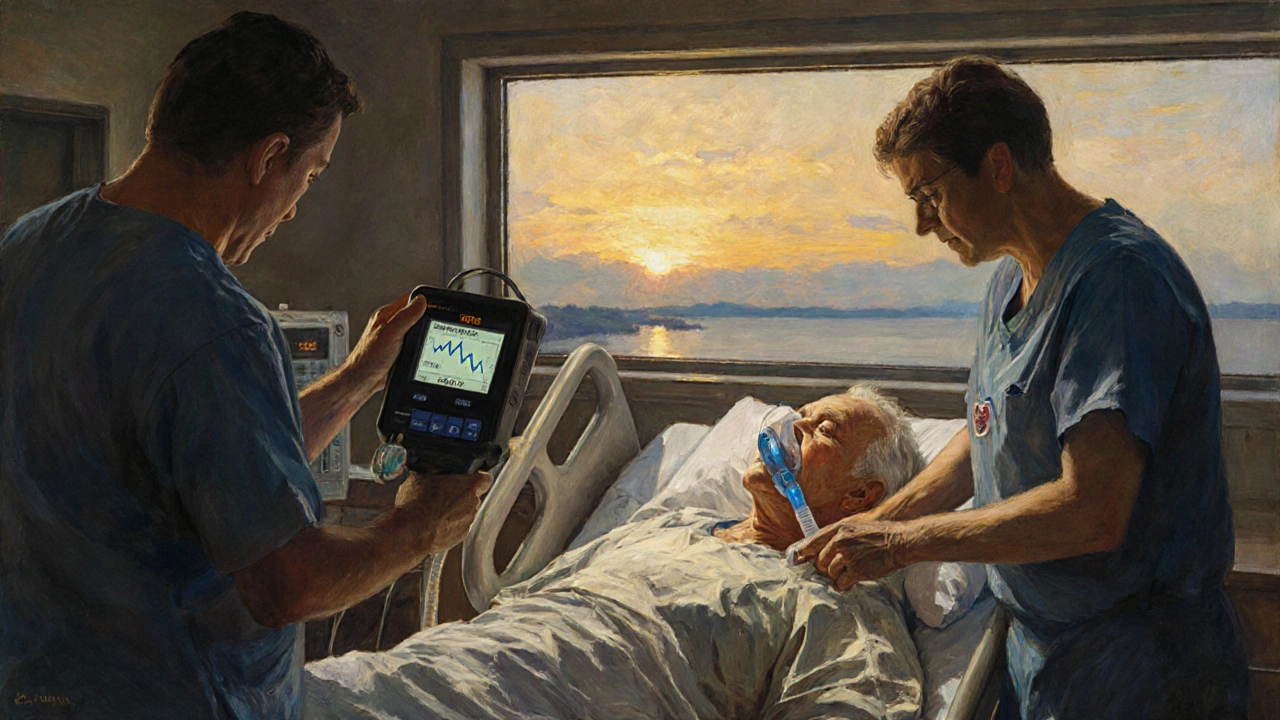
Capnography measures carbon dioxide (EtCO2) in exhaled breath. This is the most important tool for catching early respiratory depression. Normal levels are 35-45 mmHg. If EtCO2 rises above 50 or drops below 30, or if breathing drops below 8 breaths per minute, stop the procedure and get help. Capnography detects problems 12-14 minutes before pulse oximetry shows a drop. That’s enough time to intervene.
Heart rate and blood pressure - check every 5 minutes. A heart rate below 50 or above 100, or systolic blood pressure below 90, are warning signs. Combine these with breathing and oxygen levels for a full picture.
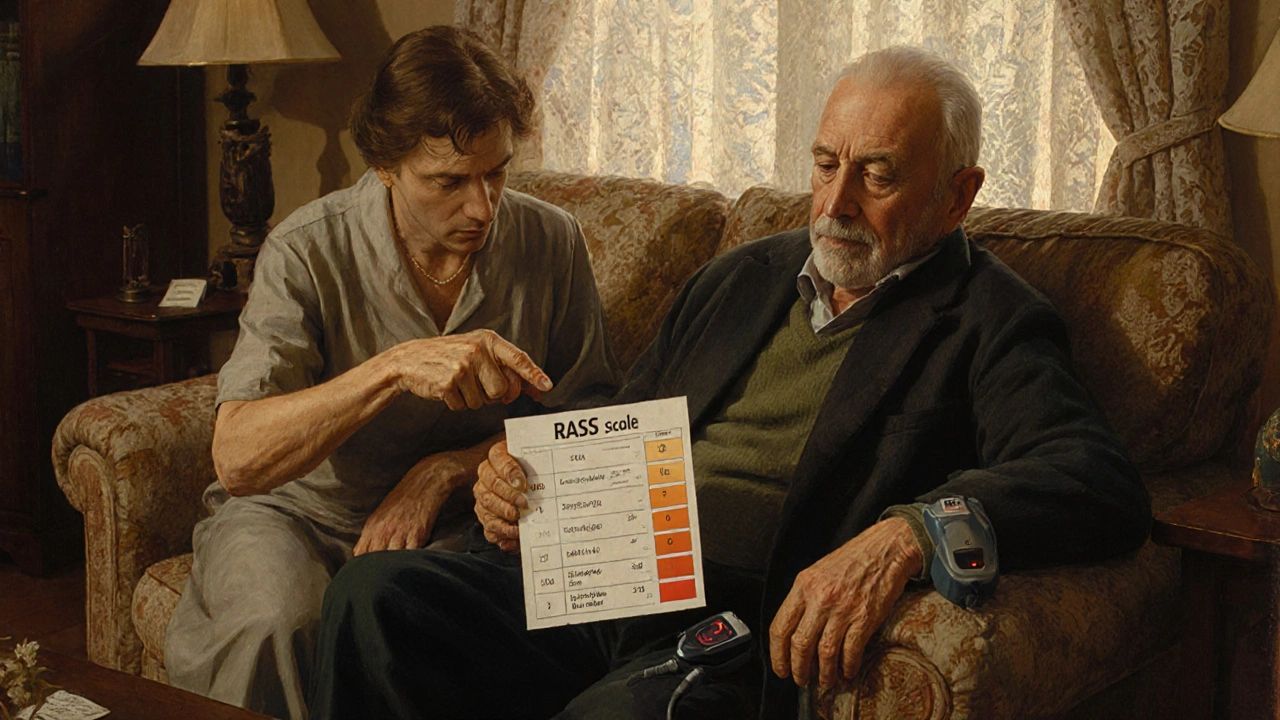
Richmond Agitation-Sedation Scale (RASS) - this is a simple tool nurses use to rate consciousness. It runs from +4 (combative) to -5 (unarousable). A score of -2 or lower means moderate to deep sedation. At -3 or below, the patient needs immediate attention. Training staff to use RASS consistently reduces overdoses by up to 41%, according to Mayo Clinic data.
Integrated Pulmonary Index (IPI) - a newer system that combines capnography, pulse oximetry, heart rate, and respiratory rate into one number from 1 to 10. A score below 7 means trouble. One nurse in Calgary reported catching a 78-year-old’s breathing drop at an IPI of 5.2 - 11 minutes before oxygen levels fell. That’s the kind of early warning that saves lives.
What Not to Do
Many mistakes happen because people rely on outdated practices:- Don’t use intermittent checks - checking every 15 or 30 minutes misses 78% of respiratory events. Continuous monitoring is non-negotiable for seniors.
- Don’t assume oxygen masks hide problems - supplemental oxygen masks can give false reassurance. Capnography is needed even when oxygen is on.
- Don’t use standard adult doses - seniors need 30-50% less medication. A common formula: dose = standard dose × (1 - 0.005 × (age - 20)). For a 75-year-old, that’s about 27% less than a 40-year-old’s dose.
- Don’t ignore skin fragility - continuous monitoring electrodes can tear fragile skin. Use hydrocolloid dressings under sensors to reduce injuries by 67%.
Setting Up a Safe Monitoring Protocol
If you’re caring for a senior at home or in a clinic, here’s how to set up a safe system:- Start with the lowest possible dose of sedative or opioid.
- Use continuous capnography + pulse oximetry. If you can’t afford both, capnography is the priority.
- Assign one person to monitor continuously - no multitasking.
- Check RASS every 15 minutes during sedation, and after any dose change.
- Keep naloxone (Narcan) immediately available. It reverses opioid overdose in minutes.
- Document every vital sign and every drug given - time, dose, route.
- Train everyone involved - nurses, aides, family caregivers - on RASS and how to recognize early signs.
These steps aren’t optional. The Joint Commission and CMS require them for reimbursement. More importantly, they prevent deaths.
Real Stories, Real Consequences
At a community hospital in Edmonton, a 90-year-old woman had a routine colonoscopy. She was on oxygen, her SpO2 stayed at 95%, and staff checked her every 15 minutes. She stopped breathing during the procedure. No one noticed until she turned blue. She survived, but suffered brain damage.At the same hospital, a few months later, another 82-year-old had the same procedure. This time, capnography and RASS were used. The capnography showed rising CO2. The RASS score dropped to -4. Staff stopped the procedure, reversed the sedation, and the patient woke up fully alert within 8 minutes.
The difference? One used outdated checks. The other used modern monitoring.
What’s Changing in 2025
New technology is making monitoring smarter. The FDA cleared the Opioid Risk Monitoring System (ORMS) in 2023. It links IV pain pumps to capnography and automatically pauses opioid delivery if breathing slows below 8 breaths per minute. In trials, it cut overdose events by 58% in seniors.Next-generation systems use machine learning to predict respiratory failure 20 minutes before it happens. These aren’t science fiction - they’re already being tested in major hospitals. But even the best tech can’t replace a trained person watching closely.
As Dr. Karen Posner, a leading expert in patient safety, said: “Technology gives you early warning. But only a human can decide what to do next.”
What You Can Do Today
You don’t need a hospital budget to protect a senior. Here’s your action plan:- Ask: “Are they being monitored continuously?” If the answer is no, push back.
- Learn the RASS scale - it’s free, simple, and available online from the American Society of Anesthesiologists.
- Keep naloxone at home if someone takes opioids regularly. Know how to use it.
- Never assume “they’re just sleepy.” Slowed breathing is the silent killer.
- Document everything. If something goes wrong, your notes could save a life - or prevent a lawsuit.
Over-sedation isn’t an accident. It’s a systems failure. But it’s also preventable. With the right tools, training, and attention, we can keep our seniors safe - not just alive, but alert, aware, and present.
What are the earliest signs of over-sedation in seniors?
The earliest signs are subtle: breathing slower than 8 breaths per minute, longer pauses between breaths, difficulty waking up, or becoming unusually quiet or unresponsive. These often happen before oxygen levels drop or skin turns blue. RASS scores below -2 are a clear clinical signal that intervention is needed immediately.
Can pulse oximetry alone detect opioid overdose in seniors?
No. Pulse oximetry measures oxygen in the blood, but if a senior is on supplemental oxygen, their SpO2 can stay above 90% even while they’re dangerously hypoventilating. This is called silent hypoxia. Capnography, which measures carbon dioxide in exhaled breath, detects respiratory depression 12-14 minutes earlier than pulse oximetry in elderly patients.
How much should sedative doses be reduced for seniors?
Seniors over 60 typically need 30-50% less sedative than younger adults. A practical formula is: dose = standard adult dose × (1 - 0.005 × (age - 20)). For an 80-year-old, that means using about 40% less than the standard dose. Always start low and go slow.
Is capnography necessary for home care?
For home care, continuous capnography isn’t always practical - but it’s ideal if available. If not, focus on frequent checks of breathing rate, responsiveness, and skin color. Use a pulse oximeter with alarms set at 90%. Keep naloxone on hand. The goal is to catch changes early, even without high-tech tools.
What should I do if I suspect an overdose?
Stop any further medication. Call 911 immediately. If you have naloxone, administer it according to instructions - it works within 2-5 minutes. Open the airway, check breathing, and begin rescue breathing if needed. Don’t wait for symptoms to worsen. Every minute counts.
Are there free tools to learn how to monitor seniors?
Yes. The American Society of Anesthesiologists (ASA) offers free RASS training materials online. The Anesthesia Patient Safety Foundation provides downloadable checklists for monitoring during sedation. Many hospitals also offer free caregiver workshops on overdose prevention - ask your local clinic or senior center.
Next Steps for Families and Caregivers
If you’re responsible for a senior’s care, start today:- Download the RASS scale from the ASA website and print it.
- Keep naloxone in the medicine cabinet - not locked away.
- Ask the doctor: “What’s the dose adjustment for their age?” Write it down.
- Teach everyone who helps care for them - even grandchildren - the signs of trouble.
- Insist on continuous monitoring during any procedure, even if it’s “just a colonoscopy.”
Over-sedation doesn’t have to be a silent threat. With awareness, simple tools, and a little preparation, you can turn a high-risk situation into a safe one.
Sam Jepsen
November 25, 2025 AT 01:08Man, I wish my dad’s nursing home had this info years ago. He got put on morphine after a fall and just kinda faded out. We thought he was just tired. Turns out his breathing was down to 6 breaths a minute and no one noticed until his lips turned blue. Capnography? Never heard of it. This post is a godsend.
Just shared it with my whole family. We’re getting naloxone for the house this week.
Yvonne Franklin
November 25, 2025 AT 21:17Stop using standard doses for seniors. That’s not advice, that’s negligence. 30-50% reduction isn’t optional. It’s physics. Their liver isn’t broken, it’s just aging. Treat it like a 70-year-old car - you don’t pump premium gas into a carbureted engine and expect it to run fine.
Michael Fitzpatrick
November 26, 2025 AT 14:53You know, I’ve been thinking about this a lot lately. My grandma’s on a low dose of oxycodone for arthritis, and honestly, she’s been a little more spaced out than usual. I didn’t think much of it - she’s 84, she’s just getting older, right? But then I read this and I realized, maybe it’s not just aging. Maybe it’s the meds building up. I checked her breathing last night - 9 breaths per minute. Not terrible, but not great. I’m gonna get her a pulse oximeter and start tracking it. Not because I’m paranoid, but because I love her. And if I can catch something early, I owe it to her to try.
Also, I just downloaded the RASS scale. It’s actually really simple. Like, I could explain it to my 12-year-old. That’s powerful.
Holly Schumacher
November 26, 2025 AT 23:32Let me get this straight - you’re telling me hospitals are still using 15-minute checks for seniors on opioids? In 2025? This isn’t negligence, this is criminal. The Joint Commission requires continuous monitoring. If your facility isn’t using capnography, they’re not just cutting corners - they’re gambling with lives. And don’t even get me started on the fact that 78% of respiratory events are missed with intermittent checks. That’s not a statistic, that’s a massacre.
And you think oxygen masks hide the problem? Of course they do. It’s like putting a bandage on a severed artery and calling it ‘good enough.’
Someone needs to sue these institutions. Not just for malpractice - for moral failure.
Daniel Jean-Baptiste
November 27, 2025 AT 04:45Big thanks for laying this out so clear. I’m a caregiver for my aunt and we’ve been using the RASS scale since last month. It’s changed everything. She used to just say she was tired and we’d leave it at that. Now we check her every 15 mins. Score of -2? We call the nurse. Score of -3? We call 911. Simple. No drama. Just action.
Also got naloxone from the pharmacy - they gave it to me for free. Just asked. No prescription needed. Crazy how easy it is if you just ask.
And yeah capnography is ideal but if you cant afford it just watch breathing and skin color. Its not perfect but its better than nothing
Rahul Kanakarajan
November 28, 2025 AT 22:45Why are we even talking about this like it’s new? This has been common knowledge in geriatric nursing since the 90s. You think your grandma’s the first person to get over-sedated? No. She’s just the first one you cared enough about to look up. Most families don’t even know what a pulse oximeter is. And you wonder why seniors die quietly.
Stop acting like this is a revelation. It’s just the tip of the iceberg. The system’s broken. You’re just now noticing.
New Yorkers
November 30, 2025 AT 17:59Here’s the uncomfortable truth: we don’t care about the elderly until they’re dying. We treat them like walking time bombs until they’re silent. Then we’re shocked. We optimize for productivity, not presence. We medicate to pacify, not to heal. And then we call it ‘care’.
This isn’t about capnography or RASS. It’s about a culture that sees aging as failure. We don’t want to watch someone fade. So we numb them. And then we pretend we’re helping.
The real overdose isn’t in the morphine. It’s in our indifference.
David Cunningham
December 2, 2025 AT 04:17Been using a home pulse oximeter on my old man for six months now. He’s got COPD and takes meloxicam daily. SpO2’s usually around 92-94. But I noticed last week his breathing slowed down even though his oxygen was fine. So I started timing his breaths - 7 per minute. Didn’t tell him. Just called his doc. They cut his dose by 40%. He’s been more alert since. No drama. Just quiet adjustments.
Also got the RASS chart printed and taped to the fridge. My wife says it looks like a restaurant menu. I say it’s saving his life.
luke young
December 2, 2025 AT 23:12My sister works in a long-term care unit and she told me they just got a new monitoring system that beeps if breathing drops. She said it saved two lives last month. One guy was on oxygen, looked fine, but his EtCO2 was climbing. They reversed it before he turned blue. She cried after. Said she’s never seen a machine so quiet but so loud with meaning.
Anyway, I’m getting naloxone for my mom. She’s 81, on gabapentin. I don’t know if she needs it - but I’d rather have it and not need it than need it and not have it.
Jessica Correa
December 4, 2025 AT 10:02Just got back from visiting my mom in rehab. They’re using the IPI system now. One number. 1 to 10. She was at 5.8. Staff didn’t wait. They stopped the meds, gave her oxygen, and she woke up 10 minutes later. No brain damage. No trauma. Just a quiet, smart system working. I’m not a nurse. I didn’t know any of this. But now I do. And I’m telling everyone. This isn’t just medical info. It’s a lifeline.