

Medication-Induced Hypertension Risk Checker
Check Your Medication Risks
Enter medications you're currently taking (prescription, OTC, supplements) to see if they might be raising your blood pressure.
Medications identified:
Next Steps
Most people assume high blood pressure is just a result of age, weight, or genetics. But what if it’s not you-it’s your medicine? Around 2 to 5% of all high blood pressure cases are directly caused by common drugs you might be taking right now. That’s millions of people whose blood pressure spikes not because they’re eating too much salt or skipping workouts, but because of something their doctor prescribed-or they picked up over the counter. This isn’t rare. It’s overlooked. And it’s fixable.
What Medications Actually Raise Blood Pressure?
You don’t need a prescription to trigger a dangerous spike in blood pressure. Over-the-counter painkillers like ibuprofen (Advil, Motrin) are among the most common culprits. In people with existing high blood pressure, taking 400 mg of ibuprofen three times a day can push systolic pressure up by 5 to 10 mm Hg in just two weeks. That’s enough to push someone from controlled to dangerously high. Naproxen (Aleve) is a bit safer, but still raises BP in 5 to 7% of users.
Corticosteroids like prednisone are even more potent. At doses above 20 mg per day for more than four weeks, up to 60% of patients develop hypertension. Some see their systolic pressure jump 15 mm Hg within 24 hours. This isn’t just a side effect-it’s a direct physiological response. Steroids mimic aldosterone, making your kidneys hold onto sodium and water. Your blood volume increases. Your pressure follows.
Antidepressants, especially SNRIs like venlafaxine (Effexor), can spike blood pressure too. At doses over 150 mg per day, 8 to 15% of users see clinically significant increases. It’s not depression causing the rise-it’s the drug blocking norepinephrine reuptake, which turns up your sympathetic nervous system like a volume knob. Decongestants like pseudoephedrine (Sudafed) do the same thing, constricting blood vessels and raising systolic pressure by 5 to 10 mm Hg within hours. Even your ADHD meds-amphetamine salts or methylphenidate-can raise BP in 10 to 25% of users, with dextroamphetamine posing the highest risk.
And it’s not just pills. Erythropoietin (Procrit), used for anemia, causes hypertension in 20 to 30% of patients. HIV medications (HAART) increase systolic pressure in about 18% of users, especially in older adults. Even herbal supplements like St. John’s Wort have been linked to hypertensive crises when mixed with other meds.
How Your Body Reacts to These Drugs
Not all drugs raise blood pressure the same way. Understanding the mechanism helps you spot the problem faster.
NSAIDs like ibuprofen block enzymes that help your kidneys get rid of sodium and water. Less sodium excretion = more fluid in your bloodstream = higher pressure. Studies show ibuprofen can reduce kidney blood flow by 15 to 20% within two hours. That’s not just a side effect-it’s kidney stress.
Corticosteroids bind to mineralocorticoid receptors, tricking your body into thinking it needs to hold onto salt. At 30 mg of prednisone per day, plasma volume can increase by 10% in just three days. Your heart pumps harder. Your arteries tighten.
Decongestants like pseudoephedrine activate alpha-adrenergic receptors in your blood vessels. This causes immediate vasoconstriction. One study showed a 25 to 30% increase in peripheral resistance within an hour of taking 60 mg. That’s like squeezing a garden hose-pressure builds up fast.
Antidepressants like venlafaxine flood your system with norepinephrine. Plasma levels can jump 300 to 400% at high doses. Your heart races. Your vessels clamp down. Blood pressure climbs.
These aren’t random reactions. They’re predictable, measurable, and preventable-if you know what to look for.
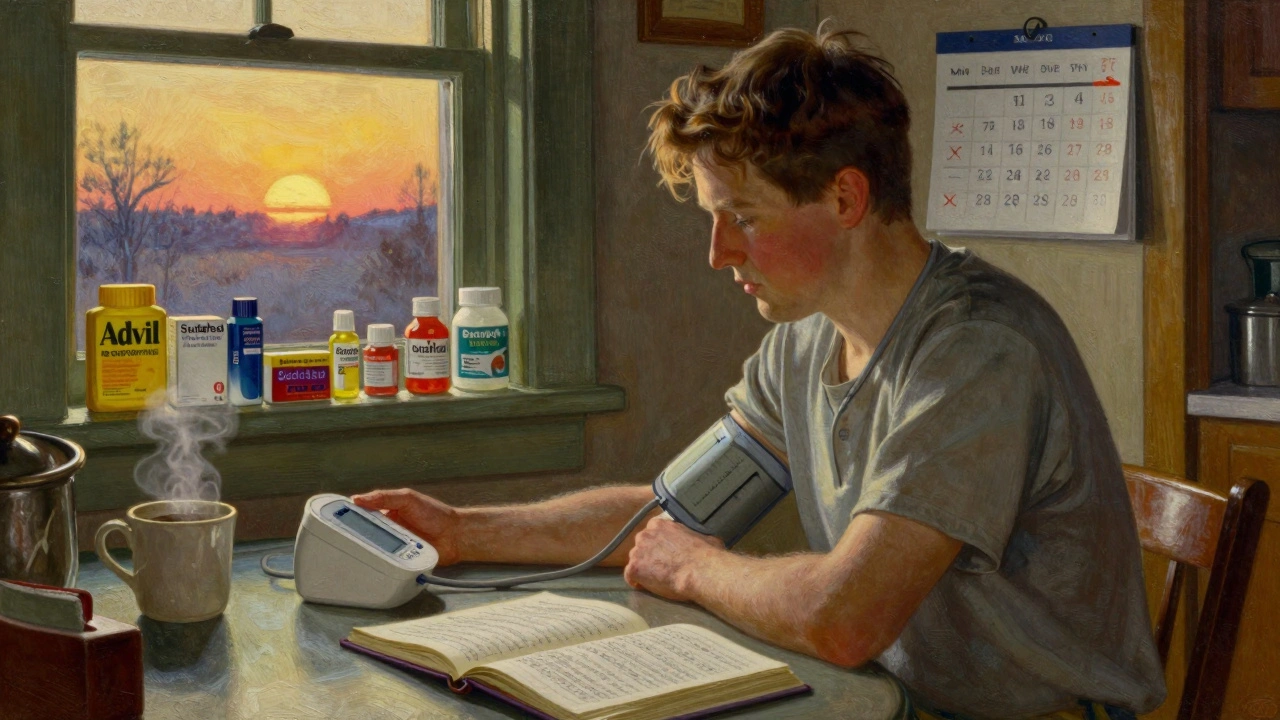
When and How to Monitor Your Blood Pressure
Monitoring isn’t optional if you’re on one of these drugs. You need a plan.
Before starting any medication known to raise BP, get a baseline reading. Then check again at one to two weeks, then four to six weeks. If you’re on steroids, check daily for the first month. Pay attention to orthostatic changes-if your blood pressure drops more than 20/10 mm Hg when you stand up, that’s a red flag.
Home monitoring is key. Take readings twice a day (morning and evening) for seven days before starting the drug, and again after any dose change. Use the average of the second six days. Don’t rely on a single office visit. Blood pressure fluctuates. Stress at the clinic can mask or mimic a problem.
For high-risk patients-those with kidney disease, existing hypertension, or taking multiple BP-raising drugs-ambulatory blood pressure monitoring (ABPM) is the gold standard. It tracks your pressure over 24 hours. A daytime average above 135 mm Hg systolic, or a 24-hour average above 130 mm Hg, confirms drug-induced hypertension.
Most doctors don’t order ABPM unless you’re resistant to treatment. But if your pressure started climbing after you began a new medication, that’s your clue. Don’t wait for a crisis. Ask for it.
How to Manage It-Step by Step
Step one: Stop the drug-if you can. For NSAIDs, stopping often brings BP back to normal in 2 to 4 weeks. Same with decongestants. For many, switching to acetaminophen (Tylenol) is enough. Celecoxib (Celebrex), a COX-2 inhibitor, raises BP by only 2.4 mm Hg on average-half the impact of ibuprofen.
If you can’t stop the drug-say you need prednisone for an autoimmune flare-then treat the high blood pressure. First-line options? Calcium channel blockers like amlodipine, or thiazide diuretics like hydrochlorothiazide. These work directly against the fluid retention and vasoconstriction caused by the offending drugs.
Don’t use beta-blockers as your first choice. They’re only 45% effective against drug-induced hypertension, compared to 72% for calcium channel blockers. Why? Because beta-blockers slow your heart, but they don’t undo the vasoconstriction or sodium retention. Your vessels are still tight. Your pressure stays high.
Lifestyle changes help too. Cut sodium to under 1,500 mg per day. Boost potassium to 2,500-3,500 mg per day with foods like bananas, spinach, sweet potatoes, and beans. Exercise 150 minutes a week-brisk walking counts. These changes alone can lower BP by 5 to 8 mm Hg.
And here’s something no one tells you: Review every medication you take-not just prescriptions. Herbal supplements, OTC cold meds, even energy drinks can interfere. A 2023 Reddit thread with nearly 300 comments from people with high BP revealed that 68% said they were never warned about NSAIDs affecting their pressure. That’s a system failure.
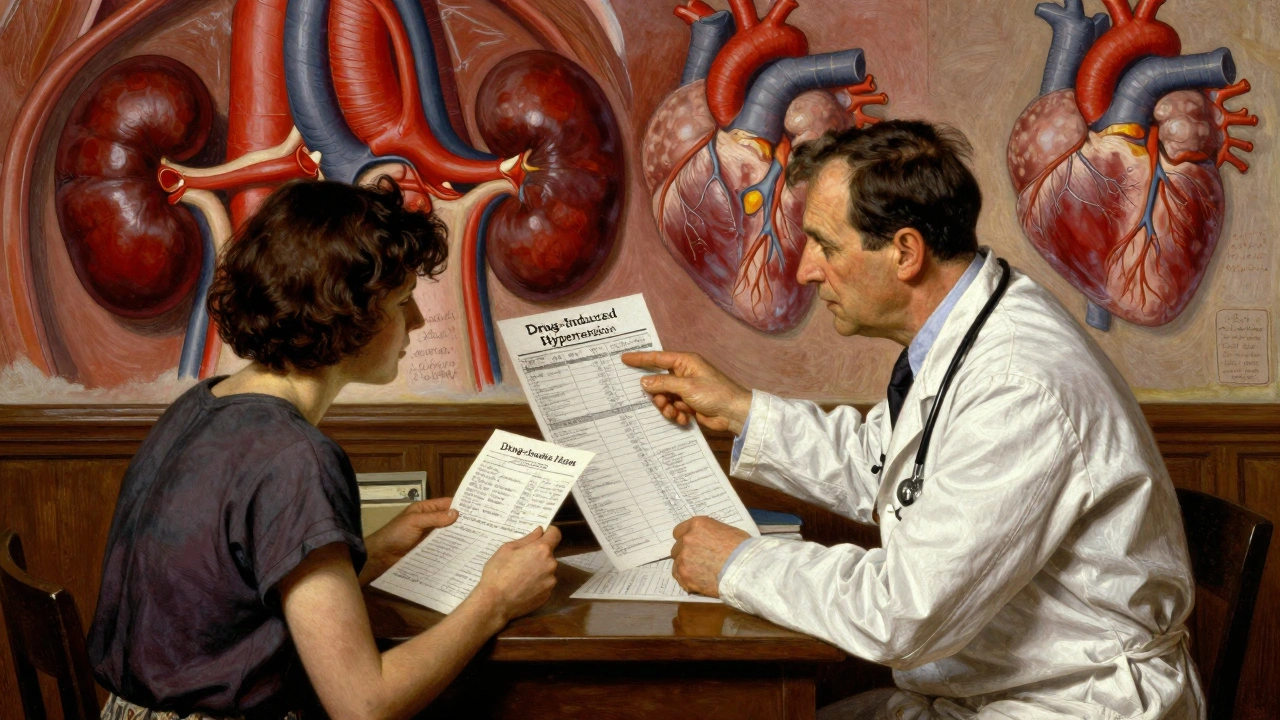
Why Doctors Miss This-And What You Can Do
Studies show only 22% of primary care providers routinely ask hypertensive patients about NSAID use. Only 58% of doctors can correctly identify all 12 high-risk medication classes. Many assume patients know to avoid certain drugs. They don’t.
Patients often don’t think of OTC meds as “medicine.” They take Advil for a headache. Sudafed for a cold. St. John’s Wort for mood. None of these are flagged in their medical records. And if their BP rises, the doctor blames stress, weight, or aging.
One patient on Zocdoc shared: “My doctor caught that my sinus med was causing 160/100 readings. Switched me to a non-decongestant version-my BP normalized in three weeks.” That’s what good care looks like.
You can demand better. Bring a full list of everything you take-prescriptions, supplements, OTCs, even caffeine intake-to every appointment. Write it down. Don’t rely on memory. Ask: “Could any of these be raising my blood pressure?” If your provider doesn’t know, ask for a referral to a hypertension specialist.
There’s a new tool from the American College of Cardiology called the Drug-Induced Hypertension Calculator. It’s built into some electronic health records. Ask if your clinic uses it. If not, print out the American Heart Association’s Medication-Induced Hypertension Checklist and bring it with you.
What’s Changing in 2025
Regulators are catching up. The FDA now requires stronger blood pressure warnings on NSAID labels. The European Medicines Agency updated corticosteroid guidelines in 2023. The American Heart Association has invested $8.5 million in research to build prediction models and better screening tools.
By 2027, the market for hypertension tech-including apps that flag drug interactions-is projected to hit $15.8 billion. Pharmacies are starting to integrate medication review systems. But until then, you’re your own best advocate.
The NIH-funded MED-BP study, testing pharmacist-led medication reviews in 45 clinics, showed a 28% drop in uncontrolled hypertension among participants. That’s not magic. That’s systematic checking. You can replicate that at home: write it down. Ask the questions. Track your numbers.
High blood pressure from medication isn’t a life sentence. It’s a signal. A warning. And with the right information, it’s reversible.
Can over-the-counter painkillers really raise blood pressure?
Yes. Ibuprofen (Advil, Motrin) can raise systolic blood pressure by 5 to 10 mm Hg in people with existing hypertension after just two weeks of regular use. Naproxen (Aleve) has a smaller effect, but still poses a risk. Acetaminophen (Tylenol) and celecoxib (Celebrex) are safer alternatives for pain relief.
How long does it take for blood pressure to return to normal after stopping the medication?
For NSAIDs and decongestants, blood pressure often normalizes within 2 to 4 weeks after stopping. For corticosteroids, it may take longer-up to 6 to 8 weeks-especially if used for more than a month. The timeline depends on the drug, dose, and how long it was taken.
Should I stop taking my medication if my blood pressure goes up?
Never stop a prescribed medication without talking to your doctor. Some drugs, like steroids or antidepressants, need to be tapered slowly. But you should report the rise in blood pressure immediately. Your doctor can help you switch to a safer alternative or add a blood pressure medication to counteract the effect.
Are herbal supplements safe for people with high blood pressure?
No. Some herbal supplements like St. John’s Wort, licorice root, and ephedra can significantly raise blood pressure. Many people don’t realize these are drugs too. Always tell your doctor about every supplement you take-even if you think it’s “natural.”
What’s the best way to track my blood pressure at home?
Use a validated upper-arm monitor. Take two readings in the morning and two in the evening, one minute apart, for seven days. Don’t count the first day’s readings. Average the rest. Record the numbers and bring them to your appointments. This gives your doctor a clear picture-not just a snapshot.
Can lifestyle changes help reverse medication-induced high blood pressure?
Yes. Reducing sodium to under 1,500 mg per day, increasing potassium intake to 2,500-3,500 mg per day, and getting 150 minutes of brisk walking per week can lower blood pressure by 5 to 8 mm Hg. These changes support your body’s ability to recover after stopping the offending medication.
Eddy Kimani
December 2, 2025 AT 09:50Interesting breakdown. The NSAID-induced BP spike is underreported in clinical practice. I’ve seen it in my rheumatology patients-ibuprofen at 800mg TID can elevate systolic by 10–15 mmHg in 14 days flat. The renal vasoconstriction mechanism is well-documented in the JAMA Internal Medicine meta-analysis from 2022. Most patients don’t connect the dots until their BP meds get upped unnecessarily.
Chelsea Moore
December 4, 2025 AT 03:43HOW DARE YOU?! PEOPLE ARE DYING BECAUSE DOCTORS ARE LAZY AND PHARMACIES AREN’T WARNED!!! I TOOK IBUPROFEN FOR A WEEK AND MY BP WENT TO 180/110!!! MY DOCTOR SAID IT WAS ‘STRESS’!!! I’M JUST A WOMAN, SO MY SYMPTOMS DON’T COUNT, RIGHT?!?!?!?!
John Biesecker
December 5, 2025 AT 15:39man. i just realized my daily advil for back pain might be the reason my bp’s been creeping up. i thought it was just aging 😅. i’m gonna switch to tylenol and see what happens. also, who knew steroids could trick your kidneys like that? mind blown. 🤯
Genesis Rubi
December 6, 2025 AT 09:30USA has the best healthcare system but you guys still let people die from OTC meds? This is why Europe is ahead. Even my cousin in Berlin gets a BP check before they prescribe anything. Here? You get a pill and a shrug. Pathetic.
Doug Hawk
December 8, 2025 AT 06:30the steroid mechanism is fascinating-mineralocorticoid receptor agonism leading to volume expansion. But clinically, the real issue is the lack of baseline monitoring. If you don't check BP before starting prednisone, you're flying blind. I’ve seen patients on 40mg daily for 3 weeks with no follow-up. That’s negligence, not care.
Kristen Yates
December 8, 2025 AT 14:13I’ve been on venlafaxine for 3 years. My BP was normal until I hit 225mg. My doctor never mentioned it. I only found out because I started checking at home. I lowered the dose and added potassium. BP dropped 12 points. I’m glad I paid attention.
Saurabh Tiwari
December 9, 2025 AT 11:48in india too, people take combiflam and ibuprofen like candy. no one thinks it's medicine. my uncle had bp 190/110 and he said 'i just took painkiller for headache'... doctor was shocked. we need awareness here too
Michael Campbell
December 10, 2025 AT 18:27Big Pharma knows this. They don’t warn you because they make more money selling you BP meds on top of the original drug. It’s a cycle. And your doctor? They’re paid by the system. They don’t want to admit they’re part of the problem.
Victoria Graci
December 11, 2025 AT 19:59It’s not just the drugs-it’s the silence around them. We treat hypertension like a moral failure: ‘You didn’t eat right, you didn’t exercise.’ But what if the culprit is the very thing meant to heal you? That’s a tragedy wrapped in a prescription bottle. The body doesn’t lie. It just screams in silent, measurable numbers.
Saravanan Sathyanandha
December 13, 2025 AT 17:23This is an excellent and timely piece. In many developing nations, self-medication with NSAIDs is rampant due to limited access to physicians. The absence of routine BP screening in primary care settings exacerbates the issue. Pharmacist-led interventions, as mentioned in the MED-BP study, could be transformative if scaled globally. We must prioritize medication reconciliation as a standard of care, not an afterthought.