

Why Your Ears Feel Clogged (And Why It’s Not Just Wax)
You’re on a plane, descending. Your ears pop, but the pressure doesn’t go away. Or maybe you’ve had a cold for a week, and your hearing feels muffled, like you’re underwater. You try swallowing, yawning, even chewing gum-nothing helps. That’s not just a stuffy nose. That’s Eustachian tube dysfunction, or ETD.
The Eustachian tube is a tiny canal, about 35 millimeters long, connecting your middle ear to the back of your throat. Its job? To balance pressure between your ear and the outside world. Every time you swallow or yawn, it opens briefly to let air in or out. When it gets blocked-thanks to a cold, allergies, or even sinus inflammation-it stays shut. Air gets trapped inside your middle ear, then slowly absorbed. That creates negative pressure, pulling your eardrum inward. Result? That heavy, stuffed-up feeling. Muffled hearing. Maybe even a quiet ringing or popping sound.
It’s not rare. In fact, about 1.5 million Americans see a doctor for it every year. Most cases start after a cold or flu. Around 68% of people with ETD had an upper respiratory infection right before symptoms showed up. Allergies? That’s another 22%. And if you fly often, drive through mountains, or use elevators in tall buildings, you’re more likely to notice it.
What ETD Actually Feels Like (Not What You Think)
People often confuse ETD with an ear infection. But there’s a big difference.
With an ear infection (acute otitis media), the pain is constant, sharp, and usually worse at night. Your ear might feel hot. You might have a fever. ETD? The pain is usually mild, intermittent, and tied to pressure changes. You might feel fine sitting at your desk, then get hit with a dull ache as the plane lands.
Here’s what ETD really feels like, based on patient reports:
- Fullness or pressure in one or both ears (87% of cases)
- Hearing that sounds distant or muffled (92% of cases)
- Popping, clicking, or crackling when you swallow
- Tinnitus-a soft ringing or buzzing (65% of people)
- Feeling slightly off-balance or dizzy (42%)
- Ear pain that comes and goes (38%)
Here’s the kicker: a doctor looking in your ear with an otoscope might see nothing unusual. That’s because the tube itself is hidden deep inside. The eardrum might look normal-even if it’s pulled inward by negative pressure. That’s why ETD is often missed or misdiagnosed.
And if your ear pain is constant and severe? That’s not ETD. That’s something else-like an infection or, very rarely, a growth in the back of your nose. Don’t ignore that.
Why It Happens (And Why Kids Get It More)
The Eustachian tube in adults is angled downward, making it easier to drain. In kids under 7, it’s shorter, straighter, and narrower-like a flat pipe. That makes it way easier to block. That’s why kids get ear infections and ETD so often.
But adults aren’t immune. Here’s what triggers it most:
- Upper respiratory infections (colds, flu) - 68%
- Allergies (hay fever, dust, pet dander) - 22%
- Sinus infections - 10%
- Smoking or secondhand smoke - irritates the lining
- Altitude changes - flying, driving through mountains, scuba diving
And if you’ve got chronic sinus issues or nasal polyps? You’re at higher risk. The lining of the tube swells up, gets sticky, and won’t open properly. It’s not just a one-time thing-it can become a cycle.
Some people get ETD after a single flight. Others have it for months. If symptoms last longer than 3 weeks, fluid can build up behind the eardrum-called serous otitis media. That can drop your hearing by another 20-50 decibels. You might start missing parts of conversations. Or feel like everyone’s mumbling.
What Works: Simple Relief Techniques (That Actually Do)
Most cases of ETD clear up on their own in 1-2 weeks. But you don’t have to sit there waiting. Here’s what works, based on what patients report and what doctors recommend.
1. Swallowing and Yawning
It sounds too simple. But it’s the #1 thing people try-and it works for 78% of them. Every time you swallow, your throat muscles tug open the Eustachian tube. So chew gum. Suck on hard candy. Drink water often. Yawn wide. Seriously. Try yawning with your mouth open and your head tilted back. You’ll feel it pop.
2. The Valsalva Maneuver
This is the classic move: pinch your nose shut, close your mouth, and gently blow out. Like you’re trying to pop your ears. Do it 3-5 times an hour when symptoms flare.
But here’s the catch: 45% of people do it wrong. They blow too hard. That can hurt your eardrum or push mucus deeper. You want a gentle, steady pressure-not a blast. Think of it like inflating a balloon slowly, not popping a balloon.
3. The Toynbee Maneuver
Same as Valsalva, but you swallow while pinching your nose. Some people find this easier. Try it with a sip of water.
4. Chewing Gum
It’s not just for fresh breath. Chewing for 10-15 minutes every 2 hours keeps the muscles moving. Sugar-free is best if you’re doing it all day.
5. Steam and Humidity
Hot showers help. So does a humidifier. Moist air reduces swelling in the nasal passages and throat, which can ease pressure on the tube. If you’re in Calgary and it’s -20°C outside, dry air is your enemy.

When to Try Medicine (And What to Avoid)
If home tricks don’t help after 5-7 days, consider medicine. But don’t guess. Here’s what works-and what doesn’t.
Decongestant Nasal Sprays (Like Afrin)
They shrink swollen tissues fast. But here’s the rule: Never use them for more than 3 days. After that, they cause rebound congestion-your nose gets worse than before. That’s called rhinitis medicamentosa. It’s real. And it’s painful.
Steroid Nasal Sprays (Like Flonase)
This is the better long-term option. Fluticasone or mometasone reduce inflammation in the nasal passages and Eustachian tube lining. You need to use them daily for 2-4 weeks to see results. No immediate pop. But over time, the swelling goes down. It’s safe for most people, even long-term.
Antihistamines
Only help if allergies are the cause. If you’ve got hay fever and your ears are clogged, a non-drowsy antihistamine like loratadine might help. But if it’s just a cold? Skip it. They dry out mucus too much, which can make ETD worse.
Antibiotics?
No. The American Academy of Otolaryngology says not to use them for ETD unless there’s clear evidence of infection. Most ETD is not bacterial. Antibiotics won’t fix a blocked tube. And they come with side effects-diarrhea, yeast infections, resistance.
Surgery? It’s More Common Than You Think
If you’ve tried everything for 3+ months and still feel like your ears are stuffed with cotton? You might need a procedure.
Two options are now standard:
1. Myringotomy with Tubes
A tiny incision is made in the eardrum. A small tube is inserted to let air in and drain fluid. Common in kids. Adults get it too-especially if fluid keeps building up. Tubes stay in 6-12 months, then fall out on their own. Quick procedure. Local anesthesia. You’re back to work the same day.
2. Balloon Dilation (BDET)
This is the newer, less invasive option. A tiny balloon is threaded up the nose, into the Eustachian tube, and inflated for 2 minutes. It gently stretches the tube open. Done in-office. Takes about 20 minutes. Local numbing. No cuts. No tubes.
Success rates? About 67% at 12 months. Some people get relief for years. Others need a repeat. But compared to older surgeries, it’s low-risk and effective. The number of these procedures has jumped 220% since 2018.
There’s also research into bioabsorbable stents-tiny devices that dissolve after supporting the tube for a few weeks. Early results show 85% symptom improvement in 3 months. Not widely available yet, but coming.
Red Flags: When to See a Doctor Right Away
ETD is usually harmless. But some signs mean something else is going on.
- Severe, constant ear pain
- Fever over 38.5°C
- Drainage from the ear (pus or blood)
- Sudden hearing loss
- Dizziness or vertigo that lasts more than a day
- One-sided symptoms that don’t improve with time
These could mean an infection, a ruptured eardrum, or-very rarely-a tumor in the nasopharynx. Less than 0.5% of ETD cases are cancer, but it’s real. If one ear stays blocked for months and nothing helps, get it checked.
What Doesn’t Work (And Why You Should Skip It)
There’s a lot of advice out there. Most of it’s useless.
- Ear candles - Dangerous. They don’t remove wax or pressure. They can burn your ear.
- Oil drops - Might feel soothing, but won’t open a blocked tube.
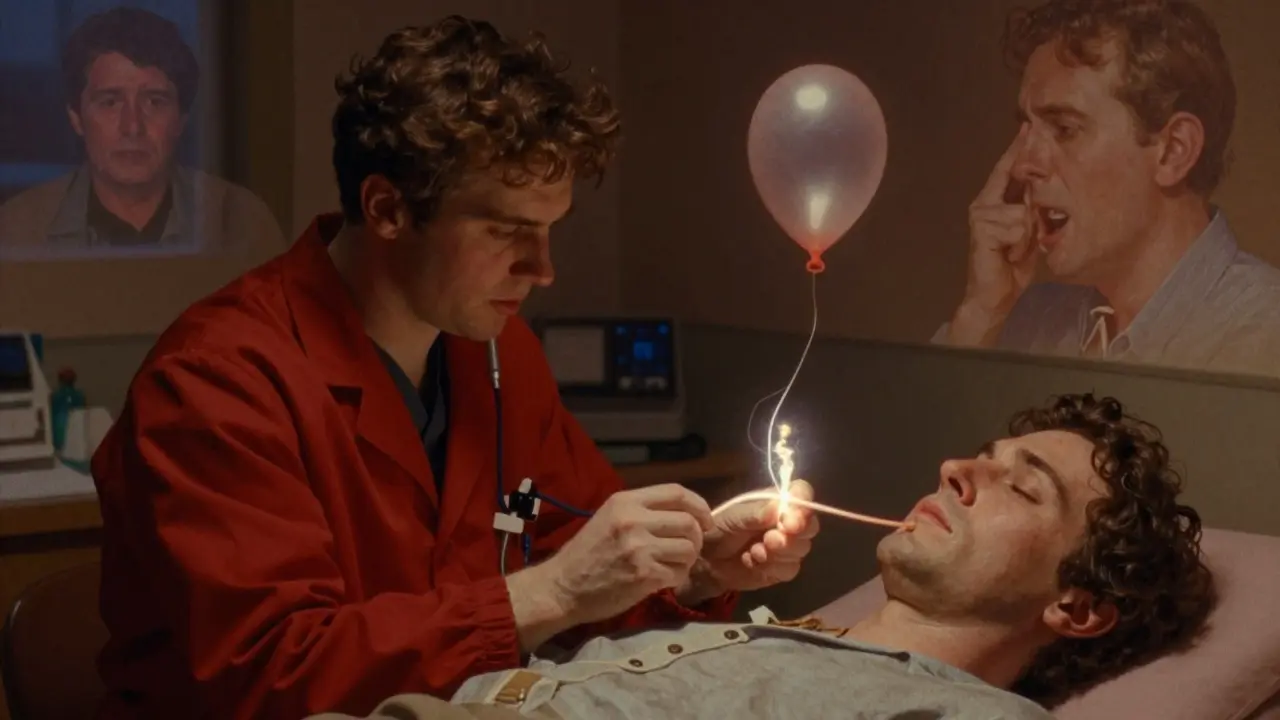
- Blowing up balloons - Not the same as Valsalva. Doesn’t target the Eustachian tube.
- Herbal supplements - No proven benefit for ETD.
Stick to science-backed methods. Your ears will thank you.
How Long Does It Last? Real Timelines
Let’s be clear: ETD doesn’t follow a calendar. But here’s what most people experience:
- Days 1-7: Symptoms peak. Try swallowing, yawning, steam, and gentle Valsalva.
- Days 8-14: 70% of cases resolve on their own. If you’re still stuck, start steroid spray.
- Weeks 3-4: If no improvement, see an ENT. You might need imaging or a hearing test.
- Months 2-3: Chronic ETD. Time to talk about balloon dilation or tubes.
Don’t wait six months hoping it’ll get better. The longer the tube stays blocked, the more fluid builds up-and the harder it is to fix.
What’s Next? The Future of ETD Care
Doctors are moving away from cutting and drilling. The trend is clear: less invasive, faster recovery, better outcomes. Balloon dilation is now the go-to for chronic cases. Research is looking at targeted drug delivery right into the tube. Some labs are even testing wearable devices that gently stimulate the tube with pressure pulses.
One thing won’t change: ETD will keep happening. With more people flying, more allergies, and more pollution, it’s not going away. But now, we have better tools to fix it.
Prakash Sharma
January 7, 2026 AT 17:19Donny Airlangga
January 8, 2026 AT 13:46swati Thounaojam
January 9, 2026 AT 18:44Aubrey Mallory
January 10, 2026 AT 15:54Dave Old-Wolf
January 11, 2026 AT 20:57Molly Silvernale
January 11, 2026 AT 22:57Ken Porter
January 13, 2026 AT 21:48Annette Robinson
January 15, 2026 AT 09:37Manish Kumar
January 16, 2026 AT 10:24Kristina Felixita
January 17, 2026 AT 16:22Joanna Brancewicz
January 18, 2026 AT 10:01Evan Smith
January 20, 2026 AT 05:07Lois Li
January 21, 2026 AT 23:56christy lianto
January 23, 2026 AT 08:24Luke Crump
January 23, 2026 AT 12:11