

The FDA doesn’t test generic drugs on thousands of patients to prove they work like the brand-name version. Instead, it uses a smart, science-backed shortcut: dissolution testing. This isn’t just a lab routine-it’s the backbone of how the agency guarantees that a $5 generic pill delivers the same effect as its $50 brand-name counterpart.
Why Dissolution Testing Matters
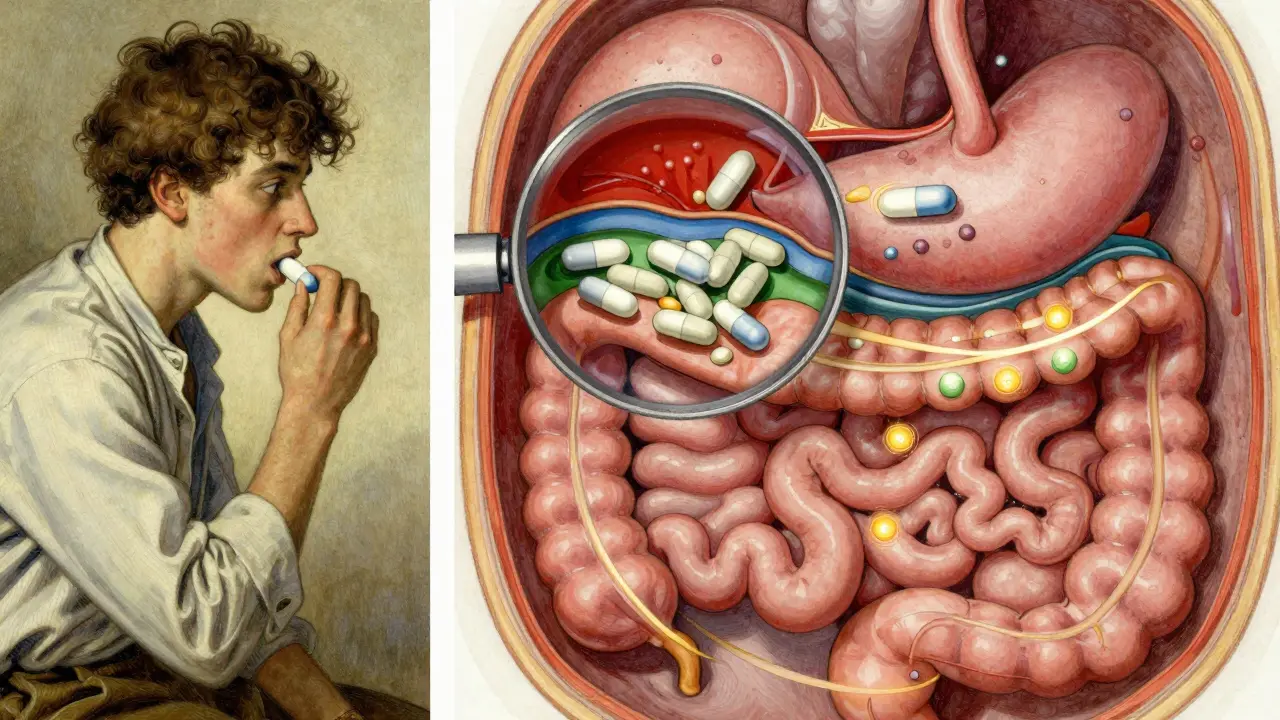
Imagine swallowing a pill. What happens next? The drug must dissolve in your stomach or intestines before it can enter your bloodstream and do its job. If it doesn’t dissolve at the right speed or in the right way, it won’t work. That’s why the FDA requires every generic drug to prove it releases its active ingredient the same way as the original brand drug. This isn’t guesswork. Dissolution testing is a controlled lab experiment that measures how quickly a drug dissolves under conditions mimicking the human digestive system. The FDA uses this data to predict whether the drug will behave the same inside the body-without needing to run expensive and time-consuming human trials every time.How the FDA Sets the Rules
The FDA doesn’t use one-size-fits-all rules. Each drug gets its own testing protocol based on its chemistry and how it’s meant to work. For example:- For fast-acting pills (immediate-release), the standard is simple: at least 80% of the drug must dissolve within 45 minutes.
- For high-solubility drugs (BCS Class I), like some painkillers or antibiotics, the FDA allows a single-point test at 30 minutes using 900 mL of 0.1N HCl. If the generic matches the brand’s dissolution profile, it can skip human bioequivalence studies entirely.
- For extended-release pills, the test gets more complex. Manufacturers must test under multiple pH levels (1.2, 4.5, and 6.8) to simulate different parts of the gut. They also test with alcohol-up to 40% ethanol-to make sure the pill doesn’t release all its drug at once if taken with a drink.
The FDA’s 2018 guidance on high-solubility drugs was a game-changer. It created clear, standardized methods for over 100 commonly used medications. Before this, every manufacturer had to invent their own test. Now, they can follow a proven recipe, cutting development time by months.
The f2 Similarity Factor: The Math Behind Equivalence
How do you know if two dissolution profiles are close enough? The FDA uses a statistical tool called the f2 similarity factor. It compares the dissolution curves of the generic and brand-name drug at multiple time points-usually every 10 to 15 minutes over 60 to 90 minutes.An f2 score of 50 or higher means the two profiles are statistically similar. That’s the green light. An f2 below 50? The FDA will ask for more data, better formulation, or even a new batch.
This isn’t just a number. It’s a direct link to real-world performance. A 2011 study from FDA scientist Dr. Lawrence Yu showed that dissolution testing reduced the need for human bioequivalence studies by more than 60% for certain drugs-without compromising safety.
What Happens If the Generic Doesn’t Match?
Sometimes, a generic drug dissolves differently than the brand-but still works in people. That’s rare, but it happens. When it does, the FDA doesn’t automatically reject it. Instead, they look at the full picture: dissolution data, bioavailability results, and manufacturing controls.In some approved cases, the FDA has set different dissolution specifications for the generic than for the brand. Why? Because the generic’s formulation might use different excipients or particle sizes that change dissolution but don’t affect absorption. The agency accepts this if clinical data confirms the drug still works.
But if a generic dissolves too fast or too slow-especially for drugs with narrow therapeutic windows like warfarin or levothyroxine-the FDA will block approval. A 10% difference in dissolution rate can mean the difference between a safe dose and a dangerous one.
Who Gets to Skip Human Testing?
The FDA lets manufacturers skip human bioequivalence studies for certain drugs using a system called the Biopharmaceutics Classification System (BCS). It groups drugs by solubility and permeability:- Class I: High solubility, high permeability → Biowaiver possible
- Class II: Low solubility, high permeability → Dissolution test must be discriminatory
- Class III: High solubility, low permeability → Biowaiver under review
- Class IV: Low solubility, low permeability → Full bioequivalence study required
For Class I drugs, if the generic matches the brand’s dissolution profile under standardized conditions, the FDA considers it bioequivalent without a single human subject. This saves companies millions and gets life-saving generics to market faster.
As of 2023, the FDA’s Dissolution Methods Database includes recommended testing protocols for over 2,800 drug products. Manufacturers check this database before starting development to avoid reinventing the wheel.

What Happens After Approval?
Approval isn’t the end. The FDA’s SUPAC-IR guidelines require manufacturers to prove that any change-switching suppliers, changing factory floors, adjusting tablet hardness-doesn’t alter the drug’s dissolution profile.That means if a company changes the granulation process, they must test the new batch against the original approved batch. If the f2 score drops below 50, they need FDA approval before selling it. This keeps quality consistent over time, even as production scales up.
Challenges Manufacturers Face
Developing a valid dissolution method isn’t easy. For complex drugs-especially those with low solubility-it can take 6 to 12 months. Scientists must test dozens of variables: buffer pH, agitation speed, apparatus type (USP Apparatus 1 or 2), volume, and sampling times.One major headache? Proving the method is “discriminatory.” That means it can tell the difference between a good formulation and a bad one. For low-solubility drugs, a method that dissolves 80% in 45 minutes might not catch a formulation that’s 10% slower in the body. The FDA requires methods that are sensitive enough to detect those small but clinically meaningful differences.
Documentation is another hurdle. ANDA submissions include 50 to 100 pages of dissolution method development data. Every step-from instrument calibration to data analysis-must be recorded and justified.
The Bigger Picture
Dissolution testing is more than a regulatory box to check. It’s a tool that balances safety, speed, and science. It lets the FDA approve hundreds of generic drugs each year without testing them on people. It saves patients money. It keeps the supply chain stable.And it’s evolving. In 2022, the FDA started exploring biowaivers for Class III drugs-those with high solubility but poor absorption. If approved, this could expand the list of drugs that skip human trials even further.
By 2025, experts predict that 35% of generic approvals will rely on standardized dissolution testing to cut development time. That’s up from 25% in 2020. The trend is clear: the more the FDA refines these methods, the faster safe, affordable generics reach patients.
At its core, dissolution testing is about trust. The FDA doesn’t assume generics are equal. It proves it-through science, data, and strict standards. That’s why you can trust a $5 pill to do the same job as its $50 name-brand twin.
What is dissolution testing in generic drugs?
Dissolution testing is a lab procedure that measures how quickly a generic drug releases its active ingredient under controlled conditions that mimic the human digestive system. It’s used by the FDA to prove the drug behaves the same way as the brand-name version, without needing human trials.
How does the FDA decide if a generic drug is bioequivalent?
The FDA uses dissolution testing as the primary indicator. For many drugs, if the generic’s dissolution profile matches the brand’s using the f2 similarity factor (f2 ≥ 50), it’s considered bioequivalent. For drugs that don’t qualify for a biowaiver, the FDA still requires human bioequivalence studies, but dissolution data is always part of the review.
What is the f2 similarity factor?
The f2 similarity factor is a statistical tool the FDA uses to compare dissolution profiles between a generic and brand-name drug. It calculates how similar the two curves are across multiple time points. An f2 score of 50 or higher means the profiles are statistically equivalent. A score below 50 usually triggers a request for more data or reformulation.
Can a generic drug be approved even if it dissolves differently than the brand?
Yes, but only if clinical data proves it works the same in the body. The FDA may allow different dissolution specifications if the generic uses different ingredients that don’t affect absorption. This is rare and requires strong evidence. Most of the time, matching the brand’s dissolution profile is required for approval.
What drugs can skip human bioequivalence studies?
Drugs classified as BCS Class I-high solubility and high permeability-can skip human studies if their dissolution profile matches the brand’s under standardized FDA conditions. Examples include some antibiotics, painkillers, and blood pressure medications. The FDA’s 2018 guidance made this process clearer and more consistent for over 100 common drugs.
Why does the FDA test with alcohol?
For extended-release pills, alcohol can cause the drug to release too quickly-a dangerous effect called “dose dumping.” The FDA tests these drugs with up to 40% ethanol to make sure they won’t release their entire dose at once if taken with alcohol. This protects patients from overdose risks.
How often does the FDA update its dissolution guidelines?
The FDA updates its guidelines regularly, especially as new science emerges. The most recent major update was in September 2023, which clarified that all dissolution methods-whether from USP, FDA, or company-developed-must be validated and proven to distinguish between good and poor formulations. The agency also maintains a live database of recommended methods for over 2,800 drugs, updated monthly.
What is the USP Dissolution Test?
The USP (United States Pharmacopeia) publishes standardized dissolution methods in General Chapters <711> and <724>. If a brand-name drug uses a USP method, the generic must use the same one. The FDA requires compliance with these methods when they exist. If no USP method exists, manufacturers must develop and validate their own, comparing it directly to the brand’s profile.
Lance Nickie
January 13, 2026 AT 13:09lol so u mean i can just swap my $50 pill for a $5 one and itll do the same thing? wild.
Priyanka Kumari
January 15, 2026 AT 11:02This is actually one of the most elegant examples of regulatory science in action. The FDA didn’t just rely on assumptions-they built a framework grounded in pharmacokinetics, biopharmaceutics, and statistical rigor. Dissolution testing isn’t a shortcut; it’s a precision tool. For patients in low-income countries, this means life-saving meds become accessible without compromising safety. Brilliant stuff.
John Pope
January 17, 2026 AT 02:18Let’s be real-this whole system is a philosophical paradox. The FDA claims to trust science, but they’re essentially betting the entire pharmacopeia on a dissolution curve. What if the stomach isn’t a beaker? What if bioavailability isn’t just about dissolution but about microbiome interactions, gastric emptying time, or even emotional stress altering absorption? We’re reducing human physiology to a lab metric. That’s not science-it’s reductionist idolatry.
And don’t get me started on f2. A statistical score of 50? That’s like saying two songs are ‘the same’ because their BPM is within 10%. What about the soul of the drug? The patient experience? The placebo effect that’s still scientifically measurable? We’re not just approving pills-we’re approving a myth.
Acacia Hendrix
January 19, 2026 AT 02:07Actually, the f2 metric is deeply flawed. It assumes linearity in dissolution kinetics, which is absurd for complex formulations like enteric-coated or multiparticulate systems. The FDA’s reliance on it is a classic case of regulatory inertia masquerading as innovation. And don’t even mention the USP methods-they’re often outdated, poorly validated, and inconsistently applied across labs. This isn’t science; it’s bureaucratic theater with a lab coat.
Lethabo Phalafala
January 19, 2026 AT 09:18I’ve been on levothyroxine for 12 years. Switched generics three times. Once, I felt like I was drowning in fatigue. Another time, I was jittery as hell. My doctor said ‘it’s the same pill.’ But my body knew better.
They say dissolution = bioequivalence. But my body isn’t a beaker. And if you’ve ever had your thyroid meds change and your heart start racing at 3 a.m.? You know this isn’t just math. This is personal.
I’m not anti-generic. I’m pro-trust-but trust needs to be earned, not calculated.
Damario Brown
January 20, 2026 AT 20:04yo so like if u take a generic with alcohol and it dumps all the drug at once… that’s basically a drug overdose right? why is this not in the news? this is like a silent epidemic. people are dying and no one’s talking about it. the fda is asleep at the wheel. also, who even uses 0.1n hcl? that’s not even real stomach acid. this whole system is a scam.
Adam Vella
January 21, 2026 AT 03:44The assertion that dissolution testing eliminates the need for human bioequivalence studies is misleading. While BCS Class I drugs may qualify for biowaivers, the assumption that solubility and permeability are the sole determinants of bioavailability ignores interindividual variability in transporter expression, first-pass metabolism, and gut wall integrity. The FDA’s framework, while statistically sound, is biologically reductive. A true understanding of bioequivalence requires integrating pharmacogenomics, not relying on surrogate endpoints derived from in vitro dissolution profiles.
Furthermore, the f2 similarity factor is not validated for nonlinear release profiles, yet it is routinely applied to extended-release formulations. This constitutes a regulatory gap with clinical implications.
Scottie Baker
January 21, 2026 AT 05:47you people are overthinking this. i’ve taken generic Adderall for 8 years. sometimes it works, sometimes i feel like a zombie. the company changed the filler. they don’t even tell you. it’s a fucking lottery. the fda doesn’t care. they just want to save money. and we’re the ones paying with our bodies.
Avneet Singh
January 22, 2026 AT 17:29How quaint. You’re all acting as if dissolution testing is some groundbreaking innovation. The USP has had standardized dissolution methods since the 1950s. What’s truly novel is the FDA’s willingness to outsource regulatory judgment to statistical algorithms while ignoring the biological complexity of human physiology. It’s not science-it’s neoliberal technocracy dressed in lab coats. And the fact that you’re celebrating this as ‘efficiency’ is the real tragedy.