

Why Prescription Labels Use Symbols and Abbreviations
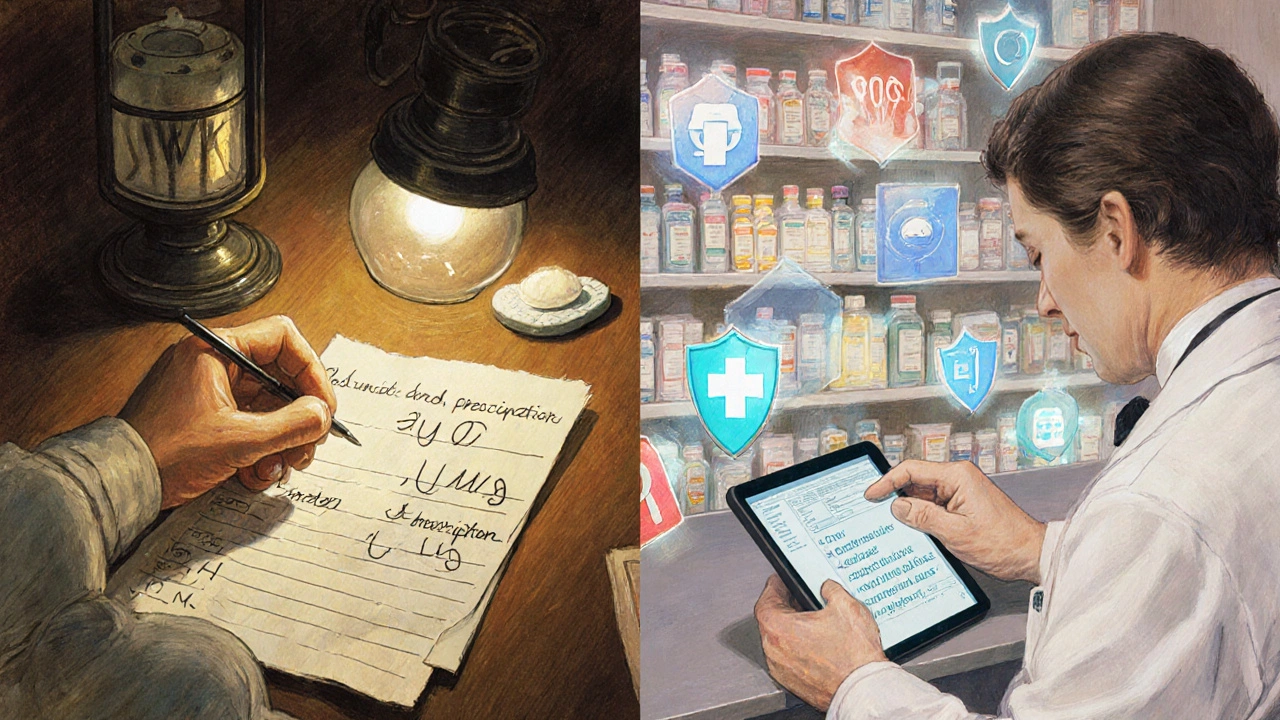
Ever looked at your prescription label and felt like you’re reading a secret code? You’re not alone. Those tiny letters and symbols - like Rx, q.d., or o.d. - aren’t there to confuse you. They’re leftovers from centuries of medical tradition, designed to save time for doctors and pharmacists. Back in the 1500s, Latin was the universal language of medicine across Europe. A doctor writing in Latin ensured that a pharmacist in Rome, Paris, or London would understand the same instruction. That’s where Rx comes from - it’s a stylized version of the Latin word recipe, meaning "take."
But here’s the problem: what started as a tool for efficiency has become a source of danger. In 2022, the Institute for Safe Medication Practices found that nearly 7 out of every 100 medication errors in U.S. hospitals were tied to confusing abbreviations. A single misread symbol can mean the difference between the right dose and a life-threatening mistake.
The Most Common Abbreviations - and the Mistakes They Cause
Some abbreviations are so common, you might think they’re harmless. But they’re not. Take q.d. - it stands for quaque die, or "daily." Sounds simple, right? But in handwritten prescriptions, it often looks like q.i.d. (four times a day). That’s why the Joint Commission banned q.d. in 2004. Pharmacists now see "daily" written out - no abbreviations.
Then there’s o.d. and o.s.. These mean "right eye" and "left eye" in Latin. But in a hurry, a patient or even a pharmacist might read o.d. as "overdose." In 2022, the American Academy of Ophthalmology reported that 12.3% of eye medication errors came from this exact confusion. That’s why Walmart, CVS, and Walgreens now print "right eye" and "left eye" on patient labels - no Latin allowed.
And don’t forget U for units. That one’s deadly. A nurse once gave a patient 10 units of insulin because they misread "10U" as "100." The patient went into a coma. The Joint Commission banned U in 2001. Now, every prescription must say "units." Same with IU for international units - it’s been confused with "IV" (intravenous), leading to fatal infusions. Today, it’s always "international units."
What’s on Your Label - and What’s Not
Your prescription label doesn’t show every abbreviation the doctor used. Pharmacies convert them. If your doctor wrote "BID," your label says "twice daily." If they wrote "SC," you’ll see "under the skin." That’s not a mistake - it’s a safety feature.
But here’s where things get messy. Not every prescriber uses electronic systems. Many still write prescriptions by hand, especially in rural clinics or urgent care centers. A 2023 survey by the American Society of Health-System Pharmacists found that 68% of community pharmacies still get handwritten prescriptions with dangerous abbreviations. The top offenders? MS (morphine sulfate or magnesium sulfate?), QD (daily?), and SC (subcutaneous or sublingual?).
That’s why pharmacists double-check. At CVS or Walgreens, every prescription goes through a three-step system: an automated system flags risky abbreviations, a pharmacist reviews it, and then the label is rewritten in plain English for you. It’s not just procedure - it’s the last line of defense.
Why Some Doctors Still Use Abbreviations
If these abbreviations are so risky, why do doctors still use them? For some, it’s habit. For others, it’s speed. Writing "BID" takes less time than "twice daily." In a busy clinic with 40 patients a day, every second counts. A 2024 Doctors.net.uk survey found that 57% of UK doctors resisted switching to full English terms after the NHS banned abbreviations in 2019 - not because they didn’t care about safety, but because it added 3 to 5 seconds per prescription.
But here’s the truth: those seconds add up. The American Hospital Association estimates that 14,287 medication incidents in 2023 were linked to abbreviations. One of the most common? "1.0 mg" misread as "10 mg." That’s why the Joint Commission requires leading zeros (0.5 mg) and bans trailing ones (1.0 mg). A tiny rule - huge impact.
What’s Changing - and What’s Coming
The world is moving away from Latin abbreviations - fast. The World Health Organization’s 2023 Global Patient Safety Challenge requires all countries to eliminate non-English abbreviations by 2030. Australia, Canada, and Germany are already halfway there. In the U.S., the U.S. Pharmacopeia’s new rules, effective May 1, 2024, require all prescribers to use plain English. Exceptions? Only metric units like mg, mL, and mcg.
Electronic prescribing systems are making this easier. Epic and Cerner now auto-convert t.i.d. to "three times a day" and flag MS as a danger. IBM Watson’s MedSafety AI, used in 178 U.S. hospitals, converts abbreviations with 99.2% accuracy. By 2027, the American Medical Informatics Association predicts 95% of prescriptions will be fully English - no Latin, no symbols, no guesswork.
But the transition isn’t smooth. Johns Hopkins found that during partial adoption, error rates spiked by 22.3%. Why? Because some systems still accept old abbreviations while others don’t. A doctor might type "q.d." in one system, and it gets converted. But if they write it on paper and fax it, the pharmacy has to catch it manually. That’s why training matters.
What You Can Do to Stay Safe
You don’t need to memorize Latin. But you do need to be your own safety net. Here’s how:
- Ask for plain English. If your label says "BID," ask, "Does this mean twice a day?"
- Check the dose. If it says "0.5 mg," make sure it’s not written as ".5 mg" - missing the leading zero is a red flag.
- Know your meds. If you’re taking insulin, morphine, or eye drops, ask what the instructions mean. Don’t assume.
- Use your pharmacy’s app. Most chains now let you view your prescription details online. Look for the "Directions" section - it should say "take once daily," not "q.d."
- Report confusion. If something doesn’t make sense, call your pharmacist. They’d rather hear from you than have you take it wrong.

The Real Cost of a Misread Symbol
It’s not just about safety - it’s about money. The Agency for Healthcare Research and Quality estimates that abbreviation-related medication errors cost U.S. hospitals $2.17 billion in 2023. Each error averages $8,742 in extra care, extended stays, and legal costs. Hospitals that fully adopted plain-language policies saw a 37.6% drop in errors - and saved millions.
And it’s getting worse. The Centers for Medicare & Medicaid Services now tie hospital reimbursements to safety compliance. Starting in 2024, hospitals with high rates of abbreviation errors could lose millions in funding. That’s why big chains are investing in AI tools and staff training - not just to protect patients, but to protect their bottom line.
What’s Next for Prescription Labels
Soon, your prescription label won’t just be in plain English - it might be interactive. Some pharmacies are testing QR codes that link to short videos explaining how to take the medication. Others are adding voice instructions via apps. The goal? No more guessing. No more symbols. Just clear, simple, safe instructions - in the language you understand.
It’s the end of an era. The Latin abbreviations that once made medicine feel like a scholarly tradition are fading - not because they’re outdated, but because they’re too dangerous to keep. And that’s a good thing.
What does Rx mean on a prescription label?
Rx comes from the Latin word "recipe," which means "take." It’s not a symbol for a drug - it’s an instruction to the pharmacist: "Take this and prepare it." You’ll see it at the top of every prescription, whether it’s handwritten or electronic. It has nothing to do with the medication itself - it’s just the start of the order.
Is q.d. the same as daily?
Yes, q.d. means "daily," from the Latin "quaque die." But because it’s often misread as q.i.d. (four times daily), the Joint Commission banned its use in 2004. Today, all prescriptions and labels must say "daily," not "q.d." If you see "q.d." on your label, ask your pharmacist - it should have been changed.
Why do some labels say o.d. and others say right eye?
o.d. means "oculus dexter," or right eye, in Latin. But because patients and even staff have confused it with "overdose," most pharmacies now replace it with "right eye" on patient labels. If you see o.d. on a doctor’s note, that’s fine - but your final label should say "right eye." If it doesn’t, ask for clarification.
Are abbreviations like BID and TID still allowed?
Prescribers can still write BID (bis in die) or TID (ter in die) on paper prescriptions, but pharmacies are required to convert them to "twice daily" and "three times daily" on your label. Electronic systems often auto-convert them too. The key is that you, as the patient, should never see those abbreviations on your final instructions - only plain English.
What should I do if I see U or IU on my prescription?
You shouldn’t see U or IU on your final label. If you do, contact your pharmacist immediately. "U" for units was banned in 2001 because it’s been confused with "0" or "4," leading to fatal overdoses. "IU" for international units has been confused with "IV," causing dangerous IV infusions. Both must be written out as "units" or "international units." If your doctor wrote "U," your pharmacist should have corrected it. If they didn’t, speak up.
Can I ask my pharmacist to explain every abbreviation on the label?
Absolutely. Pharmacists are trained to explain your medications - not just how to take them, but why. If you see anything unclear, even if it’s just a word you don’t recognize, ask. There’s no such thing as a silly question when it comes to your safety. Most pharmacies offer free counseling sessions - use them.
Final Thoughts: Trust, But Verify
The system is getting better. Technology, regulations, and training are slowly eliminating the dangerous symbols of the past. But until every doctor, pharmacy, and system is fully on board, you’re still the most important safety check. Don’t assume. Don’t guess. If it looks odd, ask. Your health depends on it.
Corra Hathaway
November 22, 2025 AT 00:32Shawn Sakura
November 22, 2025 AT 10:55Paula Jane Butterfield
November 23, 2025 AT 23:51Plain language isn’t just safer-it’s kinder. Every patient deserves to understand their meds without a Latin dictionary.
Simone Wood
November 25, 2025 AT 06:06Swati Jain
November 26, 2025 AT 13:01Florian Moser
November 26, 2025 AT 17:13jim cerqua
November 27, 2025 AT 11:13Donald Frantz
November 27, 2025 AT 12:57Julia Strothers
November 28, 2025 AT 00:22Noah Fitzsimmons
November 28, 2025 AT 20:08Eliza Oakes
November 29, 2025 AT 02:32