

When you take a generic pill, you expect it to work just like the brand-name version. But behind that simple promise is a highly controlled environment-cleanroom standards-that make it possible. These aren’t just guidelines. They’re legal requirements enforced by regulators like the FDA and EMA to ensure every dose of a generic drug is safe, effective, and identical in performance to the original. For generic manufacturers, meeting these standards isn’t optional-it’s the difference between staying in business and facing a recall that costs millions.
What Are Cleanroom Standards and Why Do They Matter?
Cleanroom standards are a set of strict environmental controls designed to prevent contamination during drug manufacturing. They regulate things like airborne particles, microbes, temperature, humidity, and even how people move through the facility. The goal? To make sure nothing foreign gets into the medicine-no dust, no bacteria, no human skin cells, no invisible contaminants that could change how the drug works. For generic drugs, this is especially critical. Unlike brand-name drugs, generics don’t run new clinical trials. Instead, they must prove they’re bioequivalent-meaning they release the same amount of active ingredient at the same rate in the body. If contamination alters the drug’s structure or stability, that equivalence breaks. And regulators will reject the application. The foundation of these standards comes from Current Good Manufacturing Practices (cGMP), first codified by the FDA in 1978. Today, the most widely referenced framework is the ISO 14644-1 standard, which classifies cleanrooms by particle count. The European Union’s Annex 1 (updated in 2023) is now the gold standard, requiring more rigorous monitoring and risk-based controls than ever before.The Four Grades of Cleanrooms and What They Mean
Pharmaceutical cleanrooms are divided into four grades, each with exact particle limits, airflow rules, and monitoring requirements. These aren’t arbitrary-they’re tied to how sensitive the drug product is.- Grade A (ISO Class 5): Used for sterile filling operations, like injecting drugs into vials. No more than 3,520 particles ≥0.5μm per cubic meter. Air flows in one direction at 0.36-0.54 m/s. Think of it as a surgical suite for drugs. Any breach here can lead to deadly contamination.
- Grade B (ISO Class 5 at rest, ISO Class 7 operational): The background area for Grade A operations. It’s where operators prepare materials before entering the sterile zone. Particle limits jump to 3.5 million during operations, but continuous monitoring is required.
- Grade C (ISO Class 7 at rest, ISO Class 8 operational): Used for non-sterile formulation, mixing, and packaging. Particle limits are 35 million during operations. Common for tablets and capsules.
- Grade D (ISO Class 8 at rest): The least controlled area, often for storage or pre-cleaning. Only monitored at rest, with a limit of 35 million particles. Still more controlled than a typical office.
Regulatory Differences: FDA vs. EU vs. Global
Not all cleanroom rules are the same. The FDA’s cGMP regulations (21 CFR Parts 210 and 211) focus on outcomes: “facilities must be designed to prevent contamination.” But they don’t specify ISO classes. The EU’s Annex 1, however, spells out exact equivalencies: Grade A = ISO 5, Grade B = ISO 7 operational, and so on. This creates a challenge for global manufacturers. A company producing a generic drug for both the U.S. and Europe must meet the stricter EU rules to avoid having shipments rejected. The FDA has signaled it will align with Annex 1, but until then, companies are stuck navigating two systems. Then there’s USP Chapter <797>, which governs compounding pharmacies. It allows ISO Class 7 buffer rooms for sterile compounding-much looser than the ISO Class 5 required for manufacturing sterile injectables. That’s why a hospital pharmacy can make a custom IV bag in a room that would never pass inspection for a generic drug plant. Japan’s Pharmaceutical Affairs Law adds another layer: it requires monitoring for particles at 1.0μm, not just 0.5μm. This means a cleanroom that meets U.S. and EU standards might still fail in Japan unless it’s upgraded.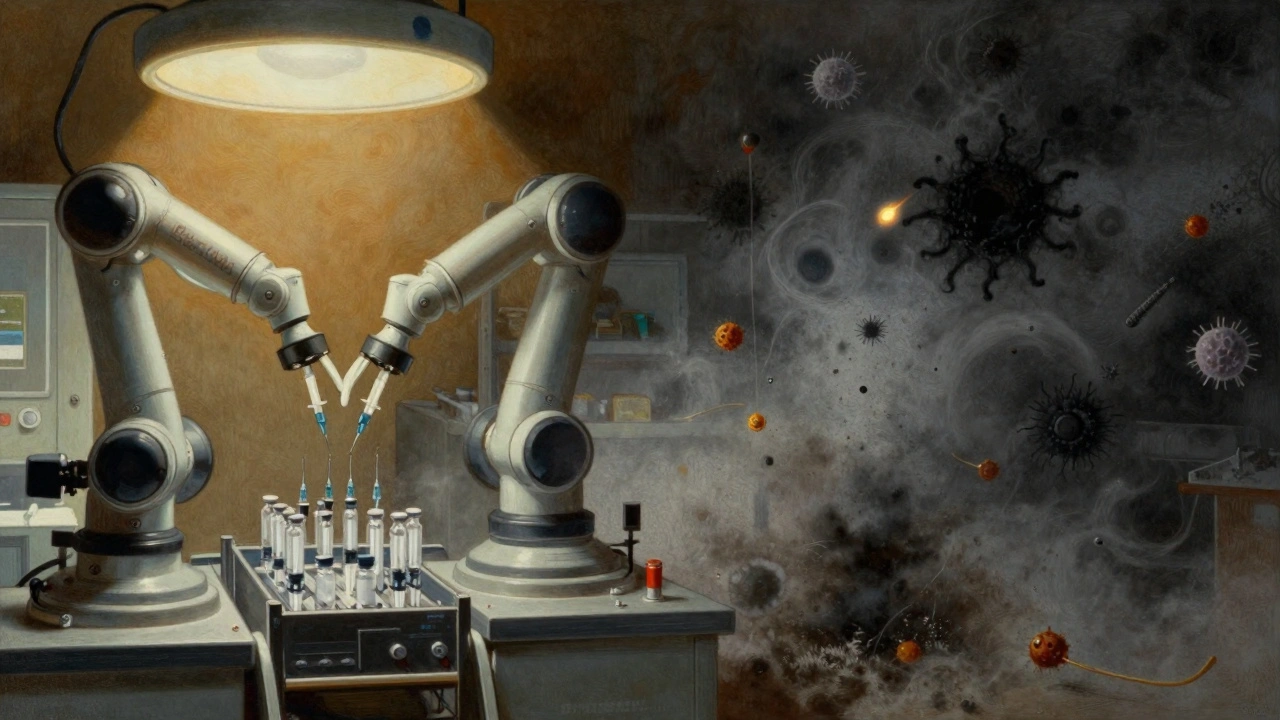
Costs and Challenges for Generic Manufacturers
Building and running a compliant cleanroom is expensive. For a Grade A environment, installation costs range from $250 to $500 per square foot. A small facility might need $5 million just to build. Then there’s the ongoing cost: energy for HVAC systems, HEPA filter replacements, continuous particle monitoring, and trained staff. Generic drug makers operate on thin margins-15% to 20% gross profit-compared to 70%-80% for innovator companies. That means every dollar spent on cleanrooms cuts into profits. One small manufacturer on Reddit shared that maintaining Grade A for a $0.50-per-unit heparin syringe made the product unprofitable after three FDA inspections flagged minor particle spikes. Training is another hidden cost. Personnel must undergo 40-60 hours of gowning and cleanroom behavior training before they’re allowed in. Even then, human error is the #1 cause of deviations. A 2022 G-Con survey found 42% of cleanroom failures came from improper gowning or movement. And it’s not just the hardware. Documentation is brutal. Companies need 15-20 standard operating procedures covering everything from cleaning schedules to how to respond to a particle alarm. One Pfizer facility spent $2.3 million and 14 months upgrading from Grade C to Grade B for a generic oncology drug. The payoff? 17 fewer out-of-spec batches per year-worth $8.5 million in avoided losses.Real-World Consequences: Successes and Failures
The stakes are high. In 2012, the New England Compounding Center’s failure to control mold and bacteria in its cleanroom led to a fungal meningitis outbreak that killed 64 people. That disaster changed everything. Today, cleanroom failures still happen. In 2022, Aurobindo Pharma received a consent decree and had to recall $137 million worth of sterile injectables because its Grade B monitoring system was inadequate. The FDA found missing data, uncalibrated sensors, and untrained staff. But there are success stories. Teva’s generic version of Copaxone was rejected twice before they installed advanced isolator technology in their Grade A zone. After the upgrade, contamination events dropped from 12 per year to just 2. The FDA approved it-and Teva now sells millions of doses globally.
What’s Changing in 2025?
Cleanroom standards aren’t static. The EU’s Annex 1 revision (August 2023) now requires continuous, real-time monitoring of particles and microbes-not just periodic samples. The FDA is expected to adopt similar rules soon. New technologies are helping. Robotics are being used to handle sterile products, reducing human contact. AI-powered monitoring systems can predict contamination risks before they happen. McKinsey predicts automation will cut cleanroom operational costs by 25-30% by 2028. But the biggest shift is in product complexity. More generics today are injectables, inhalers, and biosimilars-products that need Grade A/B environments. The FDA projects 50% of new generic applications by 2025 will require these high-grade cleanrooms, up from 35% in 2022.How to Stay Compliant
If you’re managing a generic drug facility, here’s what you need to focus on:- Map your cleanroom to the correct ISO grade based on product type.
- Install continuous monitoring systems for particles and microbes-don’t rely on manual sampling.
- Train staff relentlessly. Gowning, movement, and behavior matter as much as the filters.
- Validate every change. Even adding a new piece of equipment requires revalidation.
- Document everything. If it’s not written down, the FDA assumes it didn’t happen.
Final Thought: Quality Isn’t a Cost-It’s the Only Business Model
Cleanroom standards might feel like a burden. They’re expensive, complex, and constantly changing. But for generic drug manufacturers, they’re the foundation of trust. Patients don’t care if your drug is cheap. They care if it works. And regulators won’t approve a product that risks lives. The companies that survive aren’t the ones cutting corners. They’re the ones investing in cleanrooms as a core competency-not a compliance checkbox. In the long run, quality isn’t a cost. It’s the only thing that keeps you in business.What happens if a generic drug facility fails a cleanroom inspection?
Failure can lead to an FDA Form 483 listing violations, a warning letter, or even an import alert that blocks shipments. In severe cases, like Aurobindo Pharma’s 2022 case, companies face consent decrees requiring costly remediation and third-party audits. Product recalls can cost tens of millions. Repeated failures can lead to facility shutdowns.
Do all generic drugs need Grade A cleanrooms?
No. Only sterile products like injectables, eye drops, and inhalers require Grade A or B environments. Oral tablets and capsules typically only need Grade C or D. The requirement depends on how the drug is administered and whether it enters the bloodstream directly.
Is ISO 14644-1 the same everywhere?
The particle count standards in ISO 14644-1 are globally accepted, but how they’re applied varies. The EU mandates exact ISO equivalencies for each GMP grade. The FDA doesn’t specify ISO classes but expects equivalent control. Some countries, like Japan, add extra requirements like 1.0μm particle monitoring.
Can a generic drug be approved without meeting EU Annex 1 standards?
For the U.S. market, yes-FDA cGMP is sufficient. But if you want to sell in Europe or other regions that recognize Annex 1, you must comply. Many manufacturers build to Annex 1 from the start because it’s becoming the global benchmark. The FDA has signaled it will align with Annex 1 in upcoming guidance.
How often are cleanrooms tested for contamination?
Continuous monitoring is now required for Grade A and B areas under EU Annex 1. Particle counters run 24/7. Viable air sampling (for microbes) is done at least daily in Grade A, weekly in Grade C, and monthly in Grade D. Settle plates and surface swabs are also taken regularly. The FDA expects real-time data, not just periodic snapshots.
Saket Modi
December 1, 2025 AT 18:58bro why are we spending millions on fancy air filters for pills? just make em in a garage like the old days lol
Genesis Rubi
December 3, 2025 AT 12:27USA built the best pharma in the world and now we’re bowing to EU rules? smh. If it works, it works. Stop over-engineering medicine. 🇺🇸
Doug Hawk
December 4, 2025 AT 14:08the real issue isnt the iso grades its the human factor. 42% of failures from gowning? thats wild. you can have the cleanest room in the world but if someone sneezes while adjusting their hood, its all for naught. we need better behavioral training, not just better filters.
John Morrow
December 5, 2025 AT 18:17the notion that cleanroom standards are a 'cost center' is a fundamental misreading of pharmaceutical economics. they are the only barrier to market entry for substandard manufacturers. the $5M investment isn't an expense-it’s a moat. the companies that treat it as overhead are the ones that get 483s and vanish from the FDA database. this isn't compliance-it's survival architecture.
Kristen Yates
December 7, 2025 AT 02:13it's crazy to think that something as simple as a dust particle can make a medicine dangerous. we don't think about this stuff when we pop a pill. but someone, somewhere, is wearing a full suit just so we don't get sick.
Fern Marder
December 7, 2025 AT 12:12so let me get this straight… we’re spending $500/sq ft to keep out a single skin cell… but we still have opioid crises and drug shortages? 🤦♀️ someone’s priorities are messed up.
Carolyn Woodard
December 8, 2025 AT 04:17if we’re measuring contamination at 0.5 microns, are we not ignoring the philosophical question of what 'contamination' even means? is a human particle truly foreign if it comes from the person making the medicine? or is it just part of the human condition we’re trying to sanitize out of life? maybe the real contamination is our fear of imperfection.
Chris Wallace
December 9, 2025 AT 08:59the fact that a $0.50 heparin syringe became unprofitable after three inspections says everything about the system. we’re punishing the small guys for doing everything right. meanwhile, the big players have teams of lawyers and consultants to navigate the gray areas. it’s not about safety-it’s about market consolidation.
william tao
December 11, 2025 AT 02:44It is imperative to note, with the utmost gravity, that the regulatory divergence between the FDA and EMA constitutes a non-trivial impediment to global pharmaceutical harmonization. The absence of standardized ISO equivalency mandates, particularly in the context of Annex 1 implementation, introduces an unacceptable level of operational friction. This is not merely bureaucratic inefficiency-it is a systemic vulnerability.
Sheryl Lynn
December 12, 2025 AT 23:35cleanrooms are the last true cathedral of modern science. every HEPA filter is a prayer against chaos. every gowning procedure, a ritual. we don’t just make pills-we preserve the fragile pact between chemistry and humanity. if you think this is about profit margins, you’ve never held a vial that could save a child’s life.
Paul Santos
December 13, 2025 AT 21:45let’s be real-this is why most generics come from India and China. nobody wants to pay $5M for a room that smells like antiseptic and anxiety 😅. the west is outsourcing quality control while pretending it’s still leading. sad.
Eddy Kimani
December 13, 2025 AT 22:38robotics + AI monitoring = game changer. imagine a system that predicts contamination before it happens-like a weather forecast for microbes. this isn’t sci-fi, it’s happening in 3 labs right now. we’re on the edge of a new era. stay excited.
Chelsea Moore
December 14, 2025 AT 00:03AND YET… people still buy knockoff insulin from Instagram. WHAT IS WRONG WITH US?!?!?!!? we demand perfect medicine… but we’ll buy it from a shady guy with a “$10 off” sticker on his car. this isn’t just about cleanrooms-it’s about collective moral decay.
John Biesecker
December 15, 2025 AT 19:22you know what’s wild? we spend more on cleanrooms than on actual drug research sometimes. imagine if we put half that money into finding new treatments instead of just making the same pills in a cleaner room 🤔
Victoria Graci
December 16, 2025 AT 15:21the real tragedy isn’t the cost-it’s the silence. no one talks about the workers in those rooms. the ones who stand for 12 hours in full hazmat gear, sweating under the lights, never seeing the patient who takes the pill. they’re invisible. but without them? the whole system collapses. we owe them more than compliance reports-we owe them dignity.