

Medication Bag Checklist
What to Bring for Your Brown Bag Review
This checklist helps ensure you bring all your medications and supplements to your appointment. Bring everything you've taken in the last 30 days.
Medication Categories
Your Checklist Summary
Imagine this: You’re sitting in your doctor’s office, trying to remember every pill you take. You list your blood pressure medicine, your arthritis painkiller, and maybe your daily vitamin. But you forget the sleep aid your daughter gave you last month. Or the fish oil you started after reading an article. Or the leftover antibiotics from last winter. By the time you finish, you’ve left out nearly half your meds. And that’s exactly why brown bag medication review events exist.
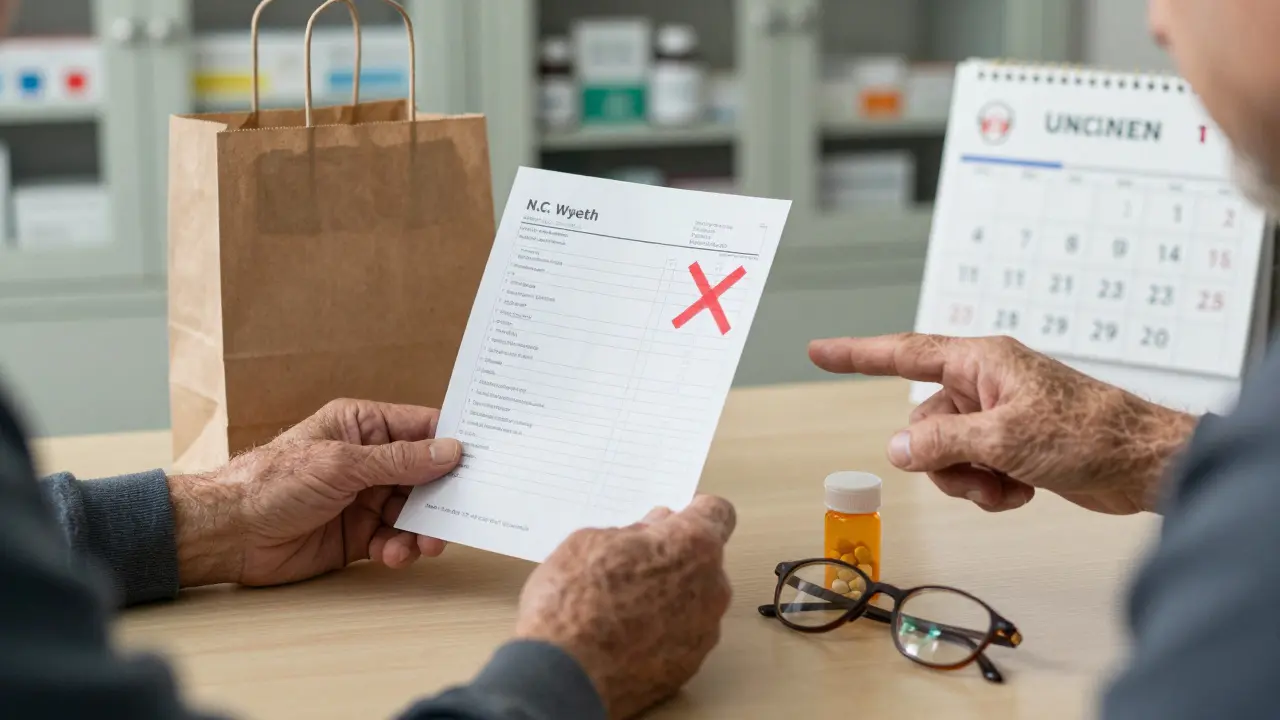
It’s not a fancy term. It’s simple. You gather every pill, capsule, cream, inhaler, patch, and supplement you take - in a brown paper bag - and bring it to your appointment. No lists. No guesswork. Just the real thing. This isn’t just a checklist. It’s a safety net. And for seniors in Canada and the U.S., it’s becoming the standard way to avoid dangerous mistakes.
Why Your Medicine Cabinet Is a Hidden Risk
Most people think they know what they’re taking. But the numbers don’t lie. A 2023 study by Home Helpers Home Care found that in nearly 7 out of 10 cases, patients were taking something they didn’t realize was harmful - either because of duplication, interaction, or just plain confusion. One man in Calgary was getting dizzy every afternoon. He thought it was aging. Turns out, he was taking two different beta blockers - one from his cardiologist, another from his family doctor. Both were for the same thing. He didn’t know. Neither did they.
Polypharmacy - taking five or more medications - affects 44.6% of seniors over 65, according to the National Poll on Healthy Aging. And that’s not even counting OTC drugs, supplements, or herbal remedies. Those aren’t harmless. They interact. They stack up. They cause falls, confusion, kidney damage, and even hospital stays. The Agency for Healthcare Research and Quality (AHRQ) says up to 20% of serious drug reactions in hospitals come from simple communication gaps. Not bad prescribing. Not bad medicine. Just bad information.
What Goes in the Brown Bag?
This isn’t about bringing your favorite vitamins. It’s about bringing everything. Every single thing you’ve taken in the last 30 days.
- All prescription medications - pills, inhalers, patches, eye drops, injectables
- All over-the-counter drugs - pain relievers, antacids, cold medicine, sleep aids
- All vitamins and minerals - even the ones you take “just because”
- All herbal supplements - turmeric, ginkgo, echinacea, St. John’s wort
- All topical creams and ointments - especially if you use them daily
- All unused or expired meds - yes, even the ones you haven’t touched in a year
Don’t sort them. Don’t throw anything away. Just put it all in the bag. The goal isn’t to impress your provider. It’s to help them see what you actually do, not what you think you do.
Many people feel embarrassed. They think, “I shouldn’t be taking so many.” Or, “I didn’t realize I was still on that.” But that’s exactly why this works. No judgment. Just clarity. One nurse in Edmonton told me about a 79-year-old woman who brought in 23 different bottles. Half were duplicates. Three were expired. Two were for conditions she no longer had. The doctor didn’t scold her. They just said, “Let’s fix this.”
How a Brown Bag Review Actually Works
This isn’t a 5-minute chat during your annual checkup. It’s a dedicated 30 to 45-minute session. You’ll sit with a pharmacist, nurse, or doctor who’s trained in medication reconciliation. They’ll go through each item. They’ll check:
- Is this medicine still needed?
- Is the dose right?
- Is there a duplicate?
- Are there dangerous interactions?
- Is there a simpler way to get the same result?
They’ll also look at expiration dates. You’d be surprised how many people are still taking pills from 2021. And they’ll ask: “When was the last time you took this?” Many seniors don’t know. They just grab the bottle.
The real magic happens when they use the “teach-back” method. Instead of just telling you what to do, they ask you to explain it back. “So, tell me how you take your blood thinner.” If you get it wrong - and many do - they correct it right then. Studies show this cuts confusion by 40% compared to just handing out a pamphlet.
Why This Beats a Written List
You might think, “I’ll just write down my meds.” But here’s the truth: When patients try to list their own medications, they get it wrong 80 to 87% of the time, according to AHRQ data. That’s not a typo. That’s almost everyone.
Why? Memory fails. Bottles get mixed up. Labels fade. You forget the name of that little white pill your cousin gave you. Or you think “as needed” means “whenever I feel like it.”
Compare that to a brown bag review: 92 to 95% accuracy. That’s not just better. That’s life-saving. One 2023 study found that in 68% of cases, a brown bag review caught a dangerous error - like someone taking both ibuprofen and naproxen, which can cause internal bleeding. Or mixing blood thinners with certain herbal supplements. Or taking three different sedatives from three different doctors.
Electronic lists? They’re better than memory. But they’re still only 45 to 60% accurate. Why? Because they don’t include what’s not in the system. Supplements. OTC drugs. Things bought at the corner store. Things your sister gave you. Things you didn’t tell your doctor about.

Who Needs This the Most?
If you’re over 65, you’re at higher risk. The average senior takes 4.7 prescriptions and nearly 2 OTC meds. That’s already a lot. Add supplements, and you’re often at 7 or 8 different substances. And that’s when things get risky.
But it’s not just seniors. If you see multiple doctors - say, a cardiologist, a rheumatologist, and a family doctor - you’re at risk for duplication. If you’ve been hospitalized recently, your meds may have changed. If you’ve had a change in memory, mobility, or vision, you might be taking meds incorrectly.
And if you’re a caregiver? This is your job too. You’re the one who helps your parent remember to take pills. You’re the one who knows they’re not sleeping right. You’re the one who notices they’re more confused than usual. Bring the bag. Ask the questions. Be the advocate.
How to Get Ready - Step by Step
Preparing for your brown bag review isn’t hard. But it does take a little time. Here’s how to do it right:
- Go through every drawer, cabinet, and bedside table. Don’t miss the bathroom or the car.
- Gather every bottle, box, packet, or tube - even if it’s empty.
- Don’t throw anything away. Even expired meds. The provider needs to see them.
- Put everything in a brown paper bag. Yes, the real kind. Not a plastic one. It’s symbolic - and practical.
- Write down the names of your doctors and pharmacies. You’ll need that info.
- Bring your list of questions. “Why am I taking this?” “Is this still needed?” “Can I stop this one?”
Pro tip: If you’re worried about forgetting, set a reminder on your phone. Or ask a family member to help you pack the bag. Many clinics now offer free medication bags - ask for one when you book your appointment.
What Happens After the Review?
After the review, you’ll get a clear, updated list of what you should be taking - and what you shouldn’t. You’ll also get a printed copy. That’s your new medication plan.
Often, one or more medications are stopped. Maybe a duplicate. Maybe one that’s no longer helping. Maybe one that’s causing side effects. In the Bexley and Greenwich pilot study, 64% of participants had at least one unnecessary drug removed. That’s not just fewer pills. That’s fewer side effects, fewer falls, better sleep, more energy.
Your provider might also suggest switching to a simpler regimen - like a once-daily pill instead of three times a day. Or replacing a risky combo with a safer alternative.
And here’s the best part: You’ll understand why you take each one. Not just “because the doctor said so.” But because you know how it helps you. That’s empowerment. That’s safety.
Barriers - And How to Overcome Them
It’s not perfect. Many people don’t do it. Why?
- “It’s too much work.” - True. Gathering 15 bottles is a hassle. But think of it like cleaning out your closet. You don’t do it often, but when you do, you feel better.
- “I’m embarrassed.” - You’re not alone. Nearly 37% of seniors feel ashamed about having so many meds. But your provider has seen this a hundred times. They’re not judging. They’re helping.
- “I forgot my insulin pens.” - Happens all the time. That’s why clinics now send reminder texts, make phone calls, and even leave notes on your door. Ask for help.
- “I don’t have transportation.” - Many community centers and pharmacies now offer mobile brown bag services. Call your local health authority. Ask.
Don’t let the inconvenience stop you. The risk of getting it wrong is far worse.
The Bigger Picture - Why This Matters Now
This isn’t just about one appointment. It’s part of a national shift in healthcare. In the U.S., Medicare now requires a medication review during every Annual Wellness Visit. By 2026, it’ll be mandatory. Kaiser Permanente and Mayo Clinic already do it for every senior. In Canada, programs in Alberta and Ontario are expanding.
Why? Because it works. Studies show that patients who complete a brown bag review have 22% fewer preventable hospitalizations. That’s not just saving money. It’s saving lives.
And it’s getting smarter. Some clinics now use apps that scan pill labels with your phone camera. They instantly check for interactions. But even these tools can’t replace the bag. Because 41% of errors involve meds that aren’t in any digital record - the ones you bought without a prescription. The ones you didn’t tell anyone about.
The future isn’t about replacing the brown bag. It’s about making it easier. And more common. And more expected.
Final Thought: Your Meds Are Not a Secret
Medications aren’t something to hide. They’re part of your health story. And if you’re taking them, your care team deserves to know exactly what you’re taking - not what you think you’re taking.
A brown bag review isn’t a test. It’s a conversation. A chance to simplify your life. To feel safer. To stop worrying about what you might have forgotten. To know, for sure, that you’re not doing more harm than good.
So next time you’re told to bring your meds - don’t just bring the ones you remember. Bring it all. The brown bag is your best tool for staying healthy, safe, and in control.
TooAfraid ToSay
January 15, 2026 AT 05:18Bro this is the dumbest thing I've ever read. You just bring your meds in a brown bag? What next, a candlelit ceremony with incense and chanting? I take three pills. One for blood pressure, one for cholesterol, and one for my existential dread. I don't need a goddamn review. I know what I'm doing.
Dylan Livingston
January 16, 2026 AT 12:52Oh, how quaint. A brown paper bag. How very... 1950s. In an era of AI-powered pharmacogenomics and real-time drug interaction dashboards, we're still relying on elderly patients hauling their entire medicine cabinets to a clinic like it's a garage sale? The fact that this is even considered a 'best practice' speaks volumes about the state of American healthcare. At least in Sweden, they have centralized digital records that auto-flag polypharmacy risks. But no, here we are, pretending that a paper bag is a solution to systemic failure. How noble. How tragic.
Anna Hunger
January 16, 2026 AT 23:12This is an exceptionally well-structured and vital article. The emphasis on medication reconciliation through physical verification-not digital assumptions-is grounded in empirical evidence and patient-centered care. The 92–95% accuracy rate compared to self-reported lists is not merely statistically significant; it is ethically imperative. I urge all healthcare institutions to institutionalize this practice as a standard of care, not an optional convenience. The teach-back method, in particular, is a gold-standard communication tool that must be trained, certified, and consistently applied. Thank you for bringing this to light with such clarity and precision.
Vicky Zhang
January 18, 2026 AT 03:16I just want to say this made me cry. Seriously. My grandma used to forget which pills were for what, and she’d take four at once because they all looked the same. One time she took her blood pressure pill and her sleeping pill together and passed out on the couch. We didn’t know why. Then we did the brown bag thing. Turned out she was taking two different blood pressure pills, plus a leftover one from her husband’s old prescription. The nurse just looked at her and said, ‘Sweetie, we’re gonna fix this.’ And we did. She’s been sleeping better, walking better, laughing better. This isn’t just about medicine. It’s about dignity. Thank you for writing this.
Allison Deming
January 19, 2026 AT 15:56It is both alarming and deeply concerning that this practice is not universally mandated. The prevalence of polypharmacy among the elderly is not a fringe issue-it is a public health crisis. The fact that nearly 70% of patients are unaware of harmful drug interactions reveals a catastrophic failure in patient education and provider accountability. To suggest that a brown bag is merely a ‘symbolic’ gesture is to misunderstand its function entirely. It is a diagnostic tool, a safeguard, and a moral obligation. Those who dismiss it as ‘inconvenient’ are not merely negligent-they are complicit in preventable harm. This is not a suggestion. It is a responsibility.
Susie Deer
January 21, 2026 AT 08:55Why are we letting foreigners tell us how to run our healthcare? This brown bag thing sounds like something from a socialist country. We don't need government-approved pill checks. We're Americans. We take what we want when we want. If you can't remember your meds, maybe you shouldn't be driving. Or living alone. Or breathing.
Andrew Freeman
January 22, 2026 AT 06:54lol why a brown bag? why not a green bag? or a backpack? is this some kind of ritual? also i took my meds to the dr once and he said ‘you dont need half this stuff’ and i was like cool but i paid for it so im keeping it
says haze
January 23, 2026 AT 17:39The brown bag is not a solution-it’s a symptom. We’ve reduced human health to a logistical problem of pill count and expiration dates, when the real issue is the commodification of care. The system doesn’t want you to understand your meds-it wants you to consume them. The bag is a performative gesture that lets providers feel ethical while doing nothing to dismantle the pharmaceutical-industrial complex that profits from your confusion. You think they care about your ‘safety’? They care about liability. And you, dear reader, are the perfect patient: compliant, confused, and quietly dying on a cocktail of branded generics.
Alvin Bregman
January 24, 2026 AT 08:00i get what this is trying to do and i think its good but honestly sometimes its just hard to get everything together. i dont have a car and my mom lives in a 3rd floor walkup and her meds are everywhere. i think the real win would be if clinics sent someone to your house with a bag. or maybe even a mobile van. like a bookmobile but for meds. just a thought
Sarah -Jane Vincent
January 25, 2026 AT 12:17Wait. This is a cover. It’s all a cover. The brown bag? It’s not about safety. It’s about tracking. They scan every pill, every bottle, every capsule. They log it into a federal database. Then they use it to flag ‘high-risk’ seniors for ‘preventative interventions’-which means forced medication adjustments, guardianship petitions, even involuntary hospitalization. You think they care about your pills? They care about your autonomy. And if you’re not careful, your ‘brown bag review’ becomes your first step into the system that takes your freedom. I’ve seen it happen. Don’t be fooled.