

When a child breaks out in hives after eating a peanut butter sandwich at lunch, or an adult starts struggling to breathe after a bite of shrimp at the office potluck, seconds matter. Anaphylaxis doesn’t wait. It doesn’t call ahead. And if the people around them don’t know what to do, it can turn deadly in minutes. That’s why a clear, ready-to-use anaphylaxis action plan isn’t just good practice-it’s a lifeline.
What Exactly Is an Anaphylaxis Action Plan?
An anaphylaxis action plan is a written, personalized emergency guide that tells exactly what to do when someone has a severe allergic reaction. It’s not a general warning. It’s a step-by-step script for saving a life. Every plan includes the person’s photo, confirmed allergens (like peanuts, shellfish, or bee stings), symptoms to watch for, and clear instructions on when and how to use epinephrine. It must be signed by a doctor and updated every year. These plans were developed because allergic reactions in schools and workplaces have become too common to ignore. The CDC estimates that about 8% of U.S. children have food allergies, and food triggers 90% of anaphylaxis cases in schools. In workplaces, the numbers are harder to track, but studies show that people with severe allergies are often left unprotected because employers don’t have formal policies. The core message across every medical guideline-from the CDC to FARE to the American Academy of Pediatrics-is simple: epinephrine is the only thing that stops anaphylaxis. Delaying it increases the risk of death by 83%. That’s why the plan must say, in plain language: Give epinephrine now. Call 911 after.What Every Plan Must Include
A good anaphylaxis action plan isn’t a one-page form filled with vague phrases like “monitor symptoms” or “notify parent.” It’s specific, actionable, and impossible to misinterpret. Here’s what every plan needs:- Photo of the person-so anyone can identify them quickly, especially if they’re unconscious.
- Confirmed allergens-not “possible triggers,” but the exact foods, medications, or insects that cause reactions.
- Symptoms split by severity-mild (itching, hives, runny nose) vs. life-threatening (trouble breathing, swelling of throat, dizziness, passing out).
- Clear epinephrine instructions-“Administer epinephrine immediately if two or more body systems are affected OR if breathing or blood pressure symptoms appear.”
- Emergency contacts-parents, guardians, or next of kin with phone numbers.
- Doctor’s signature and date-to ensure it’s current and medically valid.
How Schools Get It Right
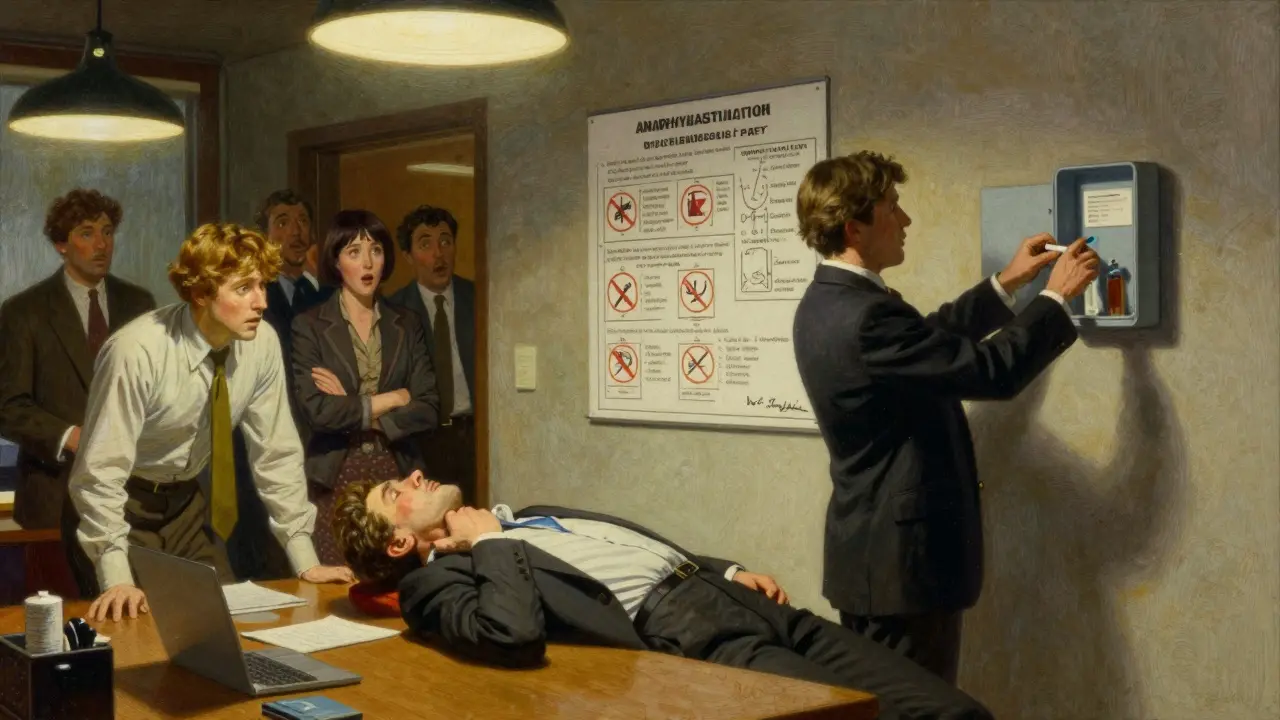
Schools are the most regulated environment for anaphylaxis preparedness. As of 2024, 49 states have laws requiring schools to have policies for managing allergies. That means:- Every student with a known allergy must have a signed action plan on file.
- At least two staff members in each classroom must be trained to use epinephrine auto-injectors.
- Epinephrine must be stored unlocked, at room temperature, and reachable within 60 seconds.
- Staff get trained when they start, and again every year.
- Stock epinephrine is available for students without their own injector.
Why Workplaces Are Falling Behind
Workplaces? Not so much. There’s no federal law requiring employers to have anaphylaxis plans. OSHA says employers must provide first aid, but doesn’t say what that means for allergies. The result? Only 34% of U.S. employers have any formal policy. Employees with severe allergies often face dangerous gaps:- Epinephrine stored in a locked cabinet behind the front desk.
- Managers who say, “We don’t allow medical devices on the floor.”
- Co-workers who’ve never seen an auto-injector and are afraid to use one.
Training Isn’t Optional-It’s Essential
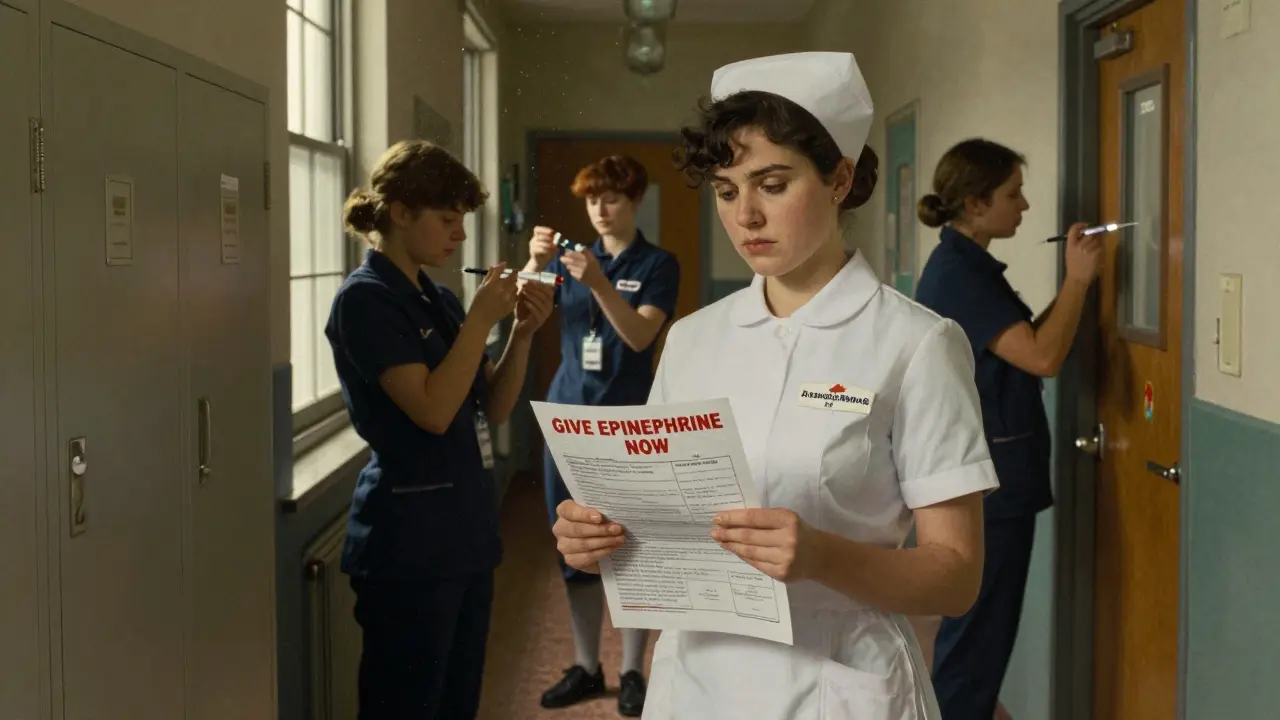
You can have the best plan in the world, but if no one knows how to use it, it’s just paper. Schools that train staff properly see better outcomes. The CDC recommends 90 to 120 minutes of initial training, plus 60 minutes every year after. That includes:- Recognizing symptoms (especially in young kids-swelling might look like a puffy cheek, not a reaction).
- Practicing with trainer injectors (not real ones).
- Knowing exactly when to give epinephrine-don’t wait for breathing to stop.
- Understanding that epinephrine is safe-even if you’re wrong, giving it is better than holding back.
Common Mistakes That Cost Lives
Even well-intentioned plans can fail because of simple errors:- Waiting for symptoms to get worse-epinephrine works best when given early. Don’t wait for wheezing or collapse.
- Using antihistamines instead-Benadryl doesn’t stop anaphylaxis. It might help a rash, but it won’t save a life.
- Not updating the plan-allergies change. A child who was allergic to eggs at age 4 might outgrow it. A worker might develop a new reaction to latex gloves. Plans must be reviewed yearly.
- Storing epinephrine in the wrong place-don’t keep it in a fridge, a locked drawer, or the principal’s office. It needs to be where the person spends most of their time.
- Assuming someone else will act-in schools, designate two trained people per room. In offices, assign a buddy system.
What You Can Do Today
Whether you’re a parent, teacher, manager, or employee with allergies, you don’t have to wait for a policy to change. Start here:- Parents: Get the FARE or AAFA action plan template. Have your doctor sign it. Give copies to the school nurse, the teacher, the bus driver, and the after-school program. Ask if they have stock epinephrine.
- Teachers and school staff: Ask for training. If your district doesn’t offer it, request it. Use FARE’s free online videos. Practice with a trainer pen.
- Employers: Talk to HR. Ask about ADA accommodations. Put epinephrine in the break room or first aid kit. Train new hires during orientation.
- Employees with allergies: Give your plan to your manager. Ask for a designated person to help in an emergency. Don’t be afraid to speak up.
The Bottom Line
Anaphylaxis action plans are no longer optional. They’re as essential as fire drills and AEDs. Schools have made progress. Workplaces have not. The difference between life and death often comes down to one thing: whether the person next to you knows what to do-and isn’t afraid to do it. If you’re reading this and you’re responsible for a child, a classroom, or a team-take action today. Download a template. Train someone. Check the storage. Update the plan. Because when seconds count, the only thing that matters is that someone is ready to act.What should I do if someone is having an anaphylactic reaction?
Administer epinephrine immediately using an auto-injector. Call 911 right after. Do not wait for symptoms to worsen. Do not give antihistamines like Benadryl instead-they don’t stop anaphylaxis. Stay with the person until help arrives.
Is epinephrine safe to use if I’m not sure it’s an allergic reaction?
Yes. Epinephrine is very safe, even if given to someone who isn’t having anaphylaxis. The risks of not giving it when needed are far greater. Medical guidelines say: if two body systems are affected (like skin + breathing) or if breathing or blood pressure symptoms appear, give epinephrine. Better to give it and be wrong than to wait and lose time.
Can a school or workplace be held legally responsible if they don’t have an anaphylaxis plan?
Schools can be held liable if they fail to follow state laws, which require plans and training in 49 states. Workplaces can be sued under the Americans with Disabilities Act if they don’t make reasonable accommodations for employees with severe allergies-like keeping epinephrine accessible. Courts have ruled in favor of employees when employers ignored known risks.
How often should an anaphylaxis action plan be updated?
At least once a year, or whenever the person’s allergies, medications, or emergency contacts change. The CDC and FARE both recommend annual reviews. Many schools and employers miss this step-41% use outdated plans, according to the National Association of School Nurses.
Where should epinephrine be stored in a school or workplace?
It must be unlocked, at room temperature, and within 60 seconds of where the person spends most of their time. In schools, that means classrooms, cafeterias, and buses. In workplaces, it should be in common areas like break rooms or near first aid stations-not locked in a cabinet or office. New York State’s 2024 guidelines specifically ban locked storage for this reason.
Dana Termini
January 6, 2026 AT 09:56My daughter has a severe peanut allergy, and her school has a printed plan in every classroom, the nurse’s office, and even on the bus. Last year, a substitute teacher used it correctly when she reacted to a snack. Epinephrine in 90 seconds. No panic. Just action. That’s what real preparedness looks like.
It’s not about fear-it’s about responsibility.
Isaac Jules
January 7, 2026 AT 00:20Let’s be real-this whole thing is just corporate liability theater. Schools are forced to do this because lawyers told them to, not because it actually saves lives. Most kids who have reactions are fine with Benadryl anyway. Epinephrine is overkill 90% of the time.
And don’t get me started on ‘stock epinephrine.’ You’re just training people to inject strangers with a drug that can cause heart attacks. Great idea, CDC.
Amy Le
January 8, 2026 AT 13:15America is turning into a nation of hypersensitive toddlers with EpiPens. We used to teach kids to tough it out. Now we’re giving them legal protections because they can’t eat a cookie without a 12-page medical waiver.
And now workplaces have to become allergy clinics? What’s next? Mandatory nut-free cubicles? A federal peanut inspector? This isn’t safety-it’s cultural surrender. We’re rewarding fear with bureaucracy.
Meanwhile, actual emergencies-like cardiac arrest or gun violence-get ignored because we’re too busy policing snack trays. Sad.
Pavan Vora
January 9, 2026 AT 02:22Interesting article, but in India, we don’t have such formal plans… but we have something better: community awareness.
My cousin, who is allergic to shellfish, always tells everyone at family dinners: ‘Don’t serve prawns near me.’ And people listen. No forms, no training, no locked cabinets. Just respect.
Maybe we don’t need all this paperwork… just common sense and kindness.
Also, epinephrine is expensive here, so we rely on speed and clarity-not equipment.
Just saying.
-Pavan from Bangalore
Lily Lilyy
January 10, 2026 AT 20:36This is so important. I’m a teacher, and I just requested training last week. Our district didn’t have any until now. I’m so glad I read this.
Every child deserves to feel safe. Every employee deserves to know they won’t be left alone in a crisis.
Let’s stop waiting for a tragedy to happen. Let’s start acting today.
Thank you for writing this. I’m sharing it with my whole staff.
Susan Arlene
January 12, 2026 AT 02:34my school had a kid go into anaphylaxis during lunch and the nurse had to run across campus to get the epi pen from the office… took 3 mins. kid was fine but like… why is it not in the cafeteria??
also why do we still have peanut butter sandwiches??
Katelyn Slack
January 13, 2026 AT 01:14My coworker has anaphylaxis to tree nuts. He never says anything, but I always check the ingredient labels before bringing snacks to the break room. I don’t want to be the person who hesitates.
It’s not hard. Just ask. Just care.
Melanie Clark
January 14, 2026 AT 04:50This is all part of the Great Allergy Agenda™
They’re pushing this to normalize medical dependency. Watch: next they’ll require epinephrine in every public bathroom. And then they’ll track your allergy data in the cloud. And then the government will control what you eat.
Why are they so scared of natural immunity? Why do we have to be protected from everything?
My kid had a reaction once. We didn’t give epinephrine. We gave him water and a hug. He’s fine. Now he eats peanuts like a normal human.
Stop medicalizing childhood. Stop turning kids into patients.
They’re not weak. They’re just being coddled.
Venkataramanan Viswanathan
January 15, 2026 AT 16:04In India, we don't have EpiPens in every office. We have neighbors. We have family. We have people who know your name and your allergies because they’ve seen you get sick before.
Maybe the problem isn't the lack of plans-it's the lack of human connection.
We don’t need a signed form. We need to care enough to remember.
-Venkat, Mumbai
Wesley Pereira
January 15, 2026 AT 20:24Oh wow, another ‘epinephrine now’ manifesto. Real groundbreaking stuff.
Let me guess-next you’re going to tell us to put AEDs in every vending machine? Or require fire extinguishers in every Zoom meeting?
Look, I get it. Allergies are serious. But this isn’t policy. This is performative compliance. You don’t train people by handing them a PDF. You train them by making it part of the culture.
And no, ‘stock epinephrine’ doesn’t solve anything if the person who finds it doesn’t know how to use it. We’ve had these plans since 2010. Why are reactions still happening?
Because nobody’s actually practicing. Just like CPR. Just like fire drills.
So let’s stop pretending paperwork = safety.
Joann Absi
January 16, 2026 AT 03:21THEY’RE HIDING THE TRUTH.
Why do you think they’re pushing epinephrine so hard? Why are schools suddenly obsessed with ‘allergy plans’? Because BIG PHARMA owns the EpiPen patents.
They made $10 BILLION off this. They pushed the CDC to make it mandatory. They scared parents into thinking their kid will die if they eat a crumb.
And now? They want it in WORKPLACES too.
It’s not about safety.
It’s about PROFIT.
Wake up.
❤️🩸 #EpiPenScam
Mukesh Pareek
January 18, 2026 AT 02:14The data is clear: epinephrine administration within 5 minutes reduces mortality by 83%. The CDC, FARE, and AAP all concur. The failure is not in the guidelines-it is in the implementation. In 68% of workplace incidents, the delay was due to lack of accessibility and training. The absence of a standardized protocol is a systemic failure. The legal liability under ADA is not hypothetical-it is jurisprudential. Organizations must adopt evidence-based protocols, not performative gestures.
-Mukesh, Delhi