

Warfarin Alcohol Risk Calculator
Calculate Your Risk
Results
If you're taking warfarin, drinking alcohol isn't just a casual choice-it's a medical decision with real, potentially life-threatening consequences. Binge drinking while on this blood thinner can send your INR levels skyrocketing, turning a simple night out into a trip to the emergency room. This isn't speculation. It's backed by years of clinical data, real patient outcomes, and guidelines from top medical organizations.
What Warfarin Does-and Why It's So Sensitive
Warfarin, sold under the brand name Coumadin, has been used since the 1950s to prevent dangerous blood clots in people with atrial fibrillation, deep vein thrombosis, or pulmonary embolism. It works by blocking vitamin K, which your body needs to make clotting factors. But here’s the catch: the difference between a safe dose and a dangerous one is tiny. Your target INR (International Normalized Ratio) is usually between 2.0 and 3.0. Go above that, and you risk bleeding. Drop below, and clots can form.
That narrow window means even small changes in your diet, medications, or alcohol intake can throw your INR off. And alcohol? It doesn’t just nudge it-it can slam it.
What Counts as Binge Drinking?
The National Institute on Alcohol Abuse and Alcoholism defines binge drinking as:
- 5 or more standard drinks in about 2 hours for men
- 4 or more standard drinks in about 2 hours for women
A standard drink is one 12-ounce beer, 5 ounces of wine, or 1.5 ounces of hard liquor. That’s not a few sips. That’s a full pint of beer or two glasses of wine in under an hour. And if you do that even once a month while on warfarin, you’re putting yourself at serious risk.
How Alcohol Messes With Your INR
Alcohol doesn’t just make warfarin stronger-it plays a double game with your liver.
When you drink heavily in one sitting, your liver gets overwhelmed. It can’t process warfarin properly because alcohol competes for the same enzymes (CYP2C9 and CYP3A4). That means warfarin builds up in your blood. Your INR spikes. Your blood thins too much. You bleed.
But here’s the twist: if you drink heavily on a regular basis, your liver adapts. It starts producing more of those enzymes. Suddenly, warfarin gets broken down too fast. Your INR drops. Clots form. You’re now at risk for stroke or pulmonary embolism.
And if you’ve been drinking for years? Liver damage can reduce vitamin K production. That makes warfarin even more potent-no matter how much you adjust your dose. This is why patients on warfarin for over a year who binge drink have a 3.1-fold higher risk of major bleeding than those who don’t.
The Numbers Don’t Lie
A 2015 study from the University of Michigan followed 1,200 patients on warfarin. Those who binge drank had a 2.3 times higher risk of major bleeding. That’s not a small increase. That’s the difference between a 5% chance and a 12% chance of a dangerous bleed in a year.
For people with certain genetic variants (CYP2C9*2 or *3), the risk jumps even higher-4.2 times. These variants slow down how fast your body clears warfarin. Add alcohol, and you’re essentially doubling your drug dose without knowing it.
The American College of Chest Physicians says the baseline annual bleeding risk on warfarin is 3-6%. Binge drinking can push that to 10% or higher. That’s not a risk you gamble with.
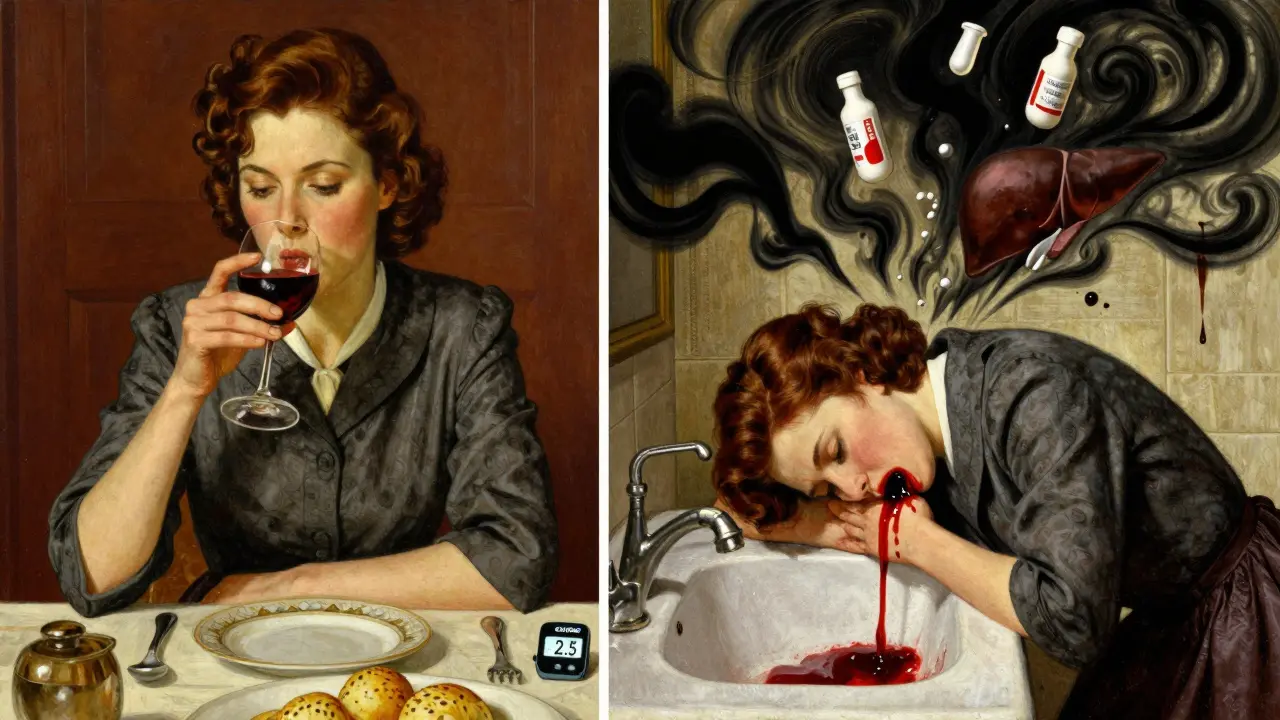
What Does a Major Bleed Look Like?
It’s not always obvious. A major bleed isn’t always a gushing wound. It’s:
- Unexplained bruising-big, dark patches with no injury
- Nosebleeds that won’t stop
- Bleeding gums when brushing your teeth
- Red or brown urine
- Black, tar-like stools or bright red blood in stool
- Vomiting blood or material that looks like coffee grounds
- Coughing up blood
- Severe headaches, dizziness, or weakness
- Excessive menstrual bleeding
If you notice any of these after drinking, get medical help immediately. Don’t wait. Don’t assume it’s “just a hangover.”
What About Light Drinking?
Some sources say “a little alcohol is okay.” But “a little” is where things get dangerous.
The British Heart Foundation says no more than 14 units per week total-and never all in one day. One unit is about half a pint of beer or a small glass of wine. That’s less than one drink a day.
University of Iowa Health Care recommends no more than:
- Two drinks per day for men
- One drink per day for women
But even that’s risky. A 2020 analysis of over 12,000 patients found that those who reported any binge drinking-even once a month-spent 42% more time outside their target INR range than those who didn’t drink at all. That means your INR could be too high one week, too low the next. No one can dose warfarin reliably under those conditions.
What About Newer Blood Thinners?
Many people switch to DOACs-drugs like apixaban, rivaroxaban, or dabigatran-because they don’t need regular INR checks. But here’s the truth: alcohol still raises bleeding risk with these drugs too.
According to the FDA’s adverse event database, heavy drinkers on rivaroxaban have an 1.8 times higher risk of gastrointestinal bleeding. The same applies to apixaban and dabigatran. The interaction isn’t as complex as with warfarin, but the danger is still real.
If you struggle with alcohol use, switching to a DOAC might reduce some risks-but it doesn’t eliminate them. The real solution is cutting back on alcohol, not just changing pills.
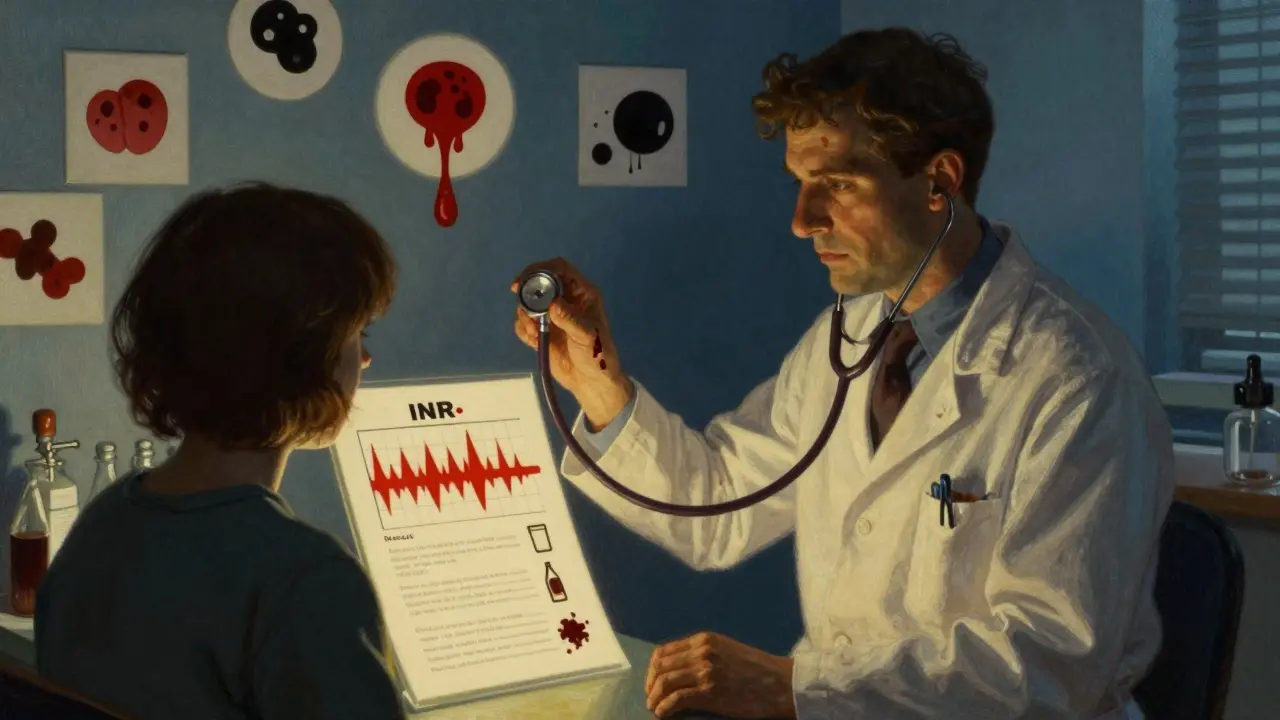
What Should You Do?
If you’re on warfarin and drink alcohol:
- Stop binge drinking. Period.
- Limit yourself to no more than one drink per day (two for men, one for women).
- Avoid alcohol entirely if you’ve had a recent bleed or your INR is unstable.
- Get your INR checked within 72 hours after any alcohol binge.
- Tell your doctor or anticoagulation clinic every time you drink-even one drink.
- Ask if you’re a candidate for a DOAC if you can’t reliably limit alcohol.
And if you’re trying to cut down? You’re not alone. A 2022 study showed that patients who got structured counseling about alcohol use reduced their bleeding events by 37%. That’s not a small win. That’s life-saving.
Why Isn’t This Warning Bigger?
It’s strange, but true: the FDA removed warfarin’s official alcohol warning in 2010 because they said the evidence wasn’t strong enough. But since then, dozens of studies-like the one from the University of Michigan-have proven the opposite. In 2022, the American College of Physicians formally asked the FDA to bring back the warning.
Meanwhile, hospitals and clinics are catching up. Epic’s electronic health record system now flags patients with alcohol misuse risk scores and suggests more frequent INR checks. But only 15% of primary care doctors routinely screen for alcohol problems in patients on warfarin.
That’s a gap. And it’s costing lives.
Bottom Line
Warfarin and alcohol don’t mix-not even a little. Binge drinking can turn a routine medication into a ticking time bomb. Even moderate drinking can make your INR unpredictable. That’s not worth the risk.
If you’re taking warfarin, your safest choice is to avoid alcohol entirely. If you choose to drink, keep it to one drink a day, never more, and never all at once. And always tell your doctor. Your INR doesn’t lie. And neither do your symptoms.
There’s no such thing as a safe binge on warfarin. There’s only risk-and the longer you wait to act, the higher that risk becomes.
Erika Putri Aldana
December 21, 2025 AT 08:25Swapneel Mehta
December 22, 2025 AT 19:31Jay lawch
December 24, 2025 AT 10:59Christina Weber
December 24, 2025 AT 20:31mukesh matav
December 26, 2025 AT 20:07Peggy Adams
December 27, 2025 AT 16:01Sarah Williams
December 27, 2025 AT 23:05Dan Adkins
December 28, 2025 AT 15:58Grace Rehman
December 29, 2025 AT 03:18Siobhan K.
December 30, 2025 AT 17:25Brian Furnell
December 31, 2025 AT 18:56Southern NH Pagan Pride
December 31, 2025 AT 19:15