

Nothing ruins a flight faster than that sharp, stabbing pain in your ear during descent. It’s not just annoying-it can feel like your eardrum is about to burst. If you’ve ever clenched your jaw, swallowed hard, or even cried out in pain while landing, you’ve experienced airplane ear. Also called barotrauma, it’s not rare. About 1 in 5 adults and more than 1 in 4 kids feel it on every flight. And if you’ve got a cold, allergies, or chronic ear issues, your odds jump even higher.
Why Your Ears Hurt When Flying
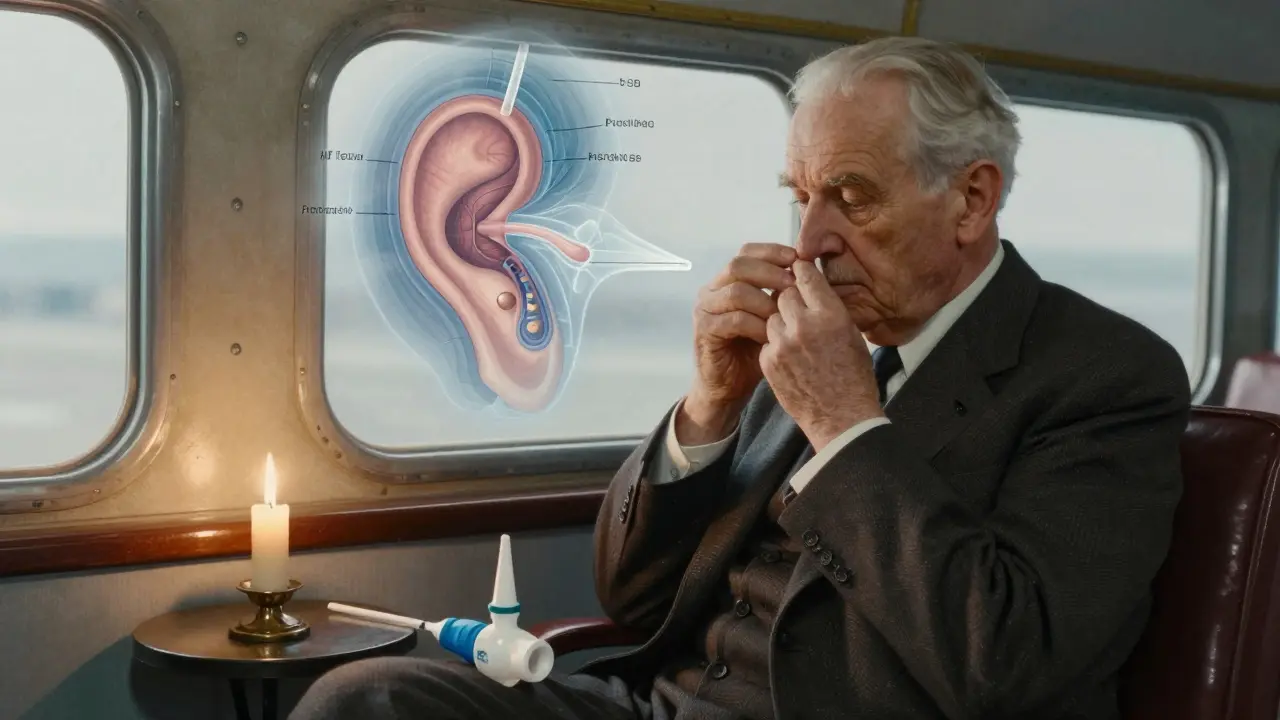
Your middle ear is a small air pocket sealed off from the outside world by your eardrum. Behind it, a tiny tube-the Eustachian tube-connects to the back of your throat. Normally, this tube opens when you swallow or yawn, letting air flow in or out to balance pressure on both sides of your eardrum. But during a flight, things change fast. As the plane climbs, cabin pressure drops. Your eardrum bulges outward. No big deal-your ears usually pop on their own. The real trouble starts on the way down. Cabin pressure rises quickly, pulling your eardrum inward. If your Eustachian tube can’t open fast enough, you get stuck with pressure imbalance. That’s when pain, muffled hearing, and even ringing kick in. Adults have Eustachian tubes that are about 35-38mm long. Kids? Theirs are only 17-18mm. Shorter tubes, plus weaker muscles, mean children struggle more. That’s why babies and toddlers often scream during descent. It’s not tantrums-it’s physics.What Happens If You Don’t Equalize
Most people feel discomfort and recover within hours. But ignoring it can lead to real damage. In extreme cases, the eardrum can tear. That’s rare-under 0.02% of flights-but it happens. More commonly, you get temporary hearing loss, dizziness, or fluid buildup behind the eardrum. These can last days or even weeks if you don’t manage the pressure properly. Studies show that people who wait until they feel pain before trying to pop their ears are 68% more likely to end up with complications. The key is to act before it hurts. Start equalizing as soon as the plane begins its descent-usually around 8,000 feet. Don’t wait for the seatbelt sign to go off. Start early, and do it often.Best Ways to Equalize Ear Pressure
There are several proven techniques. Not all work for everyone, and some carry risks. Here’s what actually helps, backed by ENT specialists and clinical data.- Swallowing or yawning: The safest method. It works for about 65% of people. Chewing gum, sucking on hard candy, or sipping water helps trigger natural swallowing. This is your first-line defense.
- Toynbee maneuver: Pinch your nose shut and swallow. It’s gentler than blowing and safer for kids. Success rate: around 68%. Works best if you do it repeatedly during descent.
- Lowry technique: Combine swallowing and gentle blowing. Pinch your nose, swallow, and blow softly at the same time. It’s more effective-89% success-but hard to master. Most people need to practice it over a few flights before it clicks.
- Voluntary Tubal Opening: This is advanced. You tense the muscles at the back of your throat while pushing your jaw forward. Sounds weird, but it works for 92% of trained users. It takes weeks of daily practice to learn. Not for beginners.
- Valsalva maneuver: Pinch your nose and blow gently. This is the most popular, but also the riskiest. Done right, it works for 82% of people. Done wrong-too hard, too fast-it can damage your inner ear. Doctors say 27% of inner ear injuries from flying come from forcing this move. Blow like you’re trying to fog up a mirror, not inflate a balloon.
For kids, the best trick is feeding them during descent. Bottle-feeding creates stronger, more consistent swallowing than sipping from a cup. One study found it improved pressure equalization by 43%. For toddlers, a pacifier works too. Older kids can chew gum or suck on candy.

Earplugs That Actually Work
Not all earplugs are created equal. Regular foam ones? Useless. They block sound but don’t help with pressure. But filtered earplugs like EarPlanes are designed specifically for flying. They have a ceramic filter that slows down pressure changes by 37%. That gives your Eustachian tube an extra 13 seconds to catch up. Clinical trials show EarPlanes reduce discomfort in 76% of users. But if you have chronic Eustachian tube dysfunction, their effectiveness drops to 42%. Still, they’re worth trying-especially if you’re flying with kids or have mild congestion. They cost about $5 a pair and are sold at most pharmacies and airports.Decongestants and Nasal Sprays: Use Them Right
If you’ve got a cold, allergies, or sinus congestion, your Eustachian tubes are already swollen shut. That’s when you need help. Nasal decongestant sprays like Afrin (oxymetazoline) shrink swollen tissues in about 10 minutes. Studies show they improve equalization success by 85%. But here’s the catch: don’t use them for more than three days in a row. They can cause rebound congestion, making things worse. Oral decongestants like Sudafed (pseudoephedrine) last longer-8 to 12 hours. But they’re not safe for everyone. People over 40, or those with high blood pressure or heart issues, should avoid them. The FDA warns that 12% of adults over 40 experience side effects like increased heart rate or dizziness. For kids under 6? Don’t use decongestants at all. There are rare but documented cases of dangerous side effects, including rapid heartbeat. A better option for chronic issues? Nasal steroid sprays like Fluticasone (Flonase). They don’t work fast, but they reduce inflammation over time. A 2023 study found that using them daily for a week before flying improved equalization success by 33%. They’re safe for long-term use and won’t cause rebound congestion.What Not to Do
Many people make the same mistakes-and end up paying for it.- Don’t sleep during descent. This is the #1 reason kids have ear pain. If you’re asleep, you’re not swallowing. Set an alarm if you’re a deep sleeper.
- Don’t blow too hard. Valsalva isn’t a power move. Gentle pressure only. If your ears don’t pop after two tries, stop. Try something else.
- Don’t wait until it hurts. Proactive equalization cuts your risk of injury by 78%. Start at 8,000 feet and do it every 300-500 feet of descent.
- Don’t use cotton swabs. No, really. Never stick anything in your ear canal to “help.” You could push wax deeper or puncture the eardrum.
New Tech and Future Solutions
The field is evolving fast. In 2022, the FDA approved the Otovent device-a nasal balloon you inflate with your nose. It gently opens the Eustachian tube. Clinical trials show 88% effectiveness. It’s simple, drug-free, and safe for kids. Mayo Clinic is now testing tiny stents placed in the Eustachian tube. In phase 2 trials, 92% of patients with chronic barotrauma had lasting relief. It’s not available yet, but it’s coming. Airlines are also making changes. New planes like the Boeing 787 keep cabin pressure at 6,000 feet instead of the old standard of 8,000. That reduces pressure changes by 25%. Delta Airlines now flies slower descents-3 degrees instead of 3.5-which cuts pressure change rates by 14%. Even smarter gear is on the way. Bose is testing earplugs with built-in pressure sensors that light up when you’ve equalized correctly. Imagine getting real-time feedback while you fly.When to See a Doctor
If you’ve tried everything and your ears still feel blocked, muffled, or painful after 48 hours, see an ENT specialist. Same if you have:- Severe dizziness
- Blood or fluid draining from your ear
- Sudden hearing loss
- Pain that gets worse instead of better
Chronic sufferers might need a simple outpatient procedure called Eustachian tube balloon dilation. It costs between $3,800 and $5,200 out-of-pocket in the U.S., but it’s 76% effective long-term. If you fly often and this keeps happening, it’s worth considering.
Final Checklist for a Pain-Free Flight
- 24 hours before: Use nasal steroid spray if you’re prone to congestion.
- 1 hour before: Take oral decongestant (if safe for you) or use nasal spray.
- Boarding: Chew gum or suck on candy. Start swallowing often.
- Ascent: No need to do much. Your ears will usually adjust on their own.
- Descent: Start at 8,000 feet. Swallow every 300-500 feet. Use EarPlanes if you have them.
- For kids: Feed them or give them a pacifier during descent.
- After landing: If your ears feel blocked, try the Toynbee maneuver. Don’t force it.
Flying shouldn’t feel like a battle with your own body. With the right prep and techniques, you can skip the pain and land with your ears clear-and your sanity intact.
Can flying damage your ears permanently?
Most cases of airplane ear are temporary and heal within days. But if you ignore symptoms or force the Valsalva maneuver too hard, you can rupture your eardrum or damage inner ear structures. Permanent hearing loss is rare, but possible-especially in people with pre-existing ear conditions. If pain or muffled hearing lasts more than two days, see a doctor.
Are EarPlanes worth buying?
Yes, if you fly often or have mild ear sensitivity. They’re not magic, but they slow pressure changes enough to give your ears time to adjust. Studies show they help 76% of users. They cost under $5 and are safe for kids. Skip them only if you have severe Eustachian tube dysfunction-then you’ll need stronger solutions like nasal sprays or medical procedures.
Why do babies cry during landing?
Babies have shorter Eustachian tubes and can’t swallow on command. During descent, pressure builds up behind their eardrums, causing pain. Feeding them (bottle or breast) during descent helps because swallowing opens the tubes. Pacifiers work too. Don’t wait until they’re screaming-start feeding as soon as the plane begins descending.
Is it safe to use decongestants before flying?
Nasal sprays like Afrin are safe for most adults if used once, 30-60 minutes before flight, and not for more than three days. Oral decongestants like Sudafed are riskier-avoid if you’re over 40, have heart problems, or high blood pressure. Never give decongestants to children under 6. Nasal steroids like Flonase are safer for regular users and can be used for a week before flying.
What’s the best technique for kids?
For infants and toddlers: feed them or give a pacifier during descent. For older kids: chew gum, suck on hard candy, or try the Toynbee maneuver (pinch nose and swallow). Avoid Valsalva-it’s too hard for kids to control. The jaw wiggle trick (moving jaw side to side while swallowing) helps too, according to pediatric audiologists.
Can I fly after ear surgery?
It depends on the surgery. After ear tube placement, flying is usually fine. After eardrum repair or balloon dilation, wait at least 2-4 weeks unless your doctor says otherwise. Always check with your ENT before flying post-surgery. Pressure changes can disrupt healing.
Jasmine Yule
December 30, 2025 AT 16:53Greg Quinn
December 31, 2025 AT 14:40Lisa Dore
January 2, 2026 AT 07:03Sharleen Luciano
January 3, 2026 AT 23:51Duncan Careless
January 4, 2026 AT 14:08Russell Thomas
January 6, 2026 AT 01:00Joe Kwon
January 6, 2026 AT 05:44Fabian Riewe
January 6, 2026 AT 09:50